
Reviewed · KILIMANJARO CLIMBS
Mt Kilimanjaro Climbing; 6 Days Machame route
Kilimanjaro’s Machame Route gives you the mountain in five distinct habitats, from wet rainforest to an icy summit. The famous sunrise from Uhuru Peak is the prize, but the changing terrain, ravens at Shira, Lava Tower, Barranco Wall, and glacier views make the days before it worthwhile too.
I like the route’s strong acclimatization profile, with a climb to 4,600 meters at Lava Tower followed by a descent to Barranco Camp. I also like the personal setup: private transportation, your own group, tents, filtered water, and a mountain crew that includes guides, porters, and a cook. The drawback is clear: six days is demanding, with long trekking hours and a tough summit night.
Key points to know before booking
- Five habitats in six days: Rainforest, moorland, semi-desert, alpine desert, and Arctic terrain give the climb real variety.
- Lava Tower at 4,600 meters: You climb high, then sleep lower at Barranco, an important part of the route’s acclimatization plan.
- Tent camping throughout: Machame has no sleeping huts, so you need to be comfortable with basic mountain camping.
- A private trip for your group: The experience is not shared with unrelated participants.
- Summit morning begins early: Day five combines a 5-kilometer ascent with a 12-kilometer descent.
- The price includes the working essentials: Park costs, transport, crew pay, tents, filtered water, and 17 listed meals are covered, but gratuity is not.
Why Machame feels different from the Coca Cola Route
Machame is often called the Whiskey Route, a playful contrast with Marangu’s Coca Cola nickname. The point is not that one is a drinkable route and the other is not. Machame is simply the harder option, with tent camping rather than huts and a trail that gains and loses altitude in a more demanding pattern.
That effort buys you variety. You do not spend six days walking through one type of scenery. The route begins under thick tropical growth, then reaches open moorland, bare volcanic ground, high ridges, and the cold Arctic zone near Kibo.
At $2,200 per person, this is not a budget walk. Still, the cost covers several items that can otherwise add up quickly: private transportation, all fees and taxes, guides and porters, sleeping tents, filtered water, breakfast each morning, five lunches, and five dinners. You still need to budget for visas, flights, insurance, drinks, personal items, laundry, and a gratuity for the mountain crew.
The private format matters. Only your group participates, so the pace and daily mood are not tied to a large mixed party. The supplied information does not give a group-size limit, so ask about the number of people in your party when booking. Pickup is offered from Moshi or Arusha, with an 8:00 a.m. start.
More Kilimanjaro routes:
- Kilimanjaro climb by Lemosho Route (7-day)
★ 5.0 · 651 reviews - Kilimanjaro climb, Machame Route (7-day)
★ 5.0 · 262 reviews - Kilimanjaro Climbing Lemosho Route 8 Days.
★ 5.0 · 186 reviews
Day 1: Machame Gate to rainforest camp
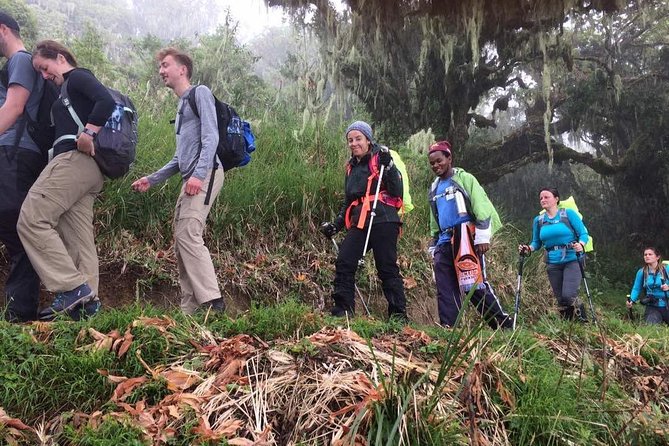
The first drive takes you from your hotel in Moshi or Arusha to Mount Kilimanjaro National Park Gate, passing through Machame village on the lower slopes. Once the formalities are complete, you begin on a winding trail through rainforest.
This is a six-hour day for many people, with 11 kilometers of walking and a stated range of five to seven hours. The forest is the right place to settle into the rhythm of a mountain trek. You gain altitude under thick growth, and the surroundings feel far removed from the towns below.
The practical catch is the trail surface. Some sections can be muddy and slippery, so gaiters and trekking poles are useful items to bring. This is not a polished path. Your shoes, balance, and patience matter from the first day.
You spend the night at Machame Camp in a tent. Since the route has no sleeping huts, you should expect a basic camp routine from here onward. Sleeping tents are included, which keeps the cost from becoming a surprise, but tent camping remains less comfortable than a hut or hotel.
Day 2: Moorland, Shira Plateau, and views of Kibo
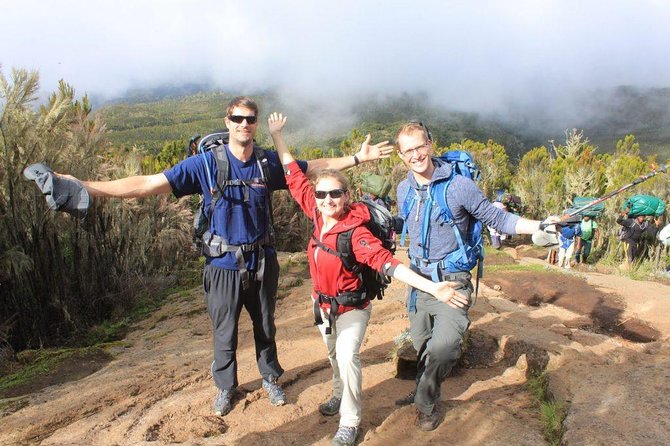
Day two is shorter in distance at 5 kilometers, though it still takes about four to six hours. The forest thins into moorland, with fewer trees and more open ground.
The destination is Shira Camp, set on a small plateau. From here, you can see Kibo to the northeast and Mount Meru toward the west. Those two volcanic peaks give the day a strong sense of place. You are no longer simply walking uphill through trees. You can read the mountain around you.
White-necked ravens may appear during the day, and the Shira Caves are a short walk from camp. These details give the stop more interest than a simple meal and sleep break. You have time to notice the mountain’s smaller features, not just its highest point.
The shorter mileage does not make the day effortless. The route continues to gain altitude, and the open moorland offers less shelter than the forest. Keep your clothing easy to adjust, since conditions can shift as the trees disappear.
Day 3: Lava Tower at 4,600 meters, then down to Barranco
Day three is one of the most useful parts of the route. You walk 10 kilometers through semi-desert and rocky terrain toward Lava Tower, with six to eight hours on the trail.
Lunch is served in a designated area before you take the rocky path upward. Lava Tower reaches 4,600 meters, a serious height even though you will not sleep there. After lunch, you descend for about two hours to Barranco Camp.
That climb high, sleep lower pattern is the key feature here. You get a chance to experience the effects of altitude at Lava Tower, then spend the night at a lower camp. It makes the day physically demanding, but it also gives the itinerary a clear acclimatization purpose.
The descent to Barranco offers views of the Western Breach and Breach Wall. Bring a camera if you use one, but do not let photography turn the descent into a race. The route is rocky, and your legs have already worked hard on the climb to Lava Tower.
This is also the point where the trip can feel more serious. The habitat is sparse, the ground is rough, and the air is thinner. A moderate fitness level is required, and you should be honest with yourself about long uphill and downhill days before booking.
More six day trips in Moshi & Kilimanjaro:
- Kilimanjaro climb, Lemosho Route (6-day)
★ 5.0 · 129 reviews - Kilimanjaro climb, Marangu route (6-day)
★ 5.0 · 72 reviews - 6 Days 5 Night Safari
★ 5.0 · 57 reviews - 6 Days Tanzania Classic Safari
★ 5.0 · 52 reviews
Day 4: Barranco Wall, Karanga Valley, and Barafu Camp
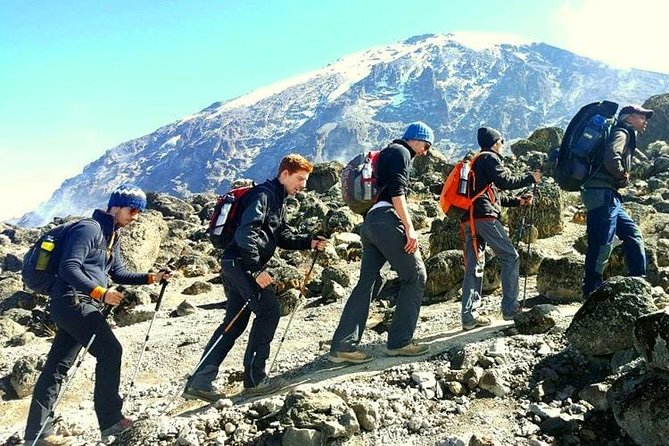
Day four covers 9 kilometers and takes about eight hours. It begins with a short scramble to the top of Great Barranco. Scramble is the important word here. This is not simply a flat walking path, and you should be ready to use your hands at times on the rocky section.
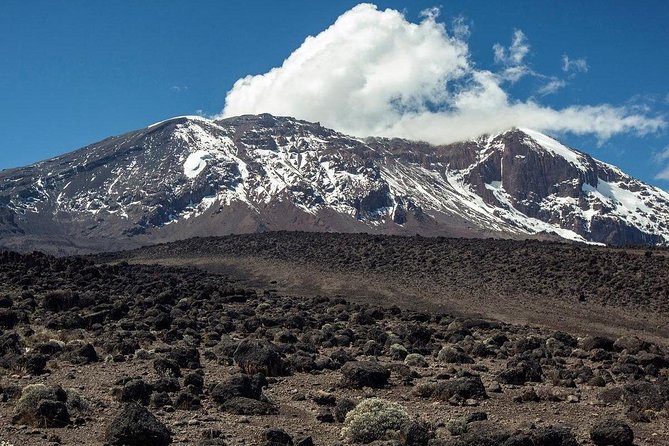
From the top, you cross scree and ridges toward Karanga Valley. The route passes beneath the icefalls of the Heim, Kersten, and Decken Glaciers. The setting becomes more exposed and severe, with the mountain’s volcanic rock and ice taking over from the moorland growth below.
After a break at Karanga, you continue toward Barafu Camp. The trail crosses the junction with the Mweka Trail, which you use for the descent later. Then comes the final climb to the camp that serves as your staging point for the summit.
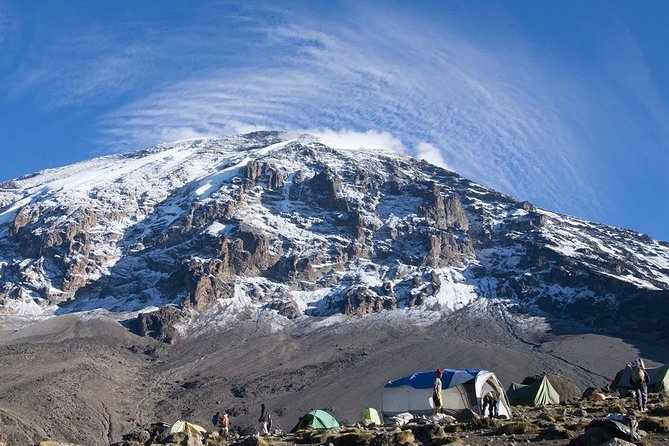
Barafu gives you views of Mawenzi and Kibo, two volcanic cones that make the mountain’s shape easier to understand. Take time to look around before resting. The next push is the hardest part of the trip for many people, and dinner is followed by preparation for the summit day.
The schedule leaves little room for wasted energy. You should organize your summit clothing and personal gear before trying to sleep. The itinerary gives you tents, meals, and filtered water, but your own preparation still matters.
Day 5: Stella Point, Uhuru Peak, and the long descent
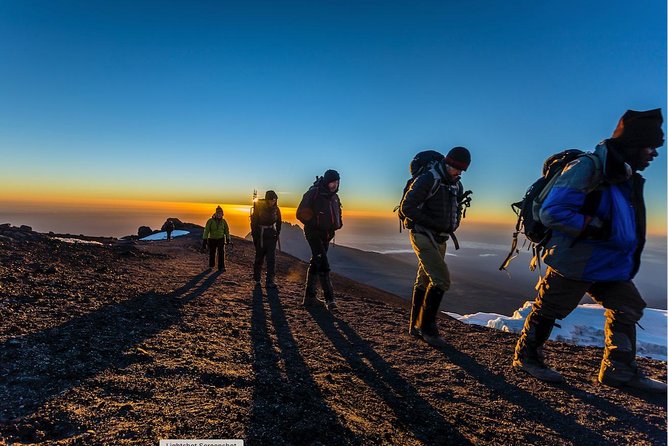
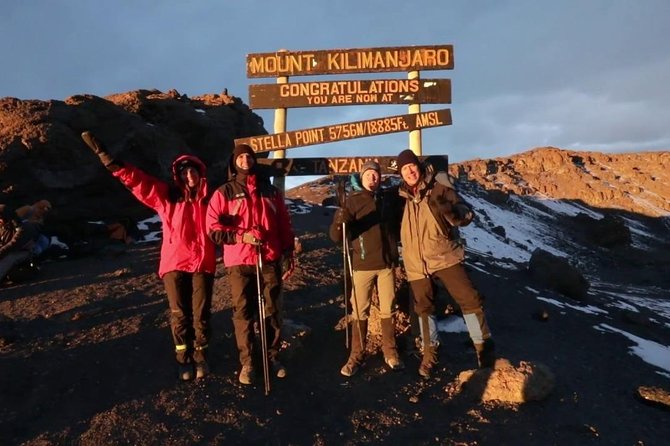
Day five is the test. The stated schedule allows seven to eight hours for the 5-kilometer ascent and another four to six hours for the 12-kilometer descent. That distance looks modest on paper, but the altitude and timing make this a full mountain day.
You begin early and climb toward the rim of the Kibo Crater between the Rebmann and Ratzel Glaciers. The final section before the rim can be snow-covered. An ice axe or ski stick is described as useful for balance, though the information provided does not say if either is supplied, so ask before departure.
At Stella Point, you reach the crater rim. From there, the route continues for about another hour to Uhuru Peak, the highest point on Kilimanjaro. The early start is designed to put you at the summit for sunrise, the moment many people remember most clearly from the climb.
After photographs at the top, you descend to Barafu Hut for rest and lunch. Then you continue past Millennium Camp toward Mweka Hut, near the edge of the forest in the giant heather zone.
This descent is not an easy afterthought. Twelve kilometers down after a summit ascent can be hard on tired knees and feet. The itinerary does offer a rest and lunch at Barafu, but you should still expect Day five to demand nearly all your energy.
The reward is the full change in setting. You start in Arctic conditions near Kibo, pass volcanic ground and giant heather, and finish much lower near the forest edge. It is a remarkable contrast packed into one day, but it is also the clearest reason not to underestimate the six-day schedule.
Day 6: Mweka Gate and the return to Moshi or Arusha
The final day is a 10-kilometer descent through rainforest, taking about three to four hours. After breakfast, you continue to Mweka Park Gate, where you receive your summit certificates.
From the gate, you walk for about another hour to Mweka Village. A vehicle meets you there and takes you back to your hotel in Moshi or Arusha. After the long summit day, that transfer is a welcome finish rather than a small detail.
The route closes the same way it began, under tropical forest. That return to thick vegetation helps mark how much ground you have covered, from the dry upper mountain to the lower slopes.
Crew, food, tents, and what the price covers
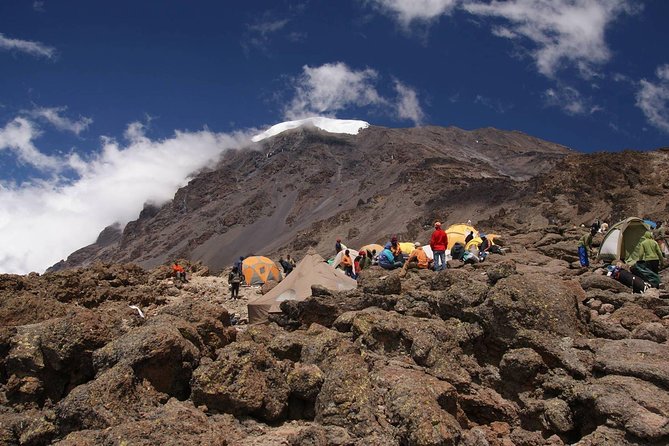
The mountain crew is a major part of this experience. The package includes guides and porters salaries, sleeping tents, filtered water, and meals. Gratuity is not included, so plan to thank the crew separately.
The food receives especially strong praise in the supplied feedback. The chef is described as preparing delicious meals each day, which matters more than it may sound when you are walking for up to ten hours. Breakfast is included on all six days, with five lunches and five dinners.
Filtered water is provided throughout the trek. Alcoholic and non-alcoholic drinks are excluded, as are laundry services and personal items. Pack with the expectation that you are responsible for your own clothing and small comforts.
The experience is private, but the crew structure is not described in detail. Ask who your guide will be, how many porters are assigned, what equipment is included, and how gratuity is handled. The name Shungu appears in the supplied feedback as a person who advised on a safari and maintained contact with a client, but no full guide roster is provided for this climb.
Who should choose this six-day climb?
I would point this trip toward someone with moderate physical fitness who wants a demanding route and accepts tent camping. You need to be ready for muddy rainforest on day one, rocky ground at Lava Tower, a scramble above Barranco, and a long summit day with a major descent.
It also suits you if scenery matters as much as the summit. Machame offers more than a direct uphill push. The habitats change repeatedly, and the route includes ravens, caves, crater-rim views, volcanic cones, glacier icefalls, and sunrise at Uhuru Peak.
I would think twice if you want short walking days, hut accommodation, or a relaxed holiday with plenty of spare time. The six-day plan is tightly packed. Day three, day four, and especially day five require stamina.
The strong point is the balance between private organization and a classic route. You have transport, meals, tents, water, and a paid crew included, while still walking through some of Kilimanjaro’s most memorable sections.
Should you book the Machame Route?
Book it if you want the Whiskey Route’s tougher character, dramatic scenery, and a private six-day climb with the main operating costs included. The Lava Tower ascent followed by a descent to Barranco is a particularly useful part of the plan, and the summit morning gives you a clear goal.
Do not book it casually. Moderate fitness is required, tent camping is part of every night, and the summit day combines an early ascent with a long descent. At $2,200, the value depends on using the included crew, transport, meals, tents, water, and park costs, not on expecting a cheap walk.
Free cancellation is available if you cancel at least 24 hours before the 8:00 a.m. start time. Inside that window, the payment is not refunded. For the right person, this is a serious but rewarding Kilimanjaro plan, with enough route variety to make the climb feel like a journey rather than one long staircase.
FAQ
Where does the Kilimanjaro climb start?
The listed start point is Moshi Urban, Tanzania, with pickup offered from hotels in Moshi or Arusha. The trekking portion begins at the Mount Kilimanjaro National Park Gate.
How long is the Machame Route experience?
The climb lasts approximately six days. Daily walking times range from about three to ten hours, with the summit ascent and descent taking the longest.
Is this a private tour?
Yes. Only your group participates in the activity. The provided information does not state a maximum group size.
Are sleeping huts included?
No. Machame uses sleeping tents rather than mountain huts. Sleeping tents are included in the $2,200 price.
What meals and drinks are included?
Breakfast is included for six days. The package also includes five lunches, five dinners, and filtered water throughout the trek. Alcoholic and non-alcoholic beverages are not included.
What fitness level is required?
The activity states that you should have a moderate physical fitness level. The route includes long walking days, rocky trails, a short scramble, high altitude at Lava Tower, and a demanding summit ascent followed by a long descent.
Newly listed around Moshi & Kilimanjaro
- Climb Mount Kilimanjaro: 7 Days Machame Route★ 5.0 · 3 reviews
- 6 Days Mount Kilimanjaro Climbing via Rongai Route★ 5.0 · 3 reviews
- Explore 1 day Ngorongoro Crater Budget Group Safari from Arusha★ 5.0 · 3 reviews
- Mt. Kilimanjaro Day Hiking★ 5.0 · 3 reviews
- Chemka (Kikuletwa) Hot Springs, Tanzania★ 5.0 · 3 reviews
- Guided City tour of Moshi★ 4.3 · 3 reviews
- 8 Day Tanzania Family Safari★ 5.0 · 3 reviews
- Serengeti Safari with Sirikwa Travel★ 5.0 · 3 reviews
Kilimanjaro Climbs, compared.








Browse the lists this tour appears in