
Reviewed · KILIMANJARO CLIMBS
Kilimanjaro climb, Rongai Route (6-day)
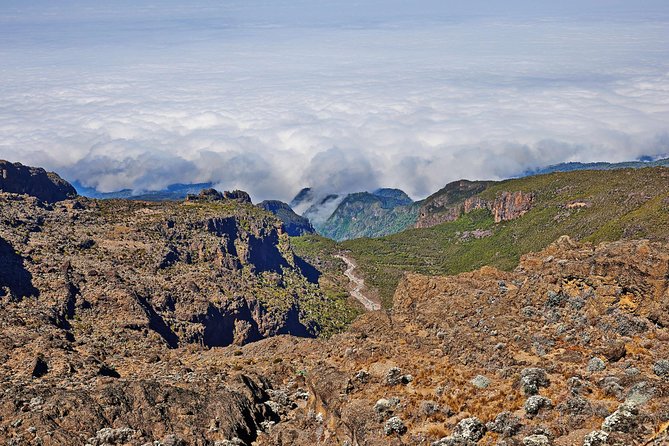
Africa’s highest peak is reached by a quiet northern route on this Kilimanjaro climb, not by the more crowded southern trails. The Rongai Route begins at Nalemuru Gate and crosses high volcanic ground before the final push to Uhuru Peak at 5,895 meters. You get forest, open moorland, Mawenzi Volcano, rocky upper slopes, and a descent through Marangu.
I like two things right away: the route’s lower traffic gives you a more private mountain experience, and the package takes care of the hard logistics, from airport transfers and park fees to tents, meals, porters, and medical checks. The main caution is simple: six climbing days is a short schedule for this altitude, so this trip suits fit regular hikers much better than first-time walkers.
Key points at a glance
- A quieter start on Kilimanjaro’s northern slope: Begin at Nalemuru Gate and hike through coniferous forest toward Simba Camp.
- Mawenzi Tarn acclimatization stop: Sleep beside Kilimanjaro’s jagged second summit and take a 200-meter practice hike.
- A serious summit schedule: Reach School Hut at 4,715 meters on day five, then leave at night for Uhuru Peak.
- Strong safety setup: Certified Wilderness First Responder guides, oxygen tanks, oximeters, medical kits, and regular medical checks are included.
- Full mountain support: Porters, cooks, camp staff, branded tents, dining equipment, sleeping pads, and three meals daily are provided.
- Good pre and post-climb comfort: Two nights at Aishi Machame Hotel, plus airport pickup and drop-off, are included.
What the 6-day Rongai Route is really like
This is a point-to-point mountain crossing with a hotel night before the hike, five nights in mountain camps, and a hotel night after the descent. The climb itself is private, meaning only your own group takes part, though the size of that group is not specified.
Rongai has a clear appeal. It is one of the less-used Kilimanjaro routes, and the approach from the north feels more remote than the better-known paths. You also see the mountain from a different angle, with especially good views toward Kibo and Mawenzi when clouds stay away.
The tradeoff is acclimatization. A six-day itinerary gives you less time for your body to adjust than longer Kilimanjaro programs. The schedule includes a useful acclimatization walk at Mawenzi Tarn, but you still need to hike slowly, drink often, rest when told, and take every altitude symptom seriously.
More Kilimanjaro routes:
- Kilimanjaro climb by Lemosho Route (7-day)
★ 5.0 · 651 reviews - Kilimanjaro climb, Machame Route (7-day)
★ 5.0 · 262 reviews - Kilimanjaro Climbing Lemosho Route 8 Days.
★ 5.0 · 186 reviews
Day 1: Aishi Machame Hotel and the pre-climb briefing
Your trip begins with pickup at Kilimanjaro International Airport. An Altezza Travel representative meets you at JRO and takes you to Aishi Machame Hotel in the foothills of Kilimanjaro.
The hotel provides a practical base rather than a mountain lodge fantasy: rooms, hot water, internet access, a swimming pool, and staff support. Breakfast is included, while lunch and dinner cost extra, with an average price of about $15 per person.
Check-in begins at 2:00 PM. In the evening, managers hold a briefing and check that you are ready for the climb. This meeting matters more than it may sound. It is your chance to review the route, confirm equipment, ask about the summit night, and make sure your personal kit is suitable before the vehicle leaves Moshi.
Day 2: Nalemuru Gate to Simba Camp
The mountain crew meets you at the hotel in the morning. From there, you drive to Nalemuru Gate, the northern entrance to Kilimanjaro National Park, at about 2,020 meters.
Park registration, climbing permits, and search and rescue registration are handled before you begin walking. The trail rises through coniferous forest on Kilimanjaro’s northern slope, with Simba Camp at 2,625 meters as the day’s target.
This is described as a moderate hiking day, but do not treat moderate as easy. Your best move is to begin slowly and keep that pace all day. The guides will lead, while porters carry the equipment and the camp team sets up ahead of you.
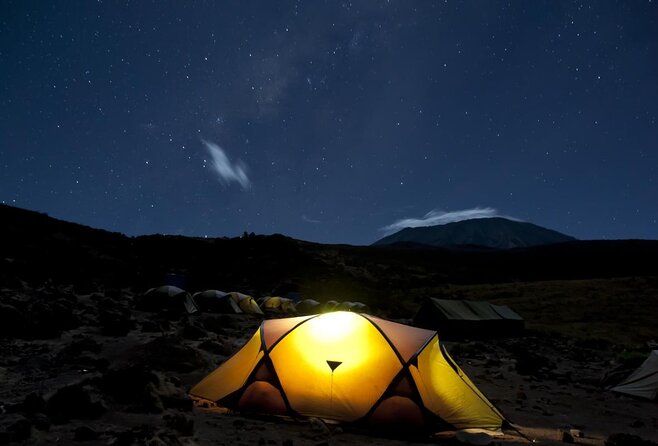
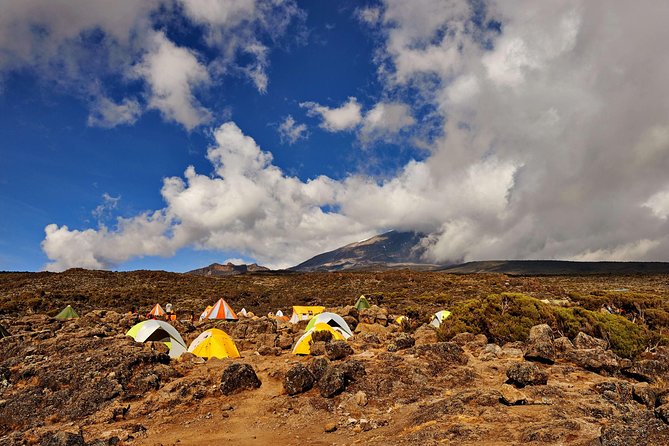
At camp, you sleep in North Face VE-25 tents shared by two hikers, unless you pay for a single tent. A dining tent, tables, chairs, sleeping pads, crockery, and cutlery are supplied. That setup gives you a proper place to eat and rest instead of forcing every meal into your sleeping tent.
Day 3: Simba Camp to Kikilewa Camp
The route climbs from Simba Camp toward Kikilewa Camp at 3,630 meters. The terrain becomes more demanding, and the day’s schedule is listed at about eight hours.
The reward is a stronger view of Kibo, Kilimanjaro’s main volcanic cone, provided the clouds cooperate. This is one of the route’s visual high points because you begin to see the mountain’s upper form rather than simply walking toward a distant summit.
Once you reach Kikilewa, rest is the priority. You might feel fine at this stage and still need to conserve energy. Altitude can catch up with you later, especially on a compressed program. Do not use the early days to prove how fast you can walk.
More six day trips in Moshi & Kilimanjaro:
- Kilimanjaro climb, Lemosho Route (6-day)
★ 5.0 · 129 reviews - Kilimanjaro climb, Marangu route (6-day)
★ 5.0 · 72 reviews - 6 Days 5 Night Safari
★ 5.0 · 57 reviews - 6 Days Tanzania Classic Safari
★ 5.0 · 52 reviews
Day 4: Mawenzi Tarn and the 200-meter acclimatization hike
This is one of the most memorable days on the Rongai itinerary. You hike to Mawenzi Tarn Camp, set at the foot of Mawenzi, Kilimanjaro’s sharply shaped second summit.
After arriving, you have lunch and a two-hour rest. Then comes an acclimatization hike gaining about 200 meters before returning to camp for dinner. This is not wasted time or an optional sightseeing stroll. Walking higher and sleeping lower can help your body adjust to the changing altitude.
Take this short hike seriously, even if it feels easy. The point is not distance. The point is to give your body a controlled exposure to higher ground, then return to camp to recover.
Mawenzi Tarn also gives you a dramatic mountain setting. The camp sits beneath a volcanic peak that looks very different from rounded Kibo. Clouds can limit views, but the combination of high rock, sparse vegetation, and the tarn makes this a special stop.
Day 5: The rocky approach to School Hut
The route now reaches School Hut Camp at 4,715 meters. The terrain changes to rocky semidesert, with far less plant life and a more severe feel underfoot.
The walking itself is not described as especially difficult, but the altitude is now the real issue. Keep a steady pace and avoid unnecessary effort. You need to arrive with enough strength for the summit attempt that begins the same night.
At School Hut, drink, eat, organize your summit gear, and sleep as much as possible. You will not get a normal night’s rest. This is the point where warm layers, gloves, headlamp, water system, and carefully packed snacks become practical concerns rather than items on a checklist.
The itinerary includes breakfast, lunch, and dinner on this day. Meal choice is broad, with vegetarian, vegan, lactose-free, gluten-free, halal, and other plans available by arrangement. Tea, coffee, juices, and soda are also provided on the mountain.
Day 6: Uhuru Peak and the long descent
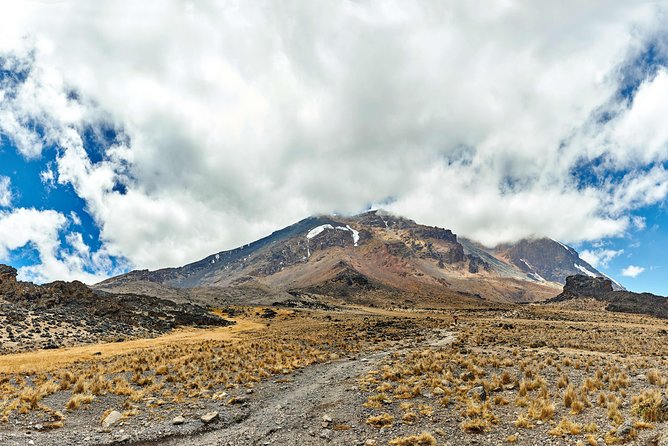
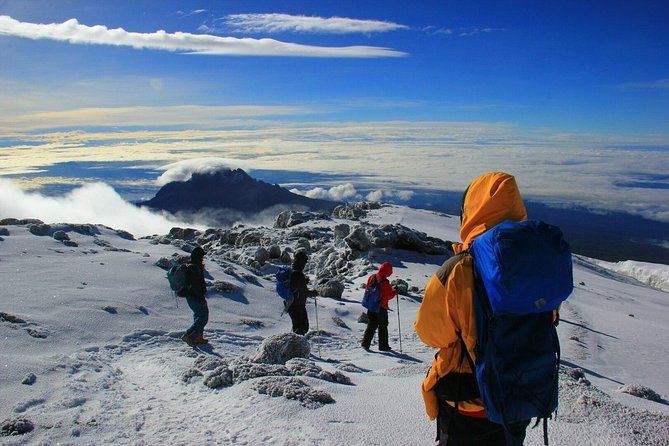
The summit attempt begins at night from School Hut. Physically, the route is described as moderate, but the altitude makes this the hardest part of the trip.
Each pair of climbers is accompanied by a guide during the ascent. That one-to-two guiding arrangement is useful because your guide can watch your pace, stamina, and mental state closely. At nearly 5,900 meters, simply putting one foot in front of the other can become a major task.
Uhuru Peak is the highest point of Kilimanjaro, at 5,895 meters. After reaching it, you can descend toward the nearest glacier if you still have the energy and if conditions allow. The glacier visit is optional, so the summit remains the main goal.
The day does not finish at the top. You return to Kibo Camp for a two-hour rest, then continue down to Horombo Camp at 3,720 meters. That makes day six exceptionally long, with about 12 hours listed. This is the biggest physical drawback of the short route.
Day 7: Marangu Gate and the return to the hotel
After breakfast at Horombo, you descend to Marangu Gate at 1,860 meters. The route ends on the eastern side of the mountain, creating a full traverse from the northern approach to the southern exit.
The group gathers after the descent, and you receive a commemorative certificate at the company office before returning to Aishi Machame Hotel. A hot shower, a real bed, and the hotel pool will likely feel more valuable than any souvenir at this point.
The included post-climb hotel night is a smart part of the package. It gives you a buffer after a demanding descent and avoids the poor planning of sending you directly to the airport while exhausted.
Guides, porters, and the human side of the climb
The crew is central to this experience. The package includes certified Wilderness First Responder guides, porters, camp masters, and cooks. Medical check-ups, oximeters, oxygen tanks, and medical kits are also included.
Past groups have been led by guides including Shabane, Kelvin, Emmanuel, Gerald, Adam, Joseph, Peter, Richard, Stanford, and Innocent. You should not assume one particular guide will be assigned to your group, but these names give you a sense of the staff members associated with the route.
The strongest praise goes to organization, guide care, porter effort, food, and safety. That combination matters on Kilimanjaro. You are not just paying for someone to point toward the summit. You are paying for a functioning camp system, reliable meals, equipment transport, route management, and support when fatigue or altitude becomes serious.
You should also think about tipping. Tips are not included and are listed as optional, based on your satisfaction. Since the porters and kitchen crew do much of the behind-the-scenes work, plan for this cost before departure rather than treating it as an afterthought.
Meals, tents, and comfort at altitude
Three meals a day are included on the mountain, with energy-rich options and several dietary plans. The cooking team has received especially warm praise, including a birthday cake carried up for one climber and meals that impressed people used to luxury accommodation.
You eat in a supplied dining tent with chairs, tables, dishes, and cutlery. That does not turn a high-altitude camp into a hotel, but it gives you structure and warmth at mealtimes.
The tents are walk-in North Face VE-25 models, shared by two hikers. Single tent use costs extra. A sleeping bag is not included, so you need to bring one or hire personal equipment through the operator. Hiking clothing, boots, and other personal gear are also your responsibility.
Is the $3,064 price good value?
At $3,064 per person, this is a major purchase. The price includes airport pickup and drop-off, all ground transport, two hotel nights, park fees, mountain tents, group equipment, food, drinks, guides, porters, cooks, medical support, and the climb itself.
That is a broad package. You are not building the trip piece by piece and then discovering extra charges for park access, transfers, camp equipment, or meals. The value is strongest if you want a managed climb and do not want to arrange each service separately.
You still need to budget for international transport, your Tanzanian visa, personal gear, mountain insurance, extra hotel meals, and crew tips. A visa costs $50 for most nationalities and $100 for US passport holders. Insurance covering trekking up to 6,000 meters is strongly recommended and is a serious practical expense, not a luxury.
The price makes more sense for a private group that values organization and safety systems. If you are comparing only the headline cost with a basic budget climb, look closely at what each operator includes.
Who should book this route?
I would choose this trip if you are a regular hiker, have good general fitness, and prefer a quieter trail with a fully supported camp system. Previous high-altitude experience is especially helpful because the short schedule leaves less room for your body to adjust.
I would think twice if you are new to hiking, uneasy with long days, or hoping for a relaxed mountain holiday. The summit night is followed by a long descent, and the climb reaches nearly 5,900 meters. Fitness alone does not remove altitude risk.
This route also suits people with a tight schedule. You get the Rongai approach, a Mawenzi acclimatization walk, a summit attempt, and a Marangu descent within six climbing days, plus hotel nights on either side.
Practical details before you reserve
The activity begins with a 9:00 AM meeting time, though airport arrivals and hotel check-in shape your first day. Confirmation is provided when you book, and airport transfers are included.
The trip is listed for moderate physical fitness, but I would prepare beyond that minimum. Practice long uphill walks, get used to carrying a daypack, and test your boots and layers before arriving in Tanzania.
Free cancellation is available up to 24 hours before the experience start time for a full refund. Changes or cancellations inside that 24-hour window are not accepted for a refund.
Should you book the 6-day Rongai Route?
Book it if you want a less-used Kilimanjaro route, strong logistical support, and a short program that still includes Mawenzi, Kibo, Uhuru Peak, and a cross-mountain descent. Altezza Travel’s package covers the costly essentials, and the repeated praise for guides, food, porter support, communication, and safety gives this operator a convincing case.
Do not book it simply because six days sounds efficient. It is efficient, but it is also demanding. If you can add more days for acclimatization, a longer Kilimanjaro itinerary may give you a better margin. If your schedule is fixed and you are a capable hiker, this Rongai trip offers a focused and well-supported path to Africa’s highest summit.
FAQ
How long is the full experience?
The full program lasts approximately eight days. It includes two hotel nights, the six-day mountain itinerary, airport transfers, and the return to the hotel after the climb.
What is the highest point reached?
The summit is Uhuru Peak at 5,895 meters.
Where does the climb begin?
The hike begins at Nalemuru Gate, the northern entrance to Kilimanjaro National Park, at about 2,020 meters.
Where does the climb finish?
The descent finishes at Marangu Gate at approximately 1,860 meters.
Are airport transfers included?
Yes. Pickup and drop-off at Kilimanjaro International Airport are included, along with all ground transportation.
Are hotel nights included?
Yes. Two nights at Aishi Machame Hotel are included, with two people sharing a room unless single accommodation is purchased at an additional cost.
What equipment is supplied?
The package includes shared North Face VE-25 tents, sleeping pads, a dining tent, tables, chairs, crockery, cutlery, and other group equipment. Personal clothing, boots, sleeping bags, and hiking gear are not included, though equipment hire is available.
Are meals and special diets included?
Three meals a day are included on the mountain, along with drinks such as tea, coffee, juices, and soda. Vegetarian, vegan, lactose-free, gluten-free, halal, and other meal plans are available.
Newly listed around Moshi & Kilimanjaro
- Climb Mount Kilimanjaro: 7 Days Machame Route★ 5.0 · 3 reviews
- 6 Days Mount Kilimanjaro Climbing via Rongai Route★ 5.0 · 3 reviews
- Explore 1 day Ngorongoro Crater Budget Group Safari from Arusha★ 5.0 · 3 reviews
- Mt. Kilimanjaro Day Hiking★ 5.0 · 3 reviews
- Chemka (Kikuletwa) Hot Springs, Tanzania★ 5.0 · 3 reviews
- Guided City tour of Moshi★ 4.3 · 3 reviews
- 8 Day Tanzania Family Safari★ 5.0 · 3 reviews
- Serengeti Safari with Sirikwa Travel★ 5.0 · 3 reviews
Kilimanjaro Climbs, compared.








Browse the lists this tour appears in