
Reviewed · KILIMANJARO CLIMBS
5 Days Kilimanjaro Trekking – Marangu Route
Kilimanjaro’s Marangu Route gives you a direct path to Africa’s highest point, with overnight huts instead of tents and a final push to Uhuru Peak at 5,895 meters. You’ll move from rainforest to open moorland, then across stark high-altitude ground beneath Kibo’s snow.
I like the solid hut-based setup and the built-in acclimatization day at Horombo. I also like the private format, since your guide can adjust the walking pace and check on your group closely. The main drawback is the five-day schedule: even with the optional rest day, the altitude gain is demanding, and the summit night will test your legs, lungs, and patience.
Key points to know before you book
- A hut-to-hut route: Sleep in mountain huts for four nights rather than camping.
- A real summit attempt: The final climb begins between midnight and 2 a.m. and reaches Uhuru Peak at 5,895 meters.
- One useful acclimatization day: You can rest at Horombo or walk to Zebra Rocks and Mawenzi Tarn Hut.
- Changing scenery: Expect rainforest, moorland, semi-desert conditions, giant senecio, lobelias, and views of Mawenzi and Kibo.
- Private support: A professional guide, cook, and porters are included, with hotel pickup and drop-off.
- Good practical value: The $1,460 price includes four nights, meals, park fees, guiding, transport, and a private trip.
From Moshi to the Marangu gate
The tour begins with pickup from the airport or your accommodation, followed by a drive to the Marangu starting gate. The exact start depends on your arrival plans, so confirm your pickup details before setting off.
Kilimanjaro rises to 5,895 meters and is the world’s tallest free-standing mountain. It has three main volcanic centers: Shira, Mawenzi, and Kibo, the snow-capped summit cone you will climb on this route.
At the gate, the trek begins through forest. This lower section is greener and more sheltered than the upper mountain, with a steady path that lets you settle into the walking rhythm. Do not mistake the easy first hours for an easy whole trip. Kilimanjaro is a long altitude climb, and the mountain gets tougher as the air thins.
The five-day itinerary is compact. You have four nights of accommodation, but the summit day is especially long because you climb from Kibo to Uhuru Peak and then descend to Horombo. You should arrive with a moderate level of fitness and a willingness to walk slowly for long periods.
More Hiking Tours in Moshi
- Private Kilimanjaro Hike 7 Day Lemosho Route
★ 5.0 · 60 reviews - Best Kilimanjaro hiking day trip tour with Kilinge Adventures
★ 4.5 · 54 reviews - #1. Best Kilimanjaro Day hike Tour-Machame Route-ISMANI
★ 4.2 · 47 reviews
Mandara to Horombo: leaving the forest behind
The route from Mandara Hut to Horombo Hut takes about three to four hours. After roughly 15 minutes, you leave the forest glades and begin across open moorland.
This change is one of the memorable parts of the climb. The trees thin out, views open toward Mawenzi and Kibo, and the plants become stranger and more adapted to the cold. Giant senecio and lobelias give the moorland an almost prehistoric feel.
Horombo sits at about 3,700 meters. That height matters. You may notice a headache, tiredness, shortness of breath, or a reduced appetite. Tell your guide how you feel rather than trying to prove anything. A calm pace is more useful than a fast one.
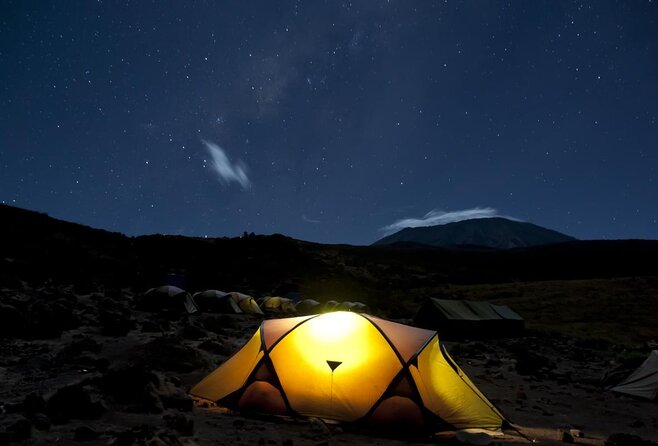
The hut accommodation makes Marangu feel more protected than routes that rely on tents. It also means you are sharing a basic mountain shelter rather than staying in a private room. Comfort here is relative: the huts are practical, but this remains a high-altitude trek.
The food is one of the strongest parts of the package. The included cook prepares meals during the climb, and several accounts specifically praise the quality and quantity of the food. You can request a vegetarian menu, and you should give the company any dietary requirements when booking.
Horombo’s extra day is not wasted time
The third day is listed as optional because you return to Horombo for the night. I would treat it as an important part of the climb, not an expendable luxury.
You can rest at camp, or take an acclimatization walk to Zebra Rocks at about 4,200 meters and Mawenzi Tarn Hut at about 4,300 meters. The point is to spend time at a higher altitude, then sleep lower at Horombo.
That pattern helps your body adjust before the summit attempt. It also gives you a day to see more of the mountain without carrying the pressure of reaching the top. The views toward Mawenzi can be excellent, and the rocky surroundings feel far more severe than the forest you left behind.
The limitation is clear: skipping this day makes an already short itinerary even more demanding. A five-day climb leaves less time for your body to adjust than longer versions of the route. If you are deciding between resting and the acclimatization walk, follow your guide’s advice and pay attention to your symptoms.
The private setup helps here. Your group is not tied to a large mixed party, so the guide can set a pace that suits your condition. Past departures have included guides named Alex and Godfrey, and the company uses a wider team of guides, porters, and cooks. Ask who will lead your climb before departure.
The midnight climb to Gilman’s Point
The summit day starts very early, between midnight and 2 a.m. You climb in darkness toward Gilman’s Point on the crater rim, reaching about 5,861 meters according to the supplied route details.
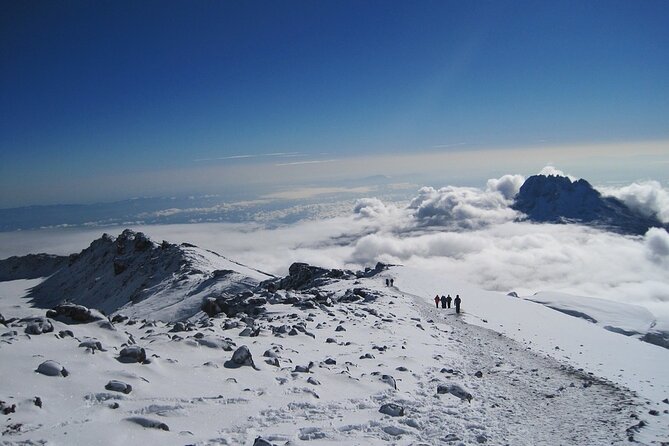
The terrain becomes steep and covered with heavy scree or snow. Progress is slow. You will likely take short steps, pause often, and concentrate on the next few meters rather than the full height above you.
This is where the guide’s pacing matters most. The strongest approach is steady and controlled. If you feel unwell, say so immediately. Altitude problems should never be hidden to protect a summit goal.
From Gilman’s Point, the route continues for another one to two hours toward Uhuru Peak. At 5,895 meters, Uhuru is the highest point in Africa. The final ridge gives you wide views, though the exact visibility depends on weather.
The summit moment is brief but powerful. You can take photographs at the top, then begin the descent. Keep your warm clothing and rain gear accessible, since conditions can change quickly and the early start exposes you to the coldest part of the day.
More Kilimanjaro routes:
- Kilimanjaro climb by Lemosho Route (7-day)
★ 5.0 · 651 reviews - Kilimanjaro climb, Machame Route (7-day)
★ 5.0 · 262 reviews - Kilimanjaro Climbing Lemosho Route 8 Days.
★ 5.0 · 186 reviews - Climbing Kilimanjaro – Machame Route
★ 5.0 · 170 reviews
Descending to Horombo after Uhuru Peak
After reaching Uhuru Peak, you return toward Kibo for lunch and a rest before continuing down to Horombo. The descent from the summit area to Horombo takes about three to four hours after the Kibo break.
Going down can feel easier because you are losing altitude, but the loose ground can be hard on tired knees. Trekking poles are useful, especially after the long summit climb. The day combines several hours of ascent, the summit itself, and a substantial descent, so do not plan anything else for this day.
This is also the point where the four-night arrangement makes sense. You have a hut waiting at Horombo rather than needing to pitch a tent after the summit. You can eat, rest, and sleep before the final walk to the gate.
The company’s support team is an important part of the price. Food, guiding, porters, and accommodation are included, and the strongest feedback about the operation centers on the crew’s care, steady pacing, meals, and service. That support does not make the mountain easy, but it can make the hard parts more manageable.
The final descent through moorland and forest
After breakfast at Horombo, you descend through moorland to Mandara Hut at about 2,700 meters. The route then continues through forest on a good path to the Marangu National Park gate at about 1,830 meters.
The lower section can be wet and muddy. Pack gaiters and trekking poles if you have them. Shorts and a T-shirt may be comfortable at the lower elevation, but keep warm clothes and rain gear close until you know what the weather is doing.
A car waits at the gate, and hot lunch is provided before the drive back to Moshi or Arusha. Airport drop-off is also available if you are flying out the same day, but you should allow plenty of time because mountain descents can run late.
The final walk is more than a simple exit. It lets you notice the full height range of the mountain in reverse, from high moorland back to thick forest. Your legs may be tired, but the changing vegetation gives the descent a satisfying sense of completion.
What the $1,460 price covers
At $1,460 per person, this is not a cheap day trip, but Kilimanjaro is not a simple walking excursion. The package includes:
- Four nights of accommodation
- Park fees and taxes
- Lunch
- A professional guide
- Hotel pickup and drop-off
- A private tour
The listed inclusions make the price easier to assess. You are paying for a guided high-altitude trek with a support team, mountain accommodation, meals, and transport, rather than only for access to the trail.
Alcoholic drinks and souvenir photos cost extra. The package also lists lunch, but you should confirm the full meal plan before departure so you know what is provided on each trekking day.
The private format adds value if you want personal attention or a flexible pace. It may be less important if your main goal is the lowest possible price. For a group that wants its own guide and schedule, the cost is more understandable.
The company reports a five-star overall rating from six published accounts. The most praised points are consistent: helpful guides, good food, comfortable accommodation by mountain standards, a well-managed pace, and strong support from cooks and porters. One group credited the crew with helping all four members reach Uhuru Peak. Another account describes completing the trek in four days, but that is not the advertised schedule and should not be treated as the normal plan.
Who will enjoy this Marangu climb
This route suits you if you want a classic Kilimanjaro climb with huts, a direct trail, and a private support team. It is also a good fit if you prefer not to sleep in tents and want a simpler overnight setup.
You need a moderate level of fitness. The tour is not presented as a technical climbing course, but the altitude and summit schedule are serious. You should be comfortable with several hours of walking, steep sections, cold conditions, and a very early summit start.
The route’s nickname, the Coca-Cola route, can create the wrong impression. Marangu is often viewed as the easier option because of its hut accommodation and established trail, but reaching 5,895 meters remains difficult. The five-day version is also relatively fast, so your preparation matters.
This trip may not suit you if you want a relaxed mountain schedule or a high chance of acclimatization through extra days. The optional Horombo day helps, but the itinerary still asks a lot from your body in a short period.
Practical preparation for five days on the mountain
Dress in layers. The lower slopes can be warm and wet, while the summit climb can be cold, snowy, and exposed. Keep warmer clothing and rain gear available during the descent rather than burying them in your luggage.
Bring gaiters for muddy lower sections and trekking poles for the loose upper ground and tired descent. A headlamp is a practical item for the midnight summit start, though the supplied details do not confirm whether one is provided, so ask before departure.
Eat even when your appetite drops. The included cook is repeatedly praised for the food, and proper meals matter when you are walking at altitude. Tell the company about vegetarian needs or other dietary requirements at booking time.
The tour operates in all weather conditions, so you need to prepare for rain, mud, cold, and changing visibility. Your guide remains the best source of advice on pace, rest, and altitude symptoms during the climb.
Booking confirmation is provided at the time of purchase. Free cancellation is available up to 24 hours before the local start time for a full refund. Changes made inside that 24-hour window are not accepted, and a minimum group requirement applies, so check the final booking terms before paying.
Should you book this Kilimanjaro tour?
Book it if you want a private, hut-based route with meals, transport, and a professional team included in one price. The best reasons are the Horombo acclimatization option, the strong food and crew support, and the chance to reach Uhuru Peak without managing logistics on your own.
Think carefully if you are choosing it only because Marangu is called the easier route. The mountain is still demanding, and five days gives you little spare time if altitude slows your progress. Use the Horombo day, train before arrival, and be honest with your guide about how you feel.
For a fit hiker who values practical support and does not mind a hard summit night, Afrishare’s five-day Marangu trip offers a well-organized path to Africa’s highest point. If you prefer a slower altitude schedule, ask about a longer version before committing.
FAQ
How long is the Marangu Route tour?
The tour lasts approximately five days and includes four nights of accommodation.
What is the highest point reached?
The climb reaches Uhuru Peak, the highest point in Africa, at 5,895 meters above sea level.
When does the summit climb begin?
The summit attempt begins very early, between midnight and 2 a.m.
Is accommodation included?
Yes. Four nights of accommodation are included in the tour price.
Is the tour private?
Yes. This is a private activity, and only your group participates.
Is hotel pickup included?
Yes. Hotel pickup and drop-off are included. Airport pickup and drop-off are also offered.
Is there an acclimatization day?
Yes. The day at Horombo can be used for rest or for an acclimatization walk to Zebra Rocks and Mawenzi Tarn Hut.
Can I request vegetarian food?
Yes. A vegetarian option is available, and you should advise the company of this or any other dietary requirement when booking.
More five day trips in Moshi & Kilimanjaro
- 5 Days Camping Tarangire, Serengeti & Ngorongoro crater & Visiting Maasai
★ 5.0 · 58 reviews - 5-Day Majestic Tanzania Safari – High End All Inclusive
★ 5.0 · 44 reviews - 5 Day Mid range Tanzania Safari
★ 5.0 · 34 reviews - 5 days Tanzania Camping Safari
★ 5.0 · 29 reviews
More Hiking Tours in Moshi & Kilimanjaro
- Best Kilimanjaro Adventure 7 days Machame route Trekking
★ 5.0 · 42 reviews - Kilimanjaro 7 Day Private Trekking Experience
★ 5.0 · 40 reviews - 8 Days Kilimanjaro Hike via Lemosho Route
★ 5.0 · 39 reviews - The Best & Unique Kilimanjaro Hiking tour 7 days Machame route
★ 5.0 · 34 reviews
Newly listed around Moshi & Kilimanjaro
- Climb Mount Kilimanjaro: 7 Days Machame Route★ 5.0 · 3 reviews
- 6 Days Mount Kilimanjaro Climbing via Rongai Route★ 5.0 · 3 reviews
- Explore 1 day Ngorongoro Crater Budget Group Safari from Arusha★ 5.0 · 3 reviews
- Mt. Kilimanjaro Day Hiking★ 5.0 · 3 reviews
- Chemka (Kikuletwa) Hot Springs, Tanzania★ 5.0 · 3 reviews
- Guided City tour of Moshi★ 4.3 · 3 reviews
- 8 Day Tanzania Family Safari★ 5.0 · 3 reviews
- Serengeti Safari with Sirikwa Travel★ 5.0 · 3 reviews
Kilimanjaro Climbs, compared.








Browse the lists this tour appears in