
Reviewed · KILIMANJARO CLIMBS
Private 8 day Northern Circuit Kilimanjaro Climb
The clever part of this 8-day Northern Circuit climb is that you see Kilimanjaro from nearly every side. You begin in the western forest, cross the Shira Plateau, trace the quiet northern slopes, reach the summit from the east, and descend through the south.
I like the extra acclimatization days and the solitude of a route used far less than Marangu or Machame. I also like the small, private setup, with your own group and a support team that has included guides such as Emmanuel, Imran, Humphrey, and Colman on Duma trips. The drawback is simple: this is a demanding mountain trek, not an easy scenic walk, and summit night lasts roughly 15 hours.
Key points to know before booking
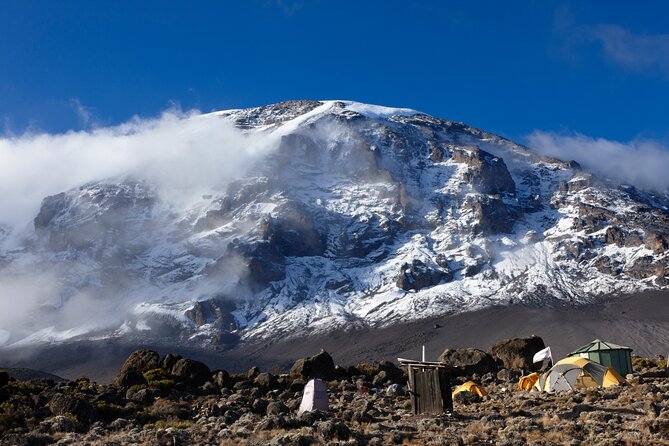
- The route circles Kilimanjaro: You see the western forest, Shira Plateau, northern slopes, eastern side, and southern descent.
- Eight days help with acclimatization: The gradual rise gives you more time to adjust before the summit attempt.
- The summit night is serious: You leave School Hut around midnight and climb to Uhuru Peak at 5,895 meters.
- The route is quiet: The Northern Circuit is known for peace and solitude, especially around the northern camps.
- The trip is private: Only your group participates, with pickup offered and a mobile ticket provided.
- Meals are included: The package lists eight lunches, seven breakfasts, and seven dinners.
Why the Northern Circuit is worth the extra days
Kilimanjaro has several routes, but the Northern Circuit gives you the broadest look at the mountain. Instead of climbing straight up and down one side, you spend several days circling Kibo, the mountain’s main volcanic cone.
That matters for two reasons. First, the views keep changing. Kibo appears from the west, Mawenzi grows larger from the east, and the northern side gives you a quieter, more remote-feeling stretch. Second, the slower schedule gives your body more time to adjust to altitude.
I would choose this route over a shorter option if reaching the summit matters more to you than saving a day or two. The extra time does not make Kilimanjaro easy, but it does reduce the rush. You have more gradual altitude gain, more moderate walking days, and a better chance to learn how your body is responding before summit night.
The route also crosses or connects with sections associated with Lemosho, Rongai, Marangu, and Mweka. That makes it especially satisfying if you want to understand the mountain rather than simply reach the top by the most direct line.
More Kilimanjaro routes:
- 8-Day Small-group Lemosho Kilimanjaro Summit Trekking
★ 5.0 · 186 reviews - 7-Day Machame Kilimanjaro Summit Tour from Arusha
★ 5.0 · 125 reviews - Private Full Day Hiking Experience to Marangu Route
★ 5.0 · 61 reviews
Day 1: Londorossi Gate to Mti Mkubwa
Your morning begins around 9:00 a.m. with the drive toward Londorossi Gate. Here you complete registration formalities before continuing another 12 kilometers by vehicle to the trailhead.
That last road section can take 45 minutes to 1 hour 30 minutes, depending on conditions. Build patience into the day. Mountain roads do not run on city schedules, and the delay is part of getting to the remote western start.
The opening walk covers about 5 kilometers, beginning at 2,389 meters and finishing at Mti Mkubwa, also called Big Tree Camp, at 2,785 meters. You gain just under 400 meters, with around four hours of walking.
This is a gentle first day by Kilimanjaro standards. The forest is the star. You walk beneath tall trees and through some of the most intact woodland on the mountain before reaching camp.
Your tent is set up before you arrive, and a snack is waiting. That small detail matters after a travel day and a first climb. You can focus on eating, drinking, and settling in rather than helping with camp chores.
The night at Mti Mkubwa is short in the itinerary, listed as about 12 hours. Bring a warm layer within easy reach, since temperatures change quickly after sunset.
Day 2: Shira One and the first view of Kibo
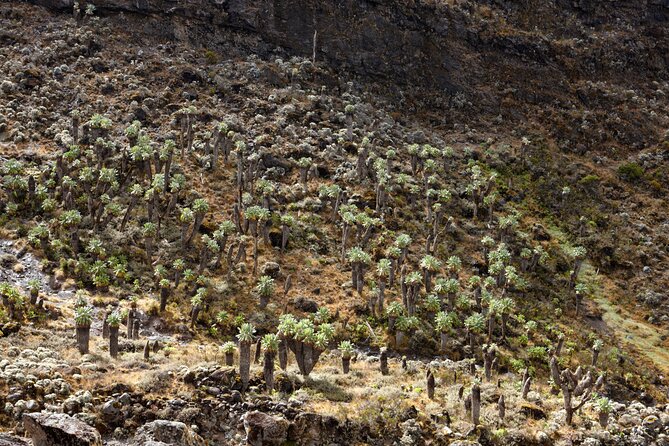
Day two is one of the most varied stages. You begin in the forest, then move into the heather and moorland zone. Trees give way to grasses, wildflowers, open slopes, and wider views.
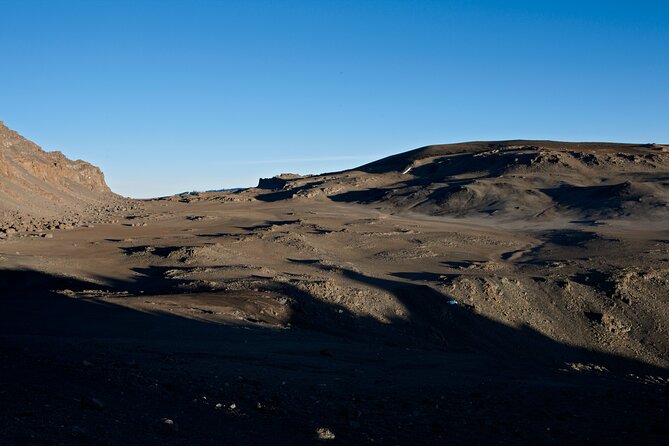
The walk takes about seven hours. You gain altitude while rounding the northern slopes of Shira Ridge, Kilimanjaro’s lesser-known third summit. From here, you may get your first clear view of the snow-covered Kibo summit, your ultimate destination.
The day ends at Shira One Camp at 3,504 meters. The camp sits on the western edge of the Shira Plateau, with views across the open plateau toward Kibo.
This is where altitude may begin to make itself known. A mild headache is possible, and the best response is not to push through dramatically. Walk pole pole, meaning slowly, and drink often. You should tell your guide about symptoms rather than trying to hide them.
The distance and time are reasonable, but the jump from the forest to 3,504 meters is noticeable. I would keep the evening quiet, eat what you can, and resist the temptation to treat the first clear view of Kibo as an invitation to hurry.
Day 3: Moir Hut and a useful acclimatization climb
You leave Shira One and reach Simba Camp in less than an hour. There is also a junction with a 4WD emergency track running down from Shira Two.
From there, the trail becomes more rugged. It winds among boulders, crosses or skirts petrified lava flows, and passes through grassy sections. The route then climbs toward an impressive cave before reaching Moir Hut at 4,161 meters.
The day covers about 9.7 kilometers, with 657 meters of total gain and around six hours of walking. You can also take an optional sunset acclimatization walk to a ridgeline at about 4,300 meters. That extra outing adds roughly 1.9 kilometers and 139 meters of gain.
I like this design. You climb high, return to camp, and give your body a chance to practice at altitude without spending the night at the highest point reached that day. The sunset outing also gives you something meaningful to do besides sit in a tent.
Moir Hut is not a luxury stop. It is a high, exposed camp, and the combination of altitude and uneven ground can make the evening feel harder than the mileage suggests. Keep your headlamp, water, and warm clothing close.
A few more Arusha days to compare
- Balloon Safari & Bush Breakfast in Serengeti – Miracle Experience
★ 5.0 · 1,646 reviews - Tanzania Classic – 7 Days
★ 5.0 · 1,151 reviews - 4 Days Group Camping Safari
★ 5.0 · 1,101 reviews - 5 Days Group Camping Safari
★ 5.0 · 730 reviews
Day 4: Around Kibo’s northern face to Pofu
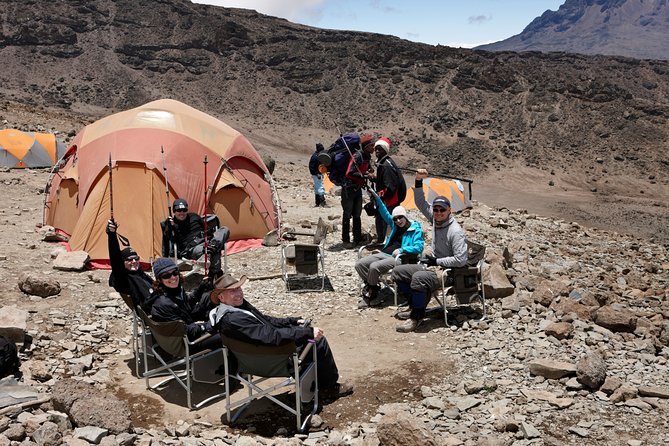
The Northern Circuit earns its name here. You reach about 4,402 meters, then descend to Second Pofu Camp at 4,033 meters.
The walking time is around six hours, but this is not a simple uphill day. You first tackle a steep, barren slope to roughly 4,300 meters. Then you contour around Kibo’s northern face, dropping into several valleys and climbing out again.
The scenery is spare and rocky. There are fewer trees and fewer signs of human activity. Peace and solitude become the main attractions, but the up-and-down route can wear you down.
Altitude symptoms are common at this stage. A headache does not automatically mean you must stop, but it does mean you need to pay attention. Move slowly, drink plenty, and follow your guide’s advice. The phrase pole pole becomes practical here, not decorative.
Second Pofu Camp is listed as Old Pofu Camp in the schedule. That variation in naming is worth noting when you compare route documents. The important point is the overnight position on the northern side of Kibo, at about 4,033 meters.
Day 5: Third Cave and the growing Mawenzi view
This is a shorter day in distance, about 6.8 kilometers and around four hours, but do not mistake short for effortless.
The trail continues around the northern slopes with repeated climbs and descents. The gradients are less severe than on day four, yet the constant changes in height can leave your legs tired.
The payoff is the view. Kibo remains to your right, while Mawenzi begins to loom larger ahead. Mawenzi is Kilimanjaro’s sharp, jagged second summit, and its shape gives this part of the route a different character from the broad, rounded slopes of Kibo.
You sleep at Third Cave Camp. The camp is at about 3,936 meters. Because the day is not long, you have more time to rest, check your equipment, and prepare for the harder stages ahead.
This is a good day to take stock. If you have been walking too fast, carrying too much, or neglecting food and water, the northern slopes will expose it. Use the extra time to make small corrections before the summit push.
Day 6: School Hut at 4,717 meters
You now traverse the eastern slopes and climb from Third Caves to School Hut. The distance is only about 4.9 kilometers, but the elevation gain is a substantial 781 meters.
You should reach camp by early or mid-afternoon. School Hut sits at 4,717 meters, and this is the final overnight before the summit attempt.
The short distance can fool you. At this altitude, every uphill step costs more, and the air is thin. Your job is to walk steadily, eat, drink, and rest. You will likely be asked to sleep as soon as possible because departure comes around 11:00 p.m. to midnight.
The staff wakes you for meals, so you do not need to keep checking the time. You may not feel hungry, but try to eat. Summit night is long, and you need whatever energy you can manage.
I would organize your gear before lying down. Put your warmest clothing, headlamp, gloves, water, and personal essentials where you can reach them quickly. The less decision-making you have to do at midnight, the better.
Day 7: School Hut to Uhuru Peak, then down to Mweka
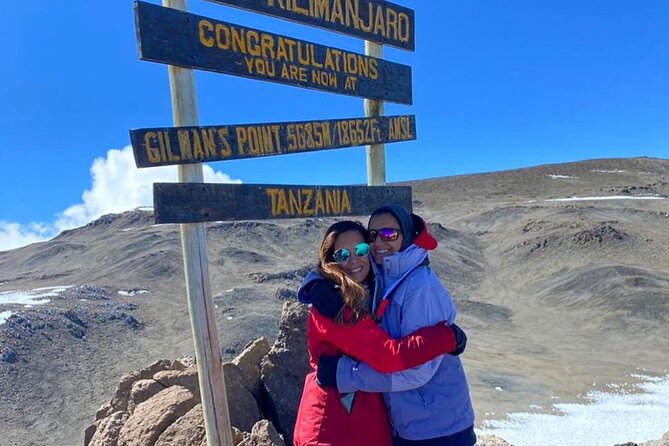
This is the defining day. You leave around midnight and climb through the dark toward Hans Meyer Cave at 5,259 meters, then Gillman’s Point at roughly 5,719 meters, before continuing to Uhuru Peak at 5,895 meters.
The summit section is difficult, especially the final 550 meters. The cold, darkness, altitude, and slow pace combine to make this a test of patience as much as fitness.
Gillman’s Point sits on the crater rim and counts as one of Kilimanjaro’s three summit points. You receive a certificate for reaching it. Uhuru Peak is the highest point and the traditional roof-of-Africa goal.
Your guide decides how long you can safely remain at the summit based on your condition, timing, and weather. This is not the place to chase a perfect photo at the expense of your health. Enjoy the moment, take photographs if conditions allow, and begin the descent when instructed.
The listed route from the summit continues about 4.86 kilometers down to Barafu Camp. There you have breakfast and rest for about an hour before walking another 6.6 kilometers down the mountain.
That makes this an exceptionally long day, listed at around 15 hours. The descent can feel faster than the climb, but tired knees and loose ground create their own problems. Save some water, keep your pace controlled, and do not assume the hard part is finished once you leave the summit.
You eventually continue toward Mweka Camp. The precise sleeping arrangement should be confirmed with Duma before departure, since the schedule gives the summit and descent details but does not clearly name the overnight stop after Barafu.
Day 8: Mweka Trail to the gate
After breakfast, you descend by the Mweka Trail to Mweka Gate at about 1,633 meters. The final walking time is around four hours.
The altitude drops quickly, and the return to warmer air is welcome. You complete the gate formalities and collect your certificate if you reached Uhuru Peak or Gillman’s Point.
A vehicle waits to take you back to your hotel and then onward to Arusha. The contrast can be sharp: after a week of tents, high camps, and early nights, a shower and a cold drink will feel like major events.
The Mweka descent is a practical finish. You do not retrace the full route, so you get a different final view of the mountain and avoid turning the return into another long circuit.
Food, support, and the private format
The package includes eight lunches, seven breakfasts, and seven dinners. That covers the listed meals for the eight-day schedule, though the itinerary should be checked for how meals are handled on the summit day and during transfers.
Food is more than a comfort on Kilimanjaro. At altitude, appetite often fades, but calories matter. Duma has accommodated vegetarian food on past climbs and has even provided a birthday cake, so mention dietary needs and special occasions before you go.
A private tour means only your group participates. That gives you more control over pace, rest, and communication than a large mixed group. It does not mean the climb is casual. Your guide still has to balance personal preferences with altitude safety and mountain conditions.
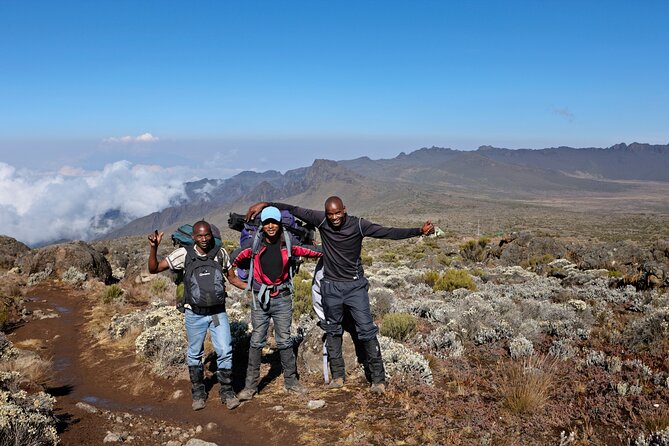
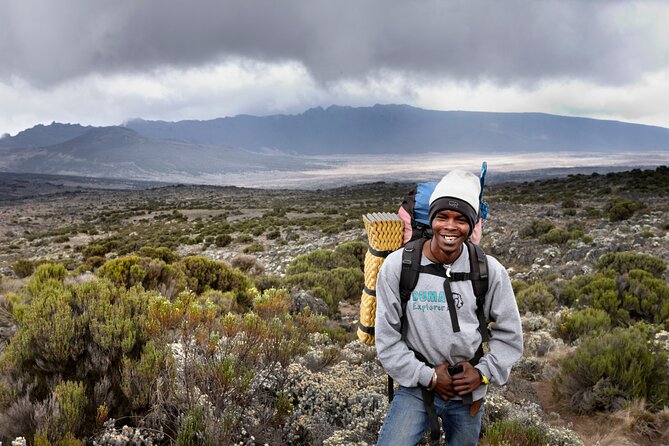
Duma’s Kilimanjaro team has included guides named Emanuel or Emmanuel, Imran, Humphrey, and Colman, along with porters including Dickson and Mariam. The exact crew for your departure should be confirmed, but the named staff gives you useful context when discussing guide experience and team roles.
The company is also identified as a KPAP-registered operator. That is relevant because porter treatment matters on Kilimanjaro. Ask for current details about porter support, tipping practice, equipment, and what your price covers before you commit.
Is $2,999 a fair price?
At $2,999 per person, this is not a bargain trek, but the eight-day route offers more walking days and more acclimatization time than shorter Kilimanjaro options.
The value comes from the route design, private format, pickup, support crew, and included meals. The Northern Circuit also gives you several distinct zones instead of repeating the same trail on the way down.
Still, do not judge the price by the headline alone. Confirm whether park fees, camping costs, transfers, hotel nights, rescue arrangements, gear, tips, and airport services are included. The information provided confirms the meals listed above and pickup offered, but it does not spell out every cost.
I would consider the price reasonable if the operator gives you a clear written breakdown and a strong safety plan. A cheaper climb can become poor value if it cuts acclimatization days or leaves you uncertain about crew welfare and emergency procedures.
Who should book this climb?
This trip suits you if you have strong physical fitness, several days available, and a real interest in the mountain’s changing environments. It is also a good fit if summit success matters to you and you prefer a private group.
You should be ready for long walking days, basic camps, cold nights, altitude symptoms, and an exhausting summit push. The route is less crowded, but solitude does not make the terrain soft.
I would not choose this experience if you want a relaxed sightseeing holiday, dislike camping, or have only a narrow window in Tanzania. The eight-day schedule is a commitment, and the summit day is physically demanding even after the extra acclimatization.
Duma offers free cancellation if you cancel at least 24 hours before the local start time. Changes or cancellations inside that window are not accepted for a refund.
FAQ
How long is the Northern Circuit Kilimanjaro climb?
The climb lasts approximately eight days. The itinerary begins at Londorossi Gate and ends at Mweka Gate before transport back to the hotel and Arusha.
What time does the experience start?
The stated start time is 9:00 a.m.
Is this a private tour?
Yes. Only your group participates in the activity.
Is pickup available?
Yes. Pickup is offered, and a vehicle is scheduled to take you from Mweka Gate back to your hotel after the descent.
What meals are included?
The package includes eight lunches, seven breakfasts, and seven dinners.
How high is Uhuru Peak?
Uhuru Peak is 5,895 meters above sea level.
How high is Gillman’s Point?
Gillman’s Point is listed at about 5,719 meters above sea level. Reaching it qualifies for a certificate.
What fitness level is required?
You should have a strong physical fitness level. The trek includes high-altitude walking, steep climbs, repeated ascents and descents, and a summit day lasting about 15 hours.
Should you book Duma’s Northern Circuit climb?
I would book this route if you want the fullest circuit of Kilimanjaro and can handle the time and physical effort. The quiet northern slopes, changing views, and extra acclimatization days make it more appealing than a rushed climb.
Before paying, ask Duma for the exact inclusions, your guide names, the post-summit camping plan, porter arrangements, and safety procedures. If those answers are clear, $2,999 can represent solid value for a private, eight-day attempt at Africa’s highest peak.
Newly listed around Arusha
- 5-Day Private Safari Tour in Tanzania’s Wildlife★ 5.0 · 3 reviews
- 3 Days private safari Tarangire ,Ngorongroro crater &Manyara★ 5.0 · 3 reviews
- 3 Day Sharing Safari – Manyara, Ngorongoro Crater and Tarangire National Parks★ 5.0 · 3 reviews
- Tarangire National Park Day Trip★ 5.0 · 3 reviews
- 2 Days Tarangire and Ngorongoro Crater Tour★ 5.0 · 3 reviews
- 6 -Day Tarangire, Manyara, Serengeti & Ngorongoro★ 5.0 · 3 reviews
- 5 Days Group Camping Safari★ 4.7 · 3 reviews
- 4 Days Tanzania Safari★ 4.5 · 3 reviews
Kilimanjaro Climbs, compared.








Browse the lists this tour appears in