
Reviewed · KILIMANJARO CLIMBS
Kilimanjaro Climb – 7 Days Machame Route
Kilimanjaro’s Machame Route earns its Whisky Route nickname honestly: it is the mountain’s scenic, demanding way up, with rainforest, high moorland, the Shira Plateau, Barranco Wall, glaciers, and a long night at altitude before the summit. The route’s gradual rise over seven days gives you a better adjustment period than a shorter climb.
I like the changing scenery and the sensible climb high, sleep lower rhythm on day three. I also like that the price includes park, camping, rescue fees, VAT, meals, tents, airport transfers, and the full mountain crew. The main drawback is summit day: reaching 5,895 meters and then descending almost 2,800 meters makes day six a serious physical test.
Key points to know before booking
- Seven days on the Machame Route: You move from tropical rainforest to snow and glaciers, then descend through forest again.
- The Barranco Wall is a highlight: Day three leads to the misty Barranco area, followed by a short but hands-on climb the next morning.
- Good altitude planning: The Lava Tower stop takes you higher before sleeping at Barranco Camp, helping your body adjust.
- Private group format: Only your party takes part, with professional guides, cooks, and porters supporting the climb.
- A strong package for $2,500: Major mountain fees, food, tents, transfers, and airport pickup and drop-off are included.
- Summit night is the hard part: The uphill push takes 5 to 7 hours, followed by another 5 to 6 hours downhill to Mweka Camp.
Why the Machame Route is worth seven days
Kilimanjaro is not a technical climbing mountain on this route, but it is not a casual walk either. The biggest challenge is altitude, followed by the repeated long days and the final summit push. Seven days gives you more time than many shorter schedules, and that matters on a mountain rising from 1,811 meters at the gate to 5,895 meters at Uhuru Peak.
The route also gives you a fuller picture of Kilimanjaro. You start under broadleaf forest and finish among snow, rock, and thin air. Along the way, the setting changes every day, so the walk does not feel like seven versions of the same trail.
This is a private activity, which is useful if your group wants to set its own pace within the planned schedule. You will still need to follow the guide’s safety advice, especially near the summit, but you are not being folded into an unknown group.
The tour has a current rating of 5 from 14 reviews, with 100 percent recommending it. That is a small sample, so I would not treat it as a guarantee. Still, the praise is notably consistent about the guides, food, porters, personal care, and motivation during the hardest stretches.
More Kilimanjaro routes:
- Kilimanjaro climb by Lemosho Route (7-day)
★ 5.0 · 651 reviews - Kilimanjaro climb, Machame Route (7-day)
★ 5.0 · 262 reviews - Kilimanjaro Climbing Lemosho Route 8 Days.
★ 5.0 · 186 reviews
Day one: Machame Gate to Machame Camp
The climb begins at Machame Gate, at 1,811 meters. From there, you walk 10.75 kilometers, or about 7 miles, for 5 to 6 hours, gaining 1,210 meters before reaching Machame Camp at 3,021 meters.
This is a proper first day, not just a warm-up. The trail runs through rainforest, and the combination of humidity, roots, mud, and steady uphill walking can make the distance feel longer than the numbers suggest. You will want sturdy boots and clothing that handles changing conditions.
The forest is one of the route’s early rewards. It feels far removed from the roads and hotels around Moshi, and the thick vegetation gives the opening stage a strong sense of departure from ordinary life. Your mountain crew carries the camping equipment and prepares three meals a day, so your main job is to walk steadily, drink, and keep your pace controlled.
Machame Camp is high enough for the first night to feel different from Moshi. Do not judge your entire climb by how you feel here. The first day’s effort, heat, and altitude can leave you tired, but the schedule gives you several more days to adjust.
Day two: Machame Camp to Shira Camp
Day two covers only 5.3 kilometers, about 3 miles, but it continues upward from 3,021 to 3,839 meters. The stated walking time is 4 to 5 hours, and the scenery changes from rainforest to moorland.
This shorter day is helpful. You gain 818 meters, but you are not forced into a long march immediately after the first day. The open moorland also gives you wider views and a sense that the mountain is changing character.
The Shira area is one of the memorable parts of the route. The forests fall away, the air feels cooler, and the path moves through a quieter, more exposed zone. Late sunsets around Shira Plateau are a particular pleasure if the weather is clear.
At this height, cold and sun can arrive together. Pack sunscreen, a warm layer, and rain protection where you can reach them quickly. Your tent is a 4-season mountain tent, but you should still bring personal clothing suitable for a high, cold camp.
Day three: Lava Tower and Barranco Camp
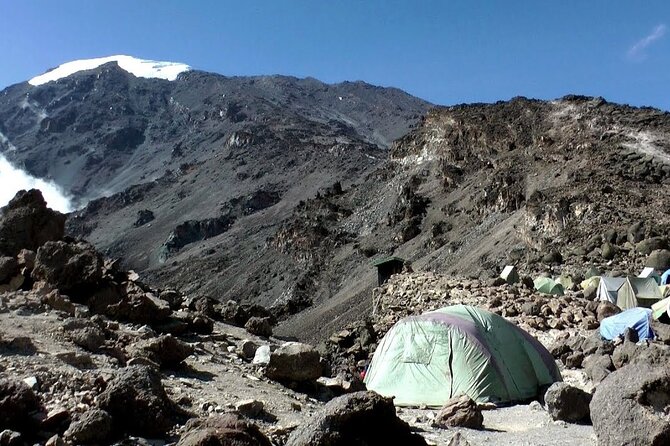
Day three is the route’s altitude-adjustment day. You walk 10.75 kilometers, or 6 miles, from Shira Camp at 3,839 meters to Lava Tower at about 4,600 meters, then continue down to Barranco Camp at 3,986 meters. Total walking time is listed as 5 to 6 hours, with only 147 meters of net altitude gain.
The important detail is the high point at Lava Tower. You go higher during the day, then sleep lower at Barranco. That pattern gives you valuable time at altitude without making your overnight camp as high as the day’s highest point.
The terrain here is semi-desert. Expect fewer trees, more rock, and a greater feeling of exposure. The misty views toward Kibo can be striking, especially as the mountain’s upper slopes begin to appear more severe.
Barranco Camp is a strong overnight stop because it sits below Lava Tower while placing you close to the Barranco Wall. If you have felt fine so far, do not become overconfident. Altitude symptoms can appear later, and you should tell your guide promptly about headache, nausea, unusual fatigue, or other concerns.
More week long trips in Moshi & Kilimanjaro:
- Climbing Kilimanjaro through 7 days Machame Route
★ 5.0 · 151 reviews - 7 Days Kilimanjaro via Machame route affordable price
★ 5.0 · 110 reviews - Private Kilimanjaro Hike 7 Day Lemosho Route
★ 5.0 · 60 reviews - 7-Day Magical Tanzania Safari -Premium High End Package
★ 5.0 · 53 reviews
Day four: Climbing the Barranco Wall
The walk from Barranco Camp to Karanga Camp is just 5.2 kilometers, or 3 miles, and takes about 3 to 4 hours. You rise from 3,986 to 4,034 meters, a modest net gain of only 48 meters.
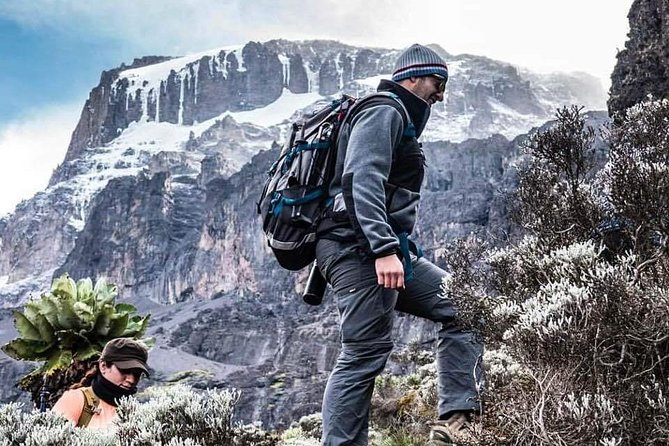
The mileage is short, but this is not necessarily an easy morning. The Barranco Wall is the route’s best-known physical feature. It requires careful foot placement and some use of your hands as you move up the rock. It is not a technical climbing pitch in the information provided, but it can feel exposed and demanding if you dislike steep ground.
The guide’s role matters here. Names associated with this operation include Nelson, Frank, and Joseph, with Octavian handling pre-trip questions for some climbers. Your assigned team may differ, so confirm who will lead your departure. In general, you want clear instructions, a calm pace, and close attention to how you are feeling.
After the wall, the route crosses alpine desert toward Karanga Camp. The short day gives you time to rest, eat, and prepare for the larger altitude gain to Barafu. That slower rhythm is one of the best reasons to choose seven days rather than trying to force the same route into fewer nights.
Day five: Karanga Camp to Barafu Camp
Day five covers 3.3 kilometers, about 2 miles, over 3 to 4 hours. The elevation rises from 4,034 meters to 4,662 meters, for a gain of 628 meters.
The short distance can be deceptive. At this altitude, every uphill step costs more, and the alpine desert offers little cover from wind or sun. You are now preparing for the summit rather than simply walking toward it.
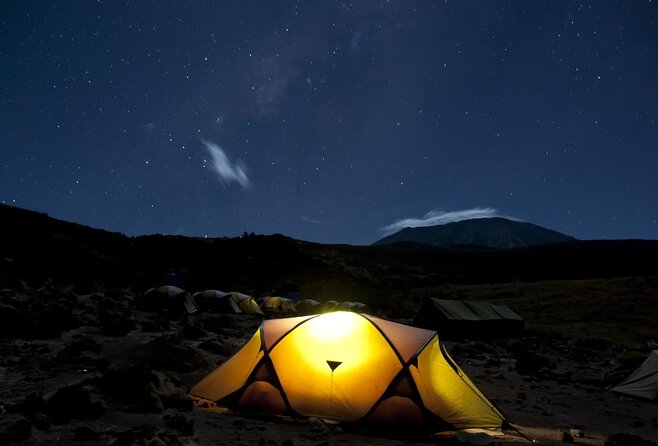
Barafu Camp is the launch point for the summit attempt. The camp sits at 4,662 meters, so you are already sleeping very high before the hardest night begins. Eat as well as you can, organize your summit clothing, and use the afternoon for rest rather than wandering around camp.
The included meals are a real part of the value here. Several people specifically praised the cooking and the crew’s willingness to handle dietary needs, including gluten-free food. One person also noted coffee and hot water delivered to the tent. These are small comforts, but at Barafu they can make a large difference to your mood and energy.
Day six: Barafu Camp to Uhuru Peak and Mweka Camp
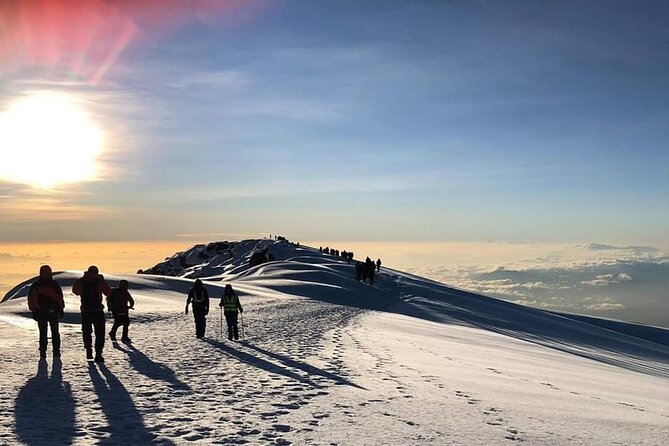
This is the day that decides the climb. You leave Barafu Camp at 4,662 meters and climb 4.86 kilometers, or 3 miles, to the summit at 5,895 meters. The uphill section takes 5 to 7 hours, usually in the coldest and darkest part of the schedule.
The altitude gain is 1,233 meters. That figure does not fully capture the difficulty. You are walking after several days on the mountain, and the high air makes the pace slow. The guide team’s steady encouragement becomes especially useful here. The crew members named in the supplied feedback include Nelson, Innocent, Raffael, John, Frank, and Joseph, but your exact team should be confirmed before departure.
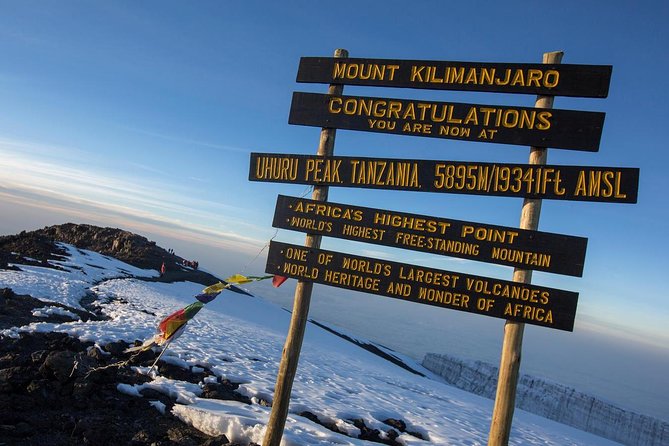
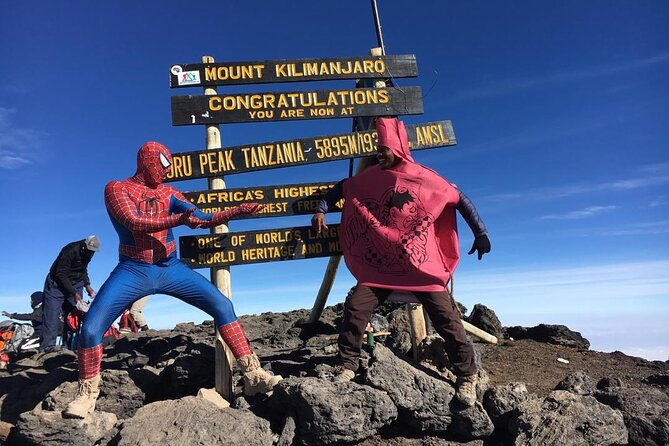
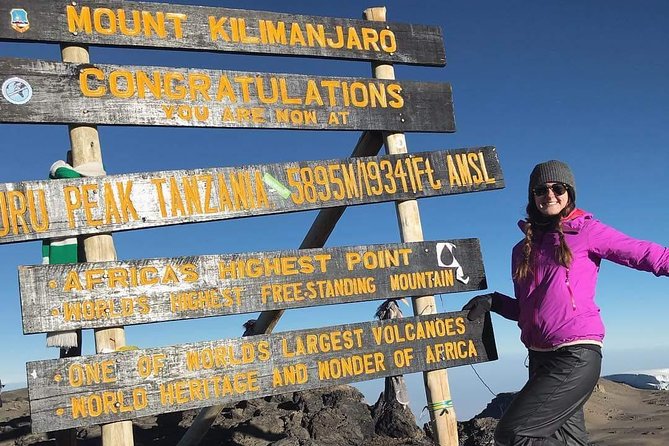
At Uhuru Peak, you are at Africa’s highest point. The summit setting includes glaciers and snow-capped views, though weather can affect what you see. Do not count on a long stay at the top. Take your photographs, absorb the moment, and follow the guide’s advice about moving down.
The descent is long and punishing in its own way. You continue 11.5 kilometers, or 7.2 miles, down to Mweka Camp at 3,106 meters, taking another 5 to 6 hours. You lose 2,789 meters in one day, so tired knees and feet are normal concerns.
This is why the tour should not be sold as a moderate walk without qualification. The day’s individual sections are manageable for a fit person with preparation, but the total workload is substantial. You need patience on the climb and care on the descent.
Day seven: Mweka Camp to Moshi
The final mountain walk runs 9.1 kilometers, or 6 miles, from Mweka Camp at 3,106 meters to Mweka Gate at 1,633 meters. It takes around 3 to 4 hours and returns to rainforest.
The change back into forest is welcome. The air becomes warmer, the trail feels less exposed, and the summit effort begins to settle into a sense of achievement. You still need to watch your footing, since descending trails can be tiring after the previous day.
At Mweka Gate, a driver meets you for the roughly 30-minute ride back to your Moshi hotel. Airport pickup and drop-off at Kilimanjaro International Airport are included, which makes this package easier to arrange if you are flying in specifically for the climb.
What the $2,500 price really covers
At $2,500 per person, the cost is not just a guiding fee. It includes park fees, camping fees, rescue fees, and 18 percent VAT on tour fees and services. It also covers transportation to and from the mountain gate, airport pickup and drop-off, 4-season tents, professional mountain guides, cooks, porters, and three meals per day on the mountain.
That list gives you a better basis for judging value. Kilimanjaro charges and crew support make up a major part of any legitimate climb, so a low headline price may not mean a cheaper final trip. Here, several expensive and necessary items are already bundled.
You still need to budget for flights, personal items, laundry, and tips for the mountain crew. Tips are not a minor afterthought on a supported mountain climb, so ask the operator for current guidance before you go. You should also bring money for anything personal that is not part of the camp service.
The price looks strongest for people who want one company to handle the main mountain arrangements. It is less attractive if you already have local transport, airport transfers, or camping equipment arranged separately, though the private format may still be useful.
Food, tents, guides, and camp life
Every night is spent in a tent, and all food is prepared while you are on the mountain. This is camping, not a lodge-based trek. You should expect basic mountain living, early starts, changing temperatures, and limited personal space.
The 4-season tents are designed for mountain conditions, but comfort will still depend on your sleeping bag, clothing, and ability to rest at altitude. The supplied details do not specify sleeping bags, mattresses, showers, or bathroom arrangements, so ask about those before paying.
The human support is a major part of the package. The guide team leads the route and watches your condition. Cooks prepare the meals, and porters carry the camp equipment. The strongest praise focuses on the crew’s warmth, English, humor, singing, encouragement, and attention to comfort.
That does not remove your responsibility. Tell the guide if you feel unwell, protect your water supply, and keep your personal essentials accessible. If you have dietary needs, state them when booking. Gluten-free food has been handled before, but you should not leave an important requirement until arrival.
Who should choose this climb?
This route suits you if you have moderate physical fitness, enjoy several hours of walking per day, and are willing to camp for six nights. You do not need to be an elite athlete based on the stated requirements, but you do need to prepare for steep uphill walking, high altitude, cold, and a very long summit day.
It can also suit families or mixed-age pairs if everyone understands the effort involved and the guide accepts the group’s ability. One praised experience involved a parent and adult child, with the guide team providing experienced support and good English.
You should think twice if you dislike tents, struggle with long downhill walks, or want a relaxed holiday with plenty of free time. The schedule has rest built into some days, but the mountain remains the focus from start to finish.
Practical points before you commit
Pickup is offered, and the package includes Kilimanjaro International Airport transfers. The activity is near public transportation, but this is not a sightseeing tour that you can join casually from the street. Confirmation is provided at booking, and you should use that moment to clarify the meeting point, packing list, sleeping arrangements, dietary needs, and exact guide team.
The cancellation terms are simple but strict close to departure. You receive a full refund if you cancel at least 24 hours before the start time. Changes or cancellations inside 24 hours are not accepted or refunded, and cut-off times use local time.
Weather can affect the departure. If poor weather forces cancellation, you are offered another date or a full refund. If the minimum number of participants is not met, you are offered another date or experience, or a full refund.
Should you book the 7-day Machame climb?
I would choose this trip if you want a scenic route, a private group, full camping support, and a price that includes the major mountain costs. The seven-day schedule gives you a more sensible pace than a rushed climb, and the route offers the greatest variety of scenery in the program.
I would not book it without asking a few direct questions first: What sleeping gear is supplied? How many climbers can one guide supervise? What is the tipping recommendation? How are medical concerns handled on summit night? What exact meals and dietary substitutions are available?
Book it if you accept that the summit day will be hard and that success is never guaranteed by a good itinerary. For a fit, prepared climber who wants Kilimanjaro’s rainforest, moorland, Barranco Wall, alpine desert, and snowy summit in one route, this is a strong-value choice.
FAQ
How long is the Kilimanjaro Machame Route experience?
The climb lasts approximately seven days, ending with transport from Mweka Gate back to a hotel in Moshi.
What is the price per person?
The listed price is $2,500 per person.
Is airport pickup included?
Yes. Pickup and drop-off at Kilimanjaro International Airport are included.
Is this a private tour?
Yes. Only your group participates in the activity.
What level of fitness do I need?
The stated requirement is a moderate level of physical fitness.
What does the route include?
The route includes park fees, camping fees, rescue fees, 18 percent VAT on tour fees and services, 4-season mountain tents, transportation to and from the mountain gate, professional guides, cooks and porters, and three meals daily while on the mountain.
Are flights included?
No. Flights are not included.
Are tips for the mountain crew included?
No. Tips to the mountain crew are not included.
How high is Uhuru Peak?
The summit reaches 5,895 meters, or 19,341 feet.
How long is summit day?
The climb from Barafu Camp to the summit takes about 5 to 7 hours. The descent to Mweka Camp takes another 5 to 6 hours.
Can I cancel for a full refund?
You can cancel at least 24 hours before the experience start time for a full refund. Cancellations made less than 24 hours before the start time are not refunded.
What happens if poor weather cancels the climb?
You are offered a different date or a full refund.
Newly listed around Moshi & Kilimanjaro
- Climb Mount Kilimanjaro: 7 Days Machame Route★ 5.0 · 3 reviews
- 6 Days Mount Kilimanjaro Climbing via Rongai Route★ 5.0 · 3 reviews
- Explore 1 day Ngorongoro Crater Budget Group Safari from Arusha★ 5.0 · 3 reviews
- Mt. Kilimanjaro Day Hiking★ 5.0 · 3 reviews
- Chemka (Kikuletwa) Hot Springs, Tanzania★ 5.0 · 3 reviews
- Guided City tour of Moshi★ 4.3 · 3 reviews
- 8 Day Tanzania Family Safari★ 5.0 · 3 reviews
- Serengeti Safari with Sirikwa Travel★ 5.0 · 3 reviews
Kilimanjaro Climbs, compared.








Browse the lists this tour appears in