
Reviewed · KILIMANJARO CLIMBS
7 Days Kilimanjaro Climb Machame Route
Machame gives you the fullest Kilimanjaro experience without taking the easiest road. Over seven days, you move from monkey-filled rainforest to open moorland, volcanic rock, high alpine desert, and the cold Arctic summit zone. The route circles the southern side of the mountain before reaching Uhuru Peak at 19,341 feet.
I like the extra acclimatization day built into this version, and I like the private format, which lets your guide adjust the pace to your group. The included tent, food, park fees, hotel nights, and transfers also make the $2,564.11 price easier to understand.
The catch is simple: Machame is not a gentle walk. You sleep in tents every night on the mountain, the summit day begins just after midnight, and the route is best for fit people with some trekking experience. Your success depends as much on patience and altitude management as on strength.
Key points to know before booking
- Five climate zones in seven days: You pass through rainforest, heath, moorland, alpine desert, and Arctic conditions.
- A private climb with a local crew: Your group travels with professional guides, cooks, and porters, with previous trips led by Daniel, John, or Godfrey.
- The extra day matters: The seven-day plan allows a slower ascent than the shorter six-day version.
- Camping is part of the deal: Three-season tents, double-layer sleeping mats, meals, water, and camping fees are included.
- Summit morning is the hard test: You climb from Barafu Camp in darkness, reach Stella Point, then continue to Uhuru Peak.
- The route is scenic but demanding: Machame offers broad mountain views, yet steep sections, loose rock, cold, rain, and altitude all add work.
Why the Machame Route is worth the effort
Machame is often called the Whiskey Route, a playful contrast with the easier-sounding Coca-Cola nickname attached to the Marangu Route. The difference is practical. Marangu offers hut accommodation and a more gradual profile, while Machame uses tents and includes steeper, rougher sections.
You choose Machame for scenery and changing habitats. The path begins in thick forest on Kilimanjaro’s southern side, climbs toward the Shira Plateau, then follows the southern circuit. This gives you mountain views from several angles before the route approaches the summit from the east and descends by the Mweka trail.
The route is about 62 kilometers from gate to gate. That number does not tell the full story, since altitude makes each kilometer feel harder. Still, the seven-day schedule is a sensible choice. You gain height gradually, then spend time climbing high and sleeping lower on the Lava Tower and Barranco day. That rhythm helps your body adjust.
The private setup is another real advantage. Instead of moving with a large fixed group, you have one group and one operating crew. Guides can watch your pace and condition more closely, while communication before arrival is handled through the company. Daniel, the company director, has been involved in arranging airport pickups, hotel stays, and detailed pre-trip planning. John has also led mountain teams.
More Kilimanjaro routes:
- 8-Day Small-group Lemosho Kilimanjaro Summit Trekking
★ 5.0 · 186 reviews - 7-Day Machame Kilimanjaro Summit Tour from Arusha
★ 5.0 · 125 reviews - Private Full Day Hiking Experience to Marangu Route
★ 5.0 · 61 reviews
Arrival, hotel nights, and the start in Moshi
The experience is listed as starting in Arusha, but the detailed plan places the pre and post-trek hotel stays in Moshi. That is worth confirming before you book, especially if your international flight lands in Arusha or Kilimanjaro airport. Two-way private airport transfers are included, along with accommodation before and after the climb.
The extra hotel night before the mountain is useful. You can meet the team, check equipment, ask questions, and avoid rushing straight from an airport to the trailhead. The morning begins with breakfast and a briefing about the route, summit conditions, and practical ways to handle the climb.
The drive from Moshi to Machame village takes about an hour. At the village, guides and porters organize food and gear, and you receive a packed lunch and mineral water. After registration at Machame Gate, the walk begins.
The company lists lodge accommodation before and after the trek, but the named hotel can vary. One previous itinerary used Keys Hotel. Ask for the confirmed property, room arrangement, and transfer timing before departure if those details matter to you.
Day 1: Machame Gate to the first forest camp
Your first walking day leads from Machame Gate through dense rainforest to Machame Camp, sometimes referred to in the itinerary as Machame Hut. The elevation rises from the village area toward roughly 9,350 feet, and the walk can take about seven hours.
This is a beautiful opening, but it is not a throwaway day. The forest can be wet, muddy, and humid, and the uphill path quickly shows you why a steady pace matters. You might see monkeys and forest birds. The old-growth trees make this section feel like a real mountain approach rather than a simple road to a campsite.
Your porters carry the main camping equipment and food, while you walk with a daypack. Keep your rain jacket, water, snacks, and warm layer accessible. Rain on the first day can soak clothing and make the trail slippery, even when conditions looked dry in town.
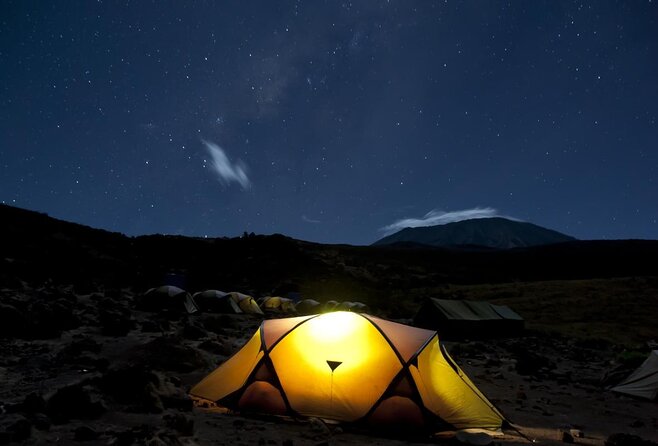
The tents are your accommodation on the mountain. Camping fees, three-season tents, double-layer sleeping mats, and three meals each day are included. The crew also provides filtered water throughout the trek. Breakfast, lunch, and dinner are covered, with snacks, coffee, and tea listed as included as well.
Day 2: Leaving the forest for Shira Plateau
The second day climbs from Machame Camp to Shira 2 Camp. The route leaves the forest behind and reaches heather, open moorland, and a rocky ridge. The stated distance is about 5 kilometers, with roughly four to six hours of walking, and the elevation rises from 9,350 to 12,500 feet.
This is a shorter day by distance, but the altitude changes the effort. You should walk slowly, drink regularly, and resist the temptation to race ahead simply because the trail looks manageable. The open ground brings wider views, and the change from tall forest to low vegetation is one of the most striking transitions on the route.
The path crosses a large river gorge before reaching Shira 2 Camp. At camp, the value of the private arrangement becomes clear: you have time to eat, rest, and ask your guide how the next day will work instead of treating camp as just a place to sleep.
Nights at this height can feel cold even after a warm day. Use the sleeping mat properly, keep dry clothes for camp, and organize your bag before dark. Small routines matter more as the altitude rises.
More week long trips in Arusha:
- Tanzania Classic – 7 Days
★ 5.0 · 1,151 reviews - 7-Day Premium Luxury Tanzania Safari All-Inclusive
★ 5.0 · 426 reviews - Group Safari 7 Days in Tanzania’s Main Parks
★ 5.0 · 240 reviews - 7 Days Tanganyika Wilderness Safari
★ 5.0 · 159 reviews
Day 3: Lava Tower, alpine desert, and Barranco
Day three is the key acclimatization day. You climb from Shira 2 toward Lava Tower at 15,190 feet, then descend to Barranco Camp at about 13,044 feet. The route covers about 7 kilometers to Lava Tower and another 3 kilometers down to Barranco, with four to five hours of ascent followed by two to three hours of descent.
Lava Tower is a tall volcanic rock formation, about 300 feet high. The surrounding alpine desert feels stark compared with the forest below. You begin and end the day at roughly similar elevations, but spending time high before sleeping lower gives your body useful exposure to altitude.
This day can bring headaches, tiredness, or shortness of breath. The itinerary calls for moderate physical fitness, but fitness alone does not prevent altitude problems. Tell your guide early if you feel unwell. A private guide can slow the pace or assess whether continuing is sensible.
The descent to Barranco passes through the striking Senecio Forest. Giant plants and volcanic slopes give this section a memorable character, and Barranco Camp sits below the Great Barranco Wall. You will want a warm meal and an early rest after this long high-altitude day.
Day 4: Climbing the Great Barranco Wall
From Barranco Camp, you descend briefly into a ravine before climbing the Great Barranco Wall. The wall rises about 900 feet, but this is a non-technical climb. It is steep and hands-on in places, yet you do not need climbing ropes or technical mountaineering skills according to the route description.
This is one of the most interesting days because the trail feels more dramatic than its distance suggests. You work through hills and valleys, descend into the Karanga Valley, then climb again to Karanga Camp. The elevation changes only slightly, from about 13,044 to 13,106 feet, and the short day helps with acclimatization.
Do not judge the day by the numbers. The repeated up and down can tire your legs, and the Barranco Wall may feel intimidating if you dislike steep ground. Your guide should show you where to place your feet and how to keep your balance. Trekking poles can help on the descents and uneven sections.
Karanga is also where you begin to think seriously about summit morning. Sort your headlamp, gloves, warm layers, water, and snacks before dinner. Leaving this preparation until the middle of the night makes an already difficult start harder.
Day 5: Karanga to Barafu Camp
The walk from Karanga to Barafu Camp covers about 4 kilometers and climbs from 13,106 to 15,331 feet. The trail joins the Mweka route and continues through rocky ground to Barafu, the high camp used before the summit attempt.
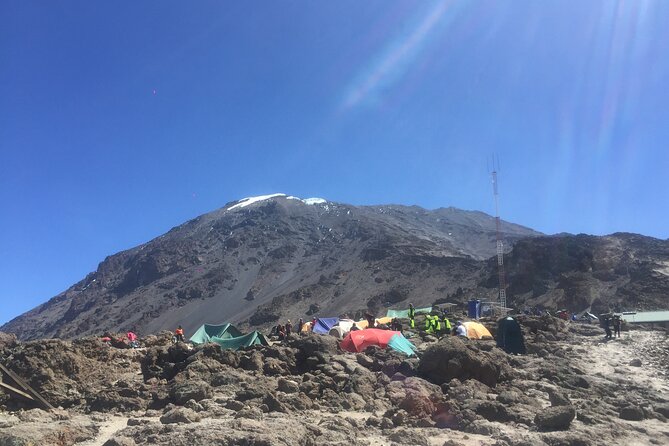
This is a short walking day, but Barafu is not a place for a leisurely afternoon stroll. You need to rest, eat, hydrate, and prepare for an early start. The itinerary notes that Mawenzi and Kibo are visible from camp, giving you a clear reminder of the two main volcanic peaks that shape Kilimanjaro.
The southern circuit is complete by this point. That route choice gives you views from different sides of the mountain instead of taking you straight up and down one corridor. It also spreads the climb across more days, which is one reason the seven-day plan is more appealing than the six-day version for many people.
Expect a basic mountain camp rather than comfort. You have a tent, mat, food, and support crew, but no hut bed or flush toilet included. A portable flush toilet and toilet tent cost an extra $65 per toilet and tent. This is an optional comfort upgrade, not part of the standard package.
Day 6: The midnight climb to Uhuru Peak
Summit day begins just after midnight. From Barafu, you climb in darkness through wind and cold, taking short, frequent breaks. The ascent to Uhuru Peak takes about seven to eight hours, and the route rises from 15,331 to 19,341 feet.
This is the toughest part of the climb. The air is thin, the ground can be rocky, and progress may feel slow. Your guide sets a deliberate pace, often much slower than your normal hiking speed. That is exactly what you want. The goal is to preserve energy and manage altitude, not to win a race.
Stella Point sits at about 18,900 feet. Reaching it near sunrise can bring one of the trip’s most rewarding views, with light spreading across Mawenzi Peak. You still have a final stretch to Uhuru Peak, so take time to recover at Stella Point without assuming the day is finished.
At Uhuru Peak, you reach the highest point in Africa. The moment may be brief because of cold, fatigue, or weather, but it is the clear payoff for the week’s steady effort. Your guide will manage the group’s timing and help you stay focused on the descent.
After the summit, you return to Barafu for lunch and continue down to Mweka Camp at about 10,065 feet. The descent covers roughly 12 kilometers. It is hard on the knees, especially over loose or rocky ground, so trekking poles are very useful here.
Mweka Camp lies in upper forest, where mist and late-afternoon rain are common. The long summit day ends with your final mountain dinner. You may be exhausted, but dropping several thousand feet usually feels welcome after the summit effort.
Day 7: Mweka Gate and the return to the hotel
The last walking day descends from Mweka Camp to Mweka Gate, dropping from about 10,065 to 5,380 feet. The distance is around 10 kilometers, with three to four hours of walking.
The lower trail can be muddy and wet after rain. Your hiking shoes will likely need cleaning, and gaiters can be useful if conditions are poor. At the gate, you collect your summit certificate before continuing about another hour to Mweka village.
A Youth Adventures and Safaris vehicle meets you at Mweka Gate and takes you back to the Moshi hotel. This transfer is a small but important detail. After the summit day and descent, you will appreciate not having to arrange local transport while tired and carrying damp gear.
The post-trek hotel night gives you a proper place to wash, sleep, and recover. It also leaves room for the included breakfast and other meals listed in the package, though you should confirm exactly which meals are supplied on each hotel day.
What the $2,564.11 price covers
The price is high compared with an ordinary guided hike, but Kilimanjaro is not an ordinary hike. The fee includes national park charges, camping fees, rescue fees, 18 percent VAT, mountain transport, guides, cooks, porters, tents, sleeping mats, three meals per mountain day, filtered water, hotel nights, and private airport transfers.
That is a substantial bundle. Park and rescue fees alone are not minor expenses, and the mountain crew carries food and camping equipment for a week. The inclusion of hotel nights also saves you from arranging separate accommodation around the climb.
You still need to budget for flights, personal items, laundry, and tips for the mountain crew. Tips are not included, and you should plan for them as a normal part of the trip budget. The optional portable flush toilet costs $65 per toilet and tent.
The biggest value comes from the seven-day schedule and private guide. A cheaper six-day itinerary may look attractive, but the extra day gives you more time to adjust before the summit. If reaching Uhuru Peak is your main goal, saving one day may be a poor trade.
Who should book this climb
You should consider this trip if you are physically fit, comfortable walking for several hours a day, and ready for basic tent camping. Previous trekking experience is recommended, though the route does not require technical climbing equipment for the Barranco Wall.
This is a good choice for a private family or friend group that wants personal attention. One previous trip involved a parent and son, while another was arranged for a solo climber who had already climbed Kilimanjaro by the Marangu Route. The company has also arranged combined safari and mountain trips, so you can ask about adding other Tanzanian plans separately.
You should think twice if you dislike cold nights, rough trails, or uncertain weather. Machame is scenic, but the scenery does not make the altitude easier. You need to accept that a summit attempt is demanding and that your guide may advise a change of plan if your health becomes a concern.
The company’s strongest practical feature is the communication before arrival. Daniel has handled lengthy planning conversations, airport pickup, hotels, and route questions. That support is valuable when you are organizing equipment and international travel from far away.
Practical preparation for seven days on Kilimanjaro
Bring layered clothing rather than one heavy coat. Conditions shift from warm and wet forest to freezing summit conditions, and you need clothes that can dry or remain protected from rain.
Keep important small items in your daypack:
- A rain jacket and waterproof protection for your bag
- Warm gloves, hat, and several insulating layers
- A headlamp for the midnight summit start
- Water and snacks for each walking day
- Trekking poles for the Barranco descent and rocky summit return
- Dry clothes reserved for sleeping
Ask the operator about the exact packing list before departure. The package includes camping equipment and mats, but it does not cover personal items. You should also clarify the hotel name, airport transfer point, and whether your booking follows the full seven-day schedule rather than the shorter six-day option.
Cancellation is free if you cancel at least 24 hours before the local start time. Cancellations made less than 24 hours in advance are not refunded, and late changes are not accepted.
Should you book the 7-day Machame climb?
I would choose this trip if you want Kilimanjaro’s most varied route, prefer a private group, and value a slower seven-day schedule over the cheapest possible ascent. The included crew, meals, equipment, park costs, hotel nights, and transfers make the price easier to justify.
I would not choose it simply because it is popular. Machame is a serious high-altitude trek with tent camping and a brutal summit morning. Book it if you are willing to train, walk slowly, sleep simply, and let the guide make safety decisions.
For a fit person with some trekking experience, this is a well-rounded way to reach Africa’s highest point. The rainforest, Shira Plateau, Lava Tower, Barranco Wall, sunrise at Stella Point, and final push to Uhuru Peak give the week a clear sense of progression. Just remember that the mountain rewards patience more than bravado.
FAQ
How long is the Kilimanjaro Machame climb?
The advertised trip lasts seven days, including the approach, summit attempt, descent, and return to Mweka Gate. A shorter six-day version is also mentioned, but the seven-day plan is intended to allow better acclimatization.
Where does the experience start?
The meeting point is listed as Arusha, in Tanzania’s Arusha Region. The detailed program says the pre and post-trek hotel accommodation is in Moshi, so confirm the exact pickup and hotel details before booking.
Is accommodation included?
Yes. A hotel stay is included before and after the trek, while accommodation on the mountain is in tents. Three-season tents and double-layer sleeping mats are supplied.
Are meals and water included?
Yes. Three meals daily are included while you are on the mountain. The package also lists breakfast, lunch, dinner, snacks, bottled water, coffee, and tea, with filtered water provided throughout the trek.
Are park fees, camping fees, and rescue fees included?
Yes. Park fees, camping fees, rescue fees, and 18 percent VAT on tour fees and services are included in the price.
Is a portable flush toilet included?
No. The standard package uses the regular mountain toilet facilities. A portable flush toilet with a toilet tent is available for an additional $65 per toilet and tent.
Newly listed around Arusha
- 5-Day Private Safari Tour in Tanzania’s Wildlife★ 5.0 · 3 reviews
- 3 Days private safari Tarangire ,Ngorongroro crater &Manyara★ 5.0 · 3 reviews
- 3 Day Sharing Safari – Manyara, Ngorongoro Crater and Tarangire National Parks★ 5.0 · 3 reviews
- Tarangire National Park Day Trip★ 5.0 · 3 reviews
- 6 -Day Tarangire, Manyara, Serengeti & Ngorongoro★ 5.0 · 3 reviews
- 2 Days Tarangire and Ngorongoro Crater Tour★ 5.0 · 3 reviews
- 5 Days Group Camping Safari★ 4.7 · 3 reviews
- 7-Day Mt. Kilimanjaro Hiking: Machame Route★ 5.0 · 3 reviews
Kilimanjaro Climbs, compared.








Browse the lists this tour appears in