
Reviewed · KILIMANJARO CLIMBS
7-Day Kilimanjaro Climb–Lemosho R. Scenic Adventure to the summit
The Lemosho Route gives you Kilimanjaro in broad strokes: monkey-filled forest, open moorland, volcanic rock, glacier views, and a sunrise summit. You spend seven days moving at a measured pace, with the key acclimatization trick of climbing high to Lava Tower and sleeping lower at Barranco.
I like the quiet start and the route’s changing scenery. I also like that the price includes guides, porters, a cook, camping gear, meals, park costs, and airport transfers. The catch is summit day: up to 14 hours on foot, with a midnight wake-up and a long descent. This is a serious physical test, not a casual week in the hills.
Key points
- Lemosho’s varied route: Walk from montane forest through heather, moorland, semi-desert, alpine desert, and summit scree.
- Useful acclimatization profile: Day three climbs to Lava Tower at 4,630 meters before dropping to Barranco Camp at 3,950 meters.
- Private group format: Only your own group takes part, with a qualified guide, assistant guides, porters, and cook.
- Full mountain support: Tents, mattresses, camp furniture, meals, drinking water, washing water, and porter wages are included.
- A demanding summit day: Expect an approximately 23-kilometer descent after reaching Uhuru Peak at 5,895 meters.
- Practical value at $2,676.39: Airport transfers and core mountain services are included, but flights, visas, insurance, gear, snacks, and a portable toilet cost extra.
Why the Lemosho Route earns seven days
Kilimanjaro is not a technical climbing mountain on this route, but altitude makes it hard. You walk for hours, sleep in tents, and gradually move above the tree line. The seven-day plan gives your body more time than a shorter itinerary, which matters on a mountain rising to 5,895 meters.
Lemosho is a good choice if you want scenery as well as the summit. The early route feels more remote than the crowded approach routes, then joins the southern circuit near Karanga and Barafu. You get a quieter opening without giving up the classic Barranco Wall, Lava Tower, and sunrise at Stella Point.
The route also offers a memorable geological tour. Kilimanjaro changes from wet forest to dry moorland, then to a stark volcanic world where little grows. By summit morning, the trees and grass are far below, replaced by loose stone, ice, and thin air.
More Kilimanjaro routes:
- Kilimanjaro climb by Lemosho Route (7-day)
★ 5.0 · 651 reviews - Kilimanjaro climb, Machame Route (7-day)
★ 5.0 · 262 reviews - Kilimanjaro Climbing Lemosho Route 8 Days.
★ 5.0 · 186 reviews
Day one: Londorossi Gate to the montane forest
The day starts with breakfast at your hotel and a guide briefing. From Moshi or Arusha, the drive to Londorossi Park Gate takes about two hours, followed by a final 45-minute stretch on a rough forest track. That last section requires a four-wheel-drive vehicle, so expect a bumpy ride rather than a polished transfer.
At the gate, the team registers with Tanzania National Parks Authority. Guides and porters organize supplies, while you receive a packed lunch and have the chance to buy mineral water near the entrance. This is also where the trip changes from road travel to walking.
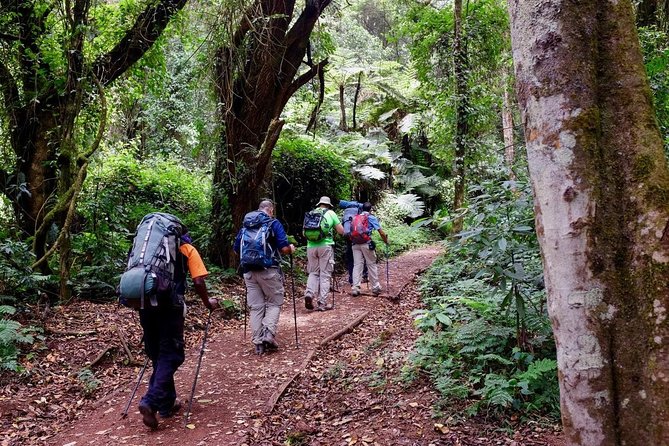
The first hike takes about three hours through montane forest. Keep an eye out for colobus monkeys, one of the route’s small rewards before the high mountain takes over. The walking is fairly short, but damp forest paths can make the opening day feel slower than the distance suggests.
Your tents should be ready when you reach camp, and the porters prepare drinking and washing water. That arrangement lets you focus on eating, resting, and getting used to the routine. You will want to pack your day bag carefully each morning because your larger luggage is handled by the support crew.
Day two: Moorland and the Shira plateau
Day two lasts about six and a half to seven hours as you leave the forest and enter heather moorland. The route crosses streams and opens onto the Shira plateau, ending at Shira Camp Two at roughly 3,840 meters.
This is one of the scenic high points of the climb. From camp, you can see toward the Western Breach and its glaciers. The wide, open setting feels very different from the enclosed forest of day one, and the high camp gives you an early taste of cold mountain nights.
Temperatures can drop below freezing here. The trip provides tents, sleeping mattresses, warm water for washing, meals, and camp furniture, but you still need proper cold-weather clothing for evenings and sleeping. A warm hat, gloves, and a dry layer for camp are not luxuries.
The day is long enough to test your pace. Walk slowly, drink regularly, and do not turn the first two days into a race. Your guide’s advice on speed and rest is central to conserving energy for the summit.
Day three: Lava Tower gives you the key altitude lesson
Day three moves into semi-desert terrain and covers about 15 kilometers in roughly seven hours. After around five hours of walking east, you reach Lava Tower at 4,630 meters, where packed lunch is served.
This is the route’s most important acclimatization day. You climb high, then descend to Barranco Camp at about 3,950 meters. That change gives your body useful exposure to altitude without forcing you to sleep at the highest point reached that day.
You may feel a headache or shortness of breath near Lava Tower. The itinerary allows an optional climb of the massive tower if weather permits, but the main value is reaching the altitude and then dropping down. Do not treat the optional climb as a test of courage. Your summit attempt is still ahead.
The descent to Barranco brings relief, but it is not effortless. Loose rock and tired legs can make downhill walking surprisingly hard. Take care of your knees and feet, and keep your packed lunch and water easy to reach.
More week long trips in Moshi & Kilimanjaro:
- Climbing Kilimanjaro through 7 days Machame Route
★ 5.0 · 151 reviews - 7 Days Kilimanjaro via Machame route affordable price
★ 5.0 · 110 reviews - Private Kilimanjaro Hike 7 Day Lemosho Route
★ 5.0 · 60 reviews - 7-Day Magical Tanzania Safari -Premium High End Package
★ 5.0 · 53 reviews
Day four: The Barranco Wall and Karanga Camp
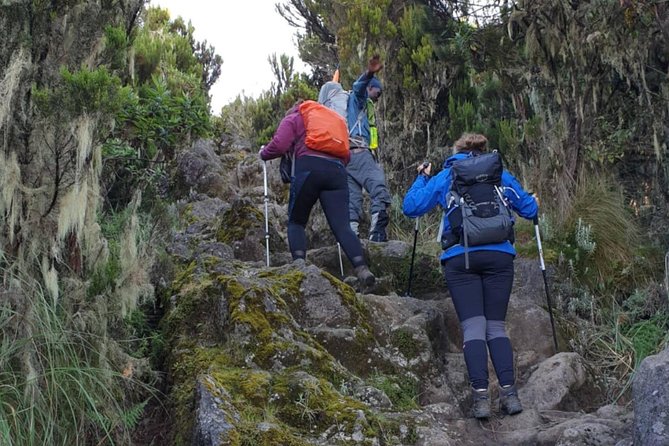
Day four is shorter, about four to five hours and approximately five kilometers. It begins with the Barranco Wall, which looks intimidating from below. The route is described as a Class 2 climb, so you should expect hands-on scrambling rather than technical rope work.
At the top, you can look across to Heim Glacier and see clouds far beneath you. This is a satisfying morning because the wall feels like a clear obstacle, and the reward arrives quickly. Move carefully and follow your guide’s instructions, especially where the path narrows or requires a handhold.
After the wall, the route winds through the Karanga Valley, with repeated ups and downs. Karanga Camp sits at around 3,950 meters, close to Barranco’s elevation. That makes this a shorter recovery and acclimatization day rather than a major gain in sleeping height.
I like this day because it breaks the climb into manageable pieces. The drawback is that short does not mean easy. You are already carrying fatigue, and the next two days put you near the summit zone.
Day five: Barafu Camp and the final rest
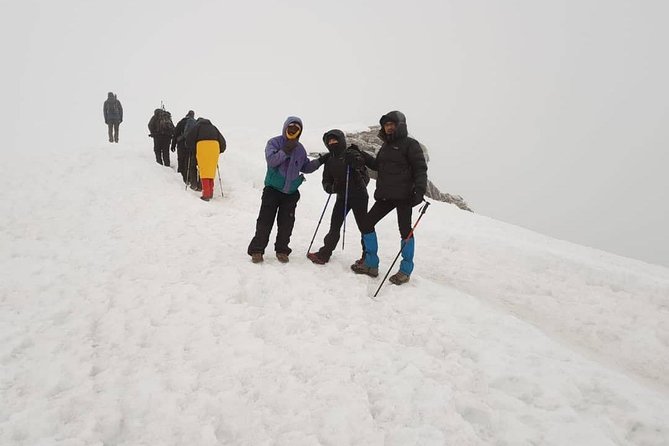
From Karanga, you walk about two to three hours and four kilometers to Barafu Camp at approximately 4,550 meters. The trail joins the Mweka Route, which you use for the final descent.
Barafu means ice in Swahili, and the camp sits on a rocky, exposed ridge. There is no accessible water at the camp, so this is the last water stop for the porters at Barafu Hut. The team carries what is needed for the camp, but you should be prepared for a more exposed and basic setting.
Tents can be affected by wind and rocks, and it is wise to learn the camp layout before darkness. Dinner is served early, then you try to sleep before the midnight wake-up. In practice, this rest may be broken by nerves, cold, altitude, or the simple difficulty of sleeping before such a demanding effort.
Keep your summit clothing, headlamp, gloves, water, and snacks organized before bed. You do not want to search through luggage at 11:30 p.m. when the guide wakes you for tea and biscuits.
Day six: Uhuru Peak, sunrise, and the long descent
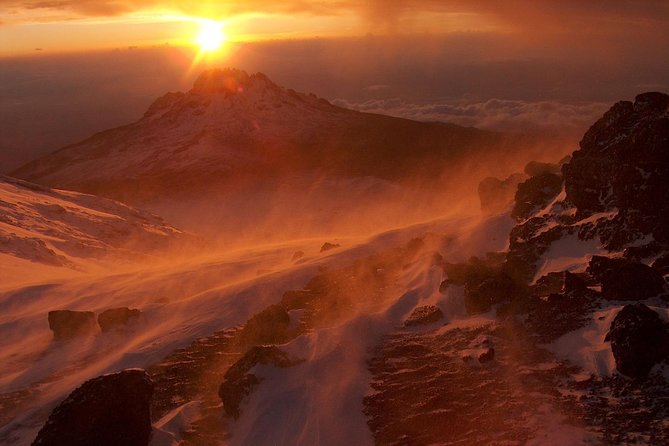
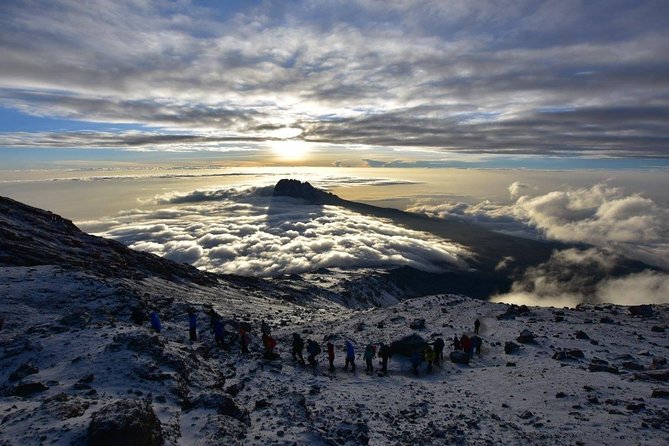
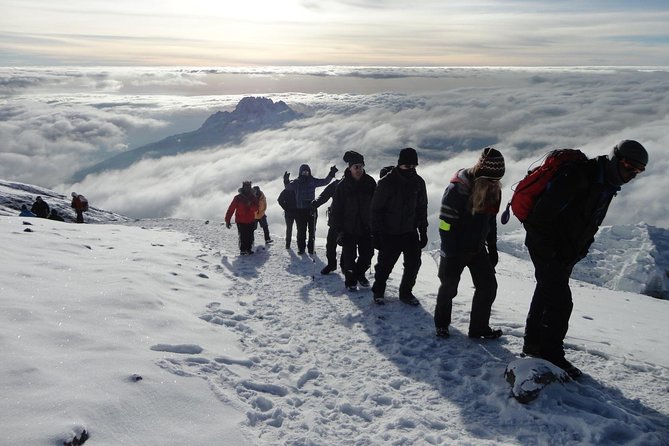
Summit day is the trip’s hardest part by a wide margin. You wake around 11:30 p.m. and begin climbing over stone scree toward Stella Point. The ascent takes about six hours for many people, though your pace depends on weather, altitude, and condition.
The trail heads northwest. The slow, dark climb is mentally tough because progress can feel small, and the air becomes thinner with every step. This is where the guide’s pacing and careful attention matter most. Emergency oxygen and a basic first aid kit are included for emergencies, but oxygen is not provided as a shortcut or summit aid.
At about 5,685 meters, Stella Point sits on the crater rim. Sunrise here can be a major emotional lift, but you still have roughly two hours to Uhuru Peak. The final section follows a snow-covered trail toward the summit at 5,895 meters, Africa’s highest point.
The route description allows about eight hours to reach Uhuru Peak, followed by seven to eight hours descending to Mweka. The total walking time is listed at 14 hours, with an approximate seven-kilometer ascent and 23-kilometer descent. That downhill distance deserves respect. Reaching the summit is only half of this day’s work.
After the summit, you descend to Mweka Camp. The surface changes underfoot, and tired legs increase the chance of slips. Keep your focus after the photographs. A slow, steady descent is safer and more comfortable than trying to finish quickly.
Day seven: Mweka Trail, certificates, and the finish
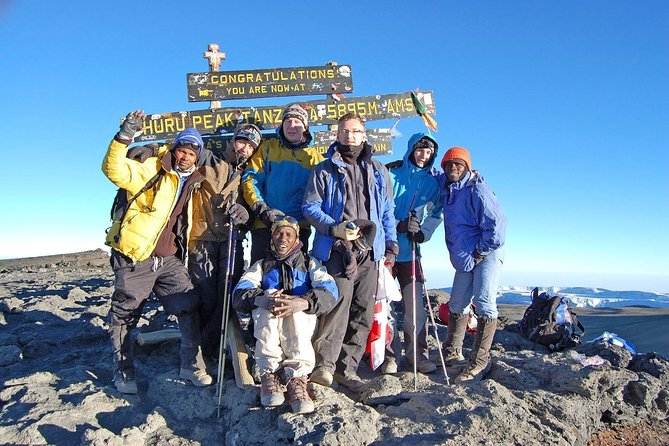
The final day begins with breakfast and a mountain celebration of dancing and singing. You also present tips to the guides, assistant guides, cook or cooks, and porters. Tipping is not included in the advertised price, so bring a plan for this important part of the mountain team’s compensation.
From camp, the descent to Mweka Gate takes about three hours through forest and covers approximately 15 kilometers according to the schedule. At the gate, you sign your name to receive a certificate. Reaching Stella Point earns a green certificate, while Uhuru Peak earns a gold certificate.
After the gate, the program includes a further one-hour descent into Mweka village, about three kilometers. The finish is practical rather than luxurious, but the certificate and team celebration give the week a clear ending.
What the $2,676.39 price really covers
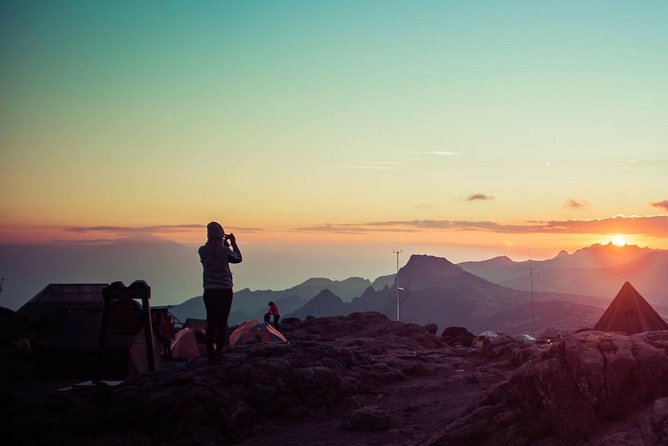
At $2,676.39 per person, this is not a cheap holiday, but much of the cost is tied to the support needed on Kilimanjaro. You receive:
- Kilimanjaro airport to Moshi transfer and return transfer
- Park fees and taxes
- Qualified mountain guide and assistant guides
- Porters and cook, including their wages
- Tents, mattresses, camp chairs, and tables
- Drinking water and hot water for daily washing
- Seven lunches, six breakfasts, and six dinners
- Emergency oxygen and a basic first aid kit
That package makes the price easier to judge. You are not simply paying for a guide to walk beside you. The fee supports a full camp operation, food preparation, transport, water handling, and a larger mountain crew.
You still need to budget for flights, visas, travel and health insurance, personal gear, medicine, water-purifying tablets, snacks, and drinks not listed. A portable toilet is optional but highly recommended, and it costs extra. Yellow fever vaccination is stated as compulsory if traveling to Tanzania, so check your health and entry requirements well before departure.
The airport transfers are a useful inclusion if you are arriving through Kilimanjaro International Airport and staying in Moshi. The package specifically covers transfers to Moshi and back to the airport, not every transfer connected with a longer Tanzania trip.
The support crew and private format
This is a private climb, so only your own group participates. That gives you more control over pace and conversation than a large shared departure, although the mountain schedule still limits how much you can change.
Guides Isa and Baraka are named in the supplied trip feedback, and the team has been praised for careful organization, medical checks, extra fresh food, and strong attention to safety. The crew also received praise for good meals and for making all four members of one group to the summit.
Those details matter because mountain service is not just about comfort. Regular checks can help identify altitude trouble early, while a cook who manages hot meals gives you a better chance of eating enough during a demanding week. Your guide remains the key person for decisions about pace, weather, and turning around.
A good support system cannot remove altitude sickness or guarantee the summit. Your own fitness, acclimatization response, and willingness to follow instructions still decide much of the outcome.
What to pack and what to arrange
Personal hiking and trekking gear is not included. You can rent equipment from stores in Moshi, but the supplied details do not specify which items are available or what rental fees will be. Ask the operator for a current gear list before you arrive.
At minimum, your planning should account for wet forest conditions, freezing camps, wind at Barafu, and cold summit hours. You also need personal medicine, snacks, and water-purifying tablets if you choose to use them. Drinking water is supplied, but personal treatment supplies are not.
Keep a small day bag organized around the walking day. Your exact baggage arrangements are not specified, so ask how much your porter-carried luggage may weigh and what you can access at camp. This is especially important before summit night.
Who should book this climb
I would choose this route if you care about scenery, want a private group, and prefer seven days rather than a rushed short itinerary. The gradual route, the Lava Tower to Barranco profile, and the shorter fourth day give you a sensible structure for acclimatization.
It also suits people who value an organized camp service. Meals, tents, water, a cook, porters, guides, and airport transfers are already built into the package. That reduces the number of arrangements you must make yourself.
I would hesitate if you dislike camping, cold nights, rough vehicle tracks, long walking days, or basic mountain facilities. Summit day is the real test, and the 23-kilometer descent can be as tiring as the climb. You should also be comfortable paying extra for gear, insurance, visas, snacks, and the recommended portable toilet.
The experience is listed as suitable for most participants, but that should not be read as a promise that the summit is easy. A medical check and honest preparation are sensible before booking any high-altitude climb.
Booking and cancellation details
Confirmation is provided at booking, and the activity operates Monday through Sunday during the stated operating period. You can cancel for a full refund if you do so at least three full days before the local start time. Cancellations or changes made inside that window are not accepted for a refund.
Because this is a private activity, confirm your group size, expected gear arrangements, pickup time, and guide assignment before departure. If you want to request Isa or Baraka, ask the operator directly, since guide assignment is not guaranteed in the supplied details.
Should you book the 7-day Lemosho climb?
Book it if your main goal is a well-supported Kilimanjaro summit attempt with strong scenery and a quieter opening route. The price is reasonable for the number of services included, especially the crew, meals, camping equipment, park costs, water, and airport transfers.
Do not book it simply because seven days sounds comfortable. The summit day remains extremely long, and personal gear, insurance, visas, snacks, tipping, and optional toilet hire add to the final bill. If you accept those limits and prepare properly, this Lemosho plan gives you a clear, varied route to Uhuru Peak with a practical support structure.
FAQ
Where does the Kilimanjaro climb begin?
The experience is based in Moshi, Tanzania. Pickup is offered, and the package includes return transfers between Kilimanjaro Airport and Moshi.
How long is the Lemosho climb?
The climb lasts approximately seven days.
Is this a private tour?
Yes. Only your own group participates in the activity.
Is airport transportation included?
Yes. Return transfers from Kilimanjaro Airport to Moshi and from Moshi back to Kilimanjaro Airport are included.
What is the highest point reached?
The summit is Uhuru Peak at 5,895 meters. The route also reaches Stella Point at 5,685 meters and Lava Tower at 4,630 meters.
How long is summit day?
The summit day is listed at about 14 hours, including approximately eight hours to Uhuru Peak and seven to eight hours descending to Mweka.
Are meals included?
Yes. The package includes six breakfasts, six dinners, and seven lunches.
Is camping equipment provided?
Yes. Tents, sleeping mattresses, camp chairs, and tables are included. Personal hiking and trekking gear is not included.
Is emergency oxygen available?
Yes. Emergency oxygen and a basic first aid kit are included. The oxygen is for emergencies only and is not provided as summit assistance.
Can I cancel for a full refund?
Yes, if you cancel at least three full days before the experience start time, based on local time. Cancellations or changes made less than three full days before the start are not refunded or accepted.
Newly listed around Moshi & Kilimanjaro
- Climb Mount Kilimanjaro: 7 Days Machame Route★ 5.0 · 3 reviews
- 6 Days Mount Kilimanjaro Climbing via Rongai Route★ 5.0 · 3 reviews
- Explore 1 day Ngorongoro Crater Budget Group Safari from Arusha★ 5.0 · 3 reviews
- Mt. Kilimanjaro Day Hiking★ 5.0 · 3 reviews
- Chemka (Kikuletwa) Hot Springs, Tanzania★ 5.0 · 3 reviews
- Guided City tour of Moshi★ 4.3 · 3 reviews
- 8 Day Tanzania Family Safari★ 5.0 · 3 reviews
- Serengeti Safari with Sirikwa Travel★ 5.0 · 3 reviews
Kilimanjaro Climbs, compared.








Browse the lists this tour appears in