
Reviewed · KILIMANJARO CLIMBS
5 Days Marangu Route Kilimanjaro Climbing
The Marangu Route gives you the most straightforward way up Kilimanjaro, with sleeping huts at every campsite instead of tents. You walk from coffee and banana country into high moorland, a stark volcanic saddle, and finally the summit zone, all on one demanding five-day schedule.
I like the practical comforts here: a bed, sponge mattress, pillow, and solar light at camp. I also like the all-inclusive setup, with park and rescue fees, mountain meals, purified water, airport transfers, and an experienced guide team covered in the $1,730 price.
The tradeoff is the short schedule. Five days gives you less time to adjust to altitude than the six-day option, which adds a rest and acclimatization day at Horombo. You need a moderate fitness level, and summit day can run for 11 to 15 hours.
Key points to know before booking
- Huts replace tents: You sleep in communal mountain huts with bunks, mattresses, pillows, and solar lighting.
- The summit attempt starts around 1 a.m.: Expect a long night and day of walking from Kibo Hut to the summit area and back to Horombo.
- The five-day pace is quick: A six-day version is available with extra time at Horombo or a climb toward Mawenzi.
- Gasto leads a seasoned team: The company identifies Gasto, also called the Kili King, as having climbed Kilimanjaro about 250 times.
- Most major mountain costs are included: Park fees, rescue fees, guides, meals, huts, drinking water, and airport transfers are part of the package.
- You can stop at Gillman’s Point: Strong climbers can continue around the crater rim to Uhuru Peak, at 5,896 meters.
Why the Marangu Route feels different
Kilimanjaro is not a technical climb in the mountaineering sense, but it is a serious high-altitude walk. The Marangu Route is often called the Coca Cola Route because it is the most established and direct path to the summit. That nickname can make it sound easy. It is not.
What makes it easier than the other routes is the infrastructure and route profile. You sleep indoors each night, rather than carrying a tent or sleeping on the ground. The path is also generally more direct, with a steady climb through several distinct vegetation zones.
That comfort matters. After a wet forest walk or a long summit night, a bunk and mattress feel like a luxury. The huts are communal, so you should expect shared sleeping space rather than a private room. This is a practical mountain arrangement, not a lodge stay.
The route also gives you a clear sense of Kilimanjaro’s changing character. On the first day, you are among trees, birds, monkeys, coffee, and banana plantations. By the third day, you are crossing a high volcanic desert between Mawenzi and Kibo. That fast change in scenery is one of the strongest reasons to choose this route.
More Kilimanjaro routes:
- 8-Day Small-group Lemosho Kilimanjaro Summit Trekking
★ 5.0 · 186 reviews - 7-Day Machame Kilimanjaro Summit Tour from Arusha
★ 5.0 · 125 reviews - Private Full Day Hiking Experience to Marangu Route
★ 5.0 · 61 reviews
Day 1: Marangu Gate to Mandara Hut
The day begins with a drive from Moshi or Arusha to the Kilimanjaro National Park gate at about 1,830 meters. The gate sits near Marangu village, where small coffee and banana plantations add a local touch before the mountain path begins.
Park entry formalities come first. Then you walk into attractive forest on a route that takes about three to five hours to Mandara Hut, at 2,700 meters. The day is relatively short by Kilimanjaro standards, which gives you a useful introduction to the pace.
The forest is the highlight. It feels cool and green, with birdlife around the huts and a chance of seeing monkeys. You may find the path steeper at the start, but the main challenge is getting used to walking steadily without burning too much energy.
At Mandara, you can rest or make the short outing toward Maundi Crater. The crater area offers a worthwhile afternoon option if you still have energy. If you are tired, staying near the hut and enjoying the forest is the sensible choice.
Your overnight stay is in a mountain hut with communal bunks, a mattress, pillow, and solar lighting. Meals are included, and the company also provides a quality mess tent with tables and chairs. That tent gives the group a separate place to eat and organize itself, even though sleeping is in the huts.
Day 2: Mandara Hut to Horombo Hut
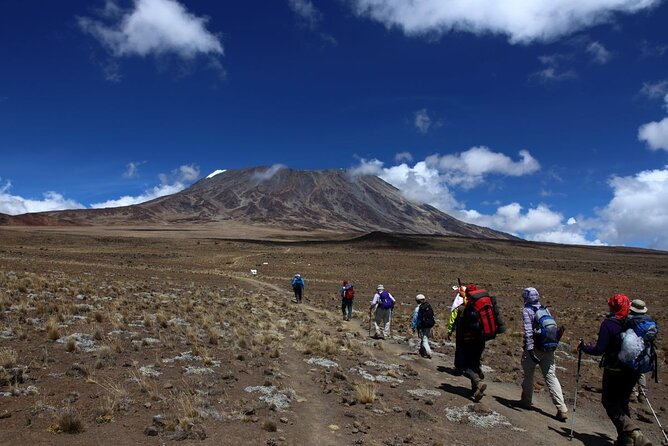
Day two covers about four to six hours and takes you from forest into grassy moorland. The first section remains steep, but the trees gradually thin and open views appear. In clear weather, you can see Kibo and Mawenzi, the two major volcanic peaks of Kilimanjaro.
The moorland zone has giant heather and occasional giant groundsel plants. This is one of the most memorable sections of the route because the vegetation begins to look unusual and oversized. The path climbs steadily to Horombo Hut at 3,720 meters.
Horombo is an important stop. You are now high enough that altitude can affect your sleep, appetite, breathing, and walking pace. The itinerary calls for roughly six hours on the mountain, but the useful point is not speed. Walk slowly, drink the purified water provided, and tell your guide if you feel unwell.
The views around Horombo can be excellent. Sunsets and sunrises often light up the peaks, and the hut site can feel far above the clouds. This is also the place where the six-day option gains its value. An extra day at Horombo gives your body more time to adjust before the higher camps.
On the five-day trip, you continue upward the next day. That saves time and may suit someone with a tight schedule, but it leaves less room for altitude adjustment. I would treat the five-day version as a demanding itinerary, not the default choice for every first-time climber.
Day 3: Horombo Hut to Kibo Hut
The third day is quieter and more severe. You climb gradually toward the Saddle, the broad volcanic area between Mawenzi and Kibo. The ground changes to loose scree and the vegetation fades away.
The walk takes about four to five hours, with Kibo Hut at 4,700 meters as the goal. Reaching camp around midday leaves the afternoon for rest, food, and mental preparation. That spare time is important because the summit attempt begins at about 1 a.m.
Kibo Hut sits at the base of Kibo’s crater wall. There is little to distract you here, which is useful. Eat what you can, organize your clothing and personal climbing gear, and try to sleep early. You are unlikely to get a long night of rest before the summit push.
The company supplies meals while you are on the mountain, including breakfast, lunch, and dinner. Fresh, hot meals were a repeated strength in the company’s service history, and that is not a small matter at altitude. Good food helps you keep moving, though you should still bring any personal snacks you know you can tolerate.
The company does not include personal climbing gear. You need to arrange that yourself. The supplied information does not specify a gear rental service, so confirm what is available before departure rather than waiting until you reach Tanzania.
More five day trips in Arusha:
- 5 Days Group Camping Safari
★ 5.0 · 730 reviews - 5-Day Highlights mid-Range Crater, Serengeti, Tarangire
★ 5.0 · 296 reviews - 5 Days Camping Tarangire, Serengeti & Ngorongoro crater & Visiting Maasai
★ 5.0 · 229 reviews - Tanzania Simba Safari – 5 Days
★ 5.0 · 217 reviews
Day 4: The 1 a.m. summit push
This is the hard day. You start by torchlight at roughly 1 a.m., aiming to reach Gillman’s Point by sunrise. The climb begins steeply over loose volcanic scree, with zigzagging sections that help reduce the direct angle.
A slow, steady pace is the whole game. From Kibo Hut to Gillman’s Point, the climb can take five or six hours. Gillman’s Point sits at 5,685 meters on the crater rim, where you can stop, rest, and watch the sunrise.
The supplied schedule describes the full day from Kibo Hut to Gillman’s Point as 11 to 15 hours, even though each listed stop is shown as about six hours. That longer figure is the one you should take seriously. The summit attempt includes the ascent, time at the high points, and a long descent.
From Gillman’s Point, climbers who still feel strong can make the roughly three-hour round trip along the crater rim to Uhuru Peak. At 5,896 meters, Uhuru is the highest point in Africa. The route passes near glaciers that still occupy much of the summit area.
You should not treat Uhuru as automatic. Gillman’s Point is already an immense achievement, and altitude can change your plans quickly. A professional guide will help assess how you are doing, but you also need to be honest about symptoms and energy. The mountain is not impressed by stubbornness.
After the crater rim, you descend to Kibo Hut and continue to Horombo Hut for the night. The descent from the summit area can feel surprisingly fast, but it is still hard on tired legs. Reaching Horombo is a major relief because you return to a lower altitude and a proper hut.
This is also the day when the five-day schedule shows its limits. You do not get a spare acclimatization day, and the ascent comes after only one night at Kibo. If you are choosing between five and six days and have the time, the additional day at Horombo is worth serious thought.
Day 5: Horombo Hut back to the park gate
The final day retraces the route through moorland to Mandara Hut, then continues down through forest to the national park gate. Walking time is about five to six hours.
The change in scenery is striking after the summit day. At high altitude, you have crossed scree and bare volcanic ground. Back in the forest, the air feels fuller, the plants return, and the path becomes greener and more familiar.
This descent is not merely a transfer. It gives you a chance to notice how far you have come in only five days. You finish at the gate and return toward Moshi or Arusha town.
The tour offers pickup, airport transfers, and a 7:30 a.m. start time. Since the mountain itinerary itself begins with transport to the gate, confirm the exact pickup arrangement and location when booking. The experience is private, meaning only your group participates, but the huts themselves are communal.
What the $1,730 price covers
At $1,730 per person, this is not a bare-bones mountain permit. The package includes overnight hut stays, professional mountain guides, park fees, rescue fees, all meals on the mountain, purified drinking water, airport transfers, and the mess tent with tables and chairs.
Those inclusions add up. Park and rescue charges are unavoidable costs of a Kilimanjaro climb, while food, water, transport, and guiding would be difficult to arrange independently. The hut accommodation also removes the need for a tent and sleeping setup.
The value depends on how much support you want. If you are comparing only the headline price, a cheaper package may look attractive. Compare what it includes before deciding. A low figure that leaves out park fees, rescue fees, meals, transfers, or guide support may not remain low for long.
Tips are not included, and neither is your personal climbing gear. Tanzania visa costs are also separate. Build those expenses into your budget.
The company’s service profile is strongest around its guides and food. Gasto is described as having climbed Kilimanjaro around 250 times, and the guide team has been praised for taking care of safety, carrying group luggage, preparing meals, and keeping spirits up. You should still confirm who will lead your specific departure and how porter responsibilities are handled.
Food, water, huts, and daily comfort
You receive breakfast, lunch, and dinner during the five mountain days. Meals are prepared and served through the mountain support team, with fresh, hot food highlighted as part of the experience.
The company provides clean, purified drinking water. That is useful, but you should still bring a personal bottle or hydration system suited to long walking days. The supplied information does not specify bottle size or refill frequency, so ask before you leave.
The huts have communal sleeping rooms, bunks, sponge mattresses, pillows, and solar lights. These are simple facilities, but they are more comfortable than sleeping on the ground. Solar lighting is especially handy when you are organizing gear before the 1 a.m. start.
A mess tent with tables and chairs gives you a dining area away from the sleeping bunks. It also creates a place to sit, eat, and prepare for the next stage. Do not expect hotel service or private bathrooms from the details provided. This remains a mountain climb.
Who should choose this five-day climb
This trip suits you if you want a direct Kilimanjaro route, prefer huts to tents, and have only five days for the mountain. It also suits climbers who value a private group and want major logistical costs bundled into one price.
You should have a moderate level of physical fitness. The daily walks may look manageable on paper, but the summit night changes the calculation. The final ascent begins at 1 a.m. and may run into a full day of walking, with a possible extension to Uhuru Peak.
The six-day option is the better fit if altitude concerns you or if you want a gentler schedule. The extra day can be spent resting at Horombo or walking toward Mawenzi. The supplied information does not give a separate six-day price, so ask the operator for the current cost.
This is not the best choice if you want private rooms, a relaxed summit schedule, or a guarantee of reaching Uhuru Peak. The huts are communal, the route is busy in character, and five days leaves limited time for adjustment.
Booking, cancellations, and practical checks
Confirmation is provided at booking. Pickup is offered, the start time is 7:30 a.m., and the experience is near public transportation. The activity is private for your group, though you should expect shared hut facilities on the mountain.
Free cancellation applies if you cancel at least 24 hours before the local start time. Cancellations within 24 hours are not refunded, and changes inside that window are not accepted.
Before paying, I would confirm four things: the exact pickup point, the guide assigned to your group, the personal gear you need to bring, and the separate costs for tips and the Tanzania visa. These questions are simple, but clear answers make the start of a demanding climb less stressful.
Should you book the Marangu Route in five days?
Book it if you want hut accommodation, a private group, and a well-supported route at a price that includes most of the major mountain expenses. The forest, moorland, Saddle, crater rim, and summit attempt give you a remarkably varied five days.
Think twice if this is your first high-altitude trek and you can spare an extra day. The six-day Marangu schedule offers better acclimatization, and that may be more valuable than saving a day.
The strongest reasons to choose Mountain Warriors are the experienced guide leadership associated with Gasto, the included logistics, and the attention to hot meals and support on the mountain. The main caution is not the route itself. It is the compressed schedule. Go in ready for a serious summit day, and choose the six-day version if your body needs more time.
FAQ
How long is the Marangu Route climbing experience?
The mountain experience lasts approximately five days. Walking times range from about three to six hours on the first three days, five to six hours on the final descent, and 11 to 15 hours for the summit day.
Where does the tour start?
The listed meeting time is 7:30 a.m. Pickup is offered, and the climb begins with transport from Moshi or Arusha toward the Kilimanjaro National Park gate.
Where do I sleep on the mountain?
You sleep in mountain huts at each campsite. The huts have communal sleeping areas, bunk beds, sponge mattresses, pillows, and solar lights.
Is this a private tour?
Yes. Only your group participates in the private tour or activity. Sleeping huts remain communal mountain facilities.
Are meals included?
Yes. Breakfast, lunch, and dinner are included for the five days on the mountain. Purified drinking water is also provided.
Are park and rescue fees included?
Yes. The price includes all park fees and rescue fees, along with professional mountain guides.
Is personal climbing gear included?
No. Personal climbing gear is not included. Tips and the Tanzania visa are also separate costs.
Can I cancel for a full refund?
Yes, if you cancel at least 24 hours before the experience start time. Cancellations or changes made less than 24 hours before the local start time are not accepted for a refund.
Newly listed around Arusha
- 5-Day Private Safari Tour in Tanzania’s Wildlife★ 5.0 · 3 reviews
- 3 Days private safari Tarangire ,Ngorongroro crater &Manyara★ 5.0 · 3 reviews
- 3 Day Sharing Safari – Manyara, Ngorongoro Crater and Tarangire National Parks★ 5.0 · 3 reviews
- Tarangire National Park Day Trip★ 5.0 · 3 reviews
- 2 Days Tarangire and Ngorongoro Crater Tour★ 5.0 · 3 reviews
- 6 -Day Tarangire, Manyara, Serengeti & Ngorongoro★ 5.0 · 3 reviews
- 5 Days Group Camping Safari★ 4.7 · 3 reviews
- 4 Days Tanzania Safari★ 4.5 · 3 reviews
Kilimanjaro Climbs, compared.








Browse the lists this tour appears in