
Reviewed · MOSHI & KILIMANJARO TOURS
Kilimanjaro 360° 9 days Tour
Cycling around Mount Kilimanjaro gives you a side of Tanzania that a standard safari or summit climb cannot. Over nine days, you pedal from Chagga coffee country to Maasai plains, wildlife corridors, mountain forest, Lake Chala, and the high Shira Plateau, with Kenya often spread out beyond the road. The route is the real attraction, not simply the mountain at the center.
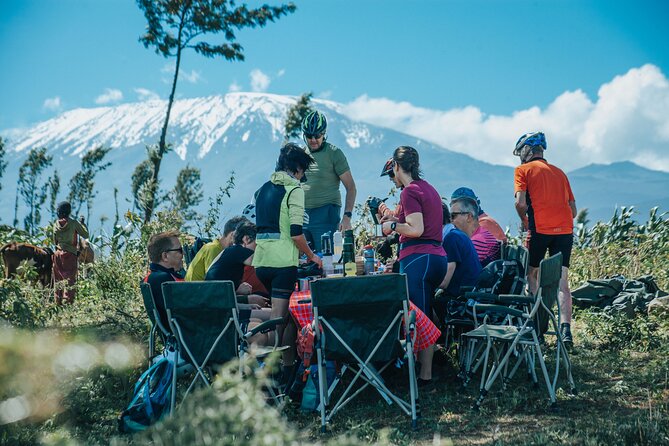
I like the close contact with local life, especially the overnight stay in a traditional Maasai hut at Olpopongi. I also like the variety: one day brings acacia woodland and open plains, the next brings muddy forest tracks or a high rocky climb with Kilimanjaro’s snowy Kibo peak in view. The main caution is fitness. This is a serious mountain-bike trip, not a gentle sightseeing ride, and some roads are steep, rough, and muddy.
Key points at a glance
- 3,700-meter Shira Plateau climb: The toughest day brings a hard uphill ride to a helipad with views toward Kibo and Maasai country.
- A genuine cross-cultural route: You pass through Chagga villages and plantations, Maasai settlements, and communities near the Kenyan border.
- Wildlife corridor riding: The Sinya and Ngasurai plains connect Kenya’s Amboseli area with Tanzania’s Enduimet wildlife zone.
- A useful support vehicle: A vehicle follows the ride, an important comfort on long, remote sections.
- Seven nights under tour arrangements: Accommodation ranges from a Maasai hut and campsites to Snow Cap Cottages and a Moshi hotel.
- A private, flexible format: Only your group takes part, and One Bike Tanzania has adapted routes for riders seeking shorter or harder challenges.
Starting in Moshi with One Bike Tanzania
Your trip begins at the One Bike Shop on Mailimoja Road in Moshi. Pickup is offered from Kilimanjaro Airport or another arrival point, and a One Bike guide takes you to your hotel. The first day is deliberately easy, giving you time to rest, receive trip information, prepare your bike, and explore Moshi if energy allows.
That quiet start matters. You are not expected to arrive and immediately attack a mountain road. The tour is organized as a private activity, so your group does not have to match the pace of strangers. This also gives the operator room to adjust the plan. One Bike has adapted the full circuit for riders who wanted a five-day version, a two-day challenge, or a route with some side adventures removed.
The guide team has earned praise for being flexible and professional before departure. That is worth noting here because the route is demanding and conditions can affect how much you ride each day. No individual guide names are provided, so you should confirm who will lead your group when booking.
A few more Moshi & Kilimanjaro days to compare
- Kilimanjaro climb by Lemosho Route (7-day)
★ 5.0 · 651 reviews - Safari Serengeti And Ngorongoro
★ 5.0 · 288 reviews - Kilimanjaro climb, Machame Route (7-day)
★ 5.0 · 262 reviews
Day 2: From Machame Gate to Maasai Country
After breakfast, a transfer takes you to Machame Gate, the starting point for the cycling route. The first roads are dirty and gravelly, leading through rain forest, banana plots, coffee plantations, and Chagga homes.
This opening section quickly shows why the trip is different from a road-based Kilimanjaro circuit. You are moving through working agricultural communities, not simply looking at scenery from a vehicle. The Chagga people are closely associated with the slopes of Kilimanjaro, and the route gives you a sense of how the lower mountain is lived in and farmed.
As you head west, the forest gives way to more open plains and acacia woodland. You pass Ngabobo and Tinga Tinga villages before reaching the edge of the national park and crossing routes used by animals. The cultural shift is striking: Chagga farms and mountain greenery give way to Maasai country, with wider views and a drier feel.
The night at Olpopongi Maasai village is one of the most distinctive parts of the tour. You sleep in a traditional Maasai hut, rather than a conventional hotel. That means less comfort and more character. If you want a polished room every night, this may not suit you. If you value a direct connection with local culture, it is a strong reason to choose this route.
Day 3: Open Plains and a Wildlife Corridor
Day three takes you across the Sinya and Ngasurai open plains. These areas form a wildlife corridor between Amboseli National Park in Kenya and the Enduimet wildlife management area in Tanzania. The riding is fully off-road, with no tarmac to smooth out the route.
The appeal here is space. On a clear day, you may see Mount Kilimanjaro, Mount Meru, and Ol Doinyo Lengai. The Kenyan border country adds another layer to the ride, since you are not only circling a famous mountain but also moving through a region shared by wildlife, pastoral communities, and two countries.
You finish at Simba Farm campsite. The route is remote and exposed, so the support vehicle is more than a nice extra. It provides practical backup on a day when heat, rough ground, and distance can add up. Water and snacks are included, but you should still treat hydration and pacing as serious parts of the trip.
Day 4: The Hard Climb to 3,700 Meters
Day four is the physical test. You leave the lower plains and climb a dirty, rocky road toward the Shira Plateau, one of Kilimanjaro’s three major volcanic peaks. The route reaches a helipad at 3,700 meters.
This is not a short photo stop reached by easy road. You are climbing by mountain bike on loose and uneven ground, and the altitude adds another concern. Strong physical fitness is required, and you should expect to work hard. The tour does not present this as an easy ride, and it should not be treated as one.
The reward is a fine high-mountain view. On one side, you can see Kilimanjaro’s upper slopes and Kibo peak, often capped with snow. On the other, Maasai country stretches outward below. After a rest, the return to Simba Farm campsite is much easier because it is mostly downhill.
This day is also where the private format helps. A group ride can feel awkward if one person is struggling while another wants to push ahead. With only your party taking part and a support vehicle following, the guide can make practical decisions about breaks and pacing.
A change of scene while you are in Moshi & Kilimanjaro:
- Kilimanjaro Climbing Lemosho Route 8 Days.
★ 5.0 · 186 reviews - Climbing Kilimanjaro – Machame Route
★ 5.0 · 170 reviews - Climbing Kilimanjaro through 7 days Machame Route
★ 5.0 · 151 reviews - Kilimanjaro climb, Lemosho Route (8-day)
★ 5.0 · 148 reviews
Day 5: Villages Along the Kenyan Border
After the Shira climb, the route moves around the northeastern side of Kilimanjaro. You ride through villages and farmland before reaching Nalemoru, the entry point for the Rongai trek route.
Nalemoru sits near the Rongai forest, a conservation area with many tree species. The change from high, open mountain roads to cultivated village country and forest edges gives the circuit another useful contrast. You are seeing Kilimanjaro from a side that many summit visitors never reach.
The night is at Snow Cap Cottages in Rongai Village. After the Maasai hut and campsite nights, this provides a more conventional stop. The itinerary does not give detailed room standards, so you should think of the accommodation as practical rather than luxurious.
Day 6: A Restful Ride to Lake Chala
Day six is designed as a calmer day after the difficult mountain sections. The route drops downhill toward Lake Chala, a striking caldera lake fed by underground springs from Kilimanjaro.
The lake gives you time to slow down. You can enjoy the water, surrounding forest, plant life, and birds instead of spending the entire day focused on the next climb. The combination of a smoother descent and a lakeside overnight makes this a sensible break in the middle of the circuit.
You spend the night by the lake. The exact accommodation style is not specified, so ask One Bike what is planned for your dates. The important point is that the stop is built around rest and nature, not another major cycling challenge.
Day 7: Mud, Forest, and More Climbing
The easier pace does not last. Day seven returns to dirt roads, occasional mud, and repeated uphill and downhill sections. The route enters dense forest, where the focus shifts from huge mountain views to close-up plants, trees, and forest life.
This may be one of the most enjoyable days for riders who prefer technical variety to long straight roads. It is also a day when weather can make a major difference. Dry dirt and muddy tracks are very different riding surfaces, and the cancellation policy notes that poor weather can affect the activity.
The day ends at Kahawa Shambani campsite in Uru village. You should expect a basic overnight rather than a resort-style stay. The campsite setting fits the tour’s practical, outdoors-focused character, but you will want to be comfortable with simple accommodation before paying for a nine-day mountain trip.
Day 8: Completing the Circuit and Returning to Moshi
The final cycling day climbs toward Mweka Gate. After circling the mountain, you turn onto tarmac for an easier ride back to Moshi.
That last road section is welcome. By this point, your legs have dealt with gravel, rocks, mud, repeated hills, and altitude. The smooth road lets you finish the route without another long technical section. Back in Moshi, dinner and an evening in town provide a chance to relax or see some nightlife before your final night at the hotel.
The tour’s shape works well: a gentle arrival day, varied riding around the mountain, a major high point on day four, a calmer lake day, then a final push and easy return. It is not a nonstop endurance race, but you should not confuse the rest day with an easy overall holiday.
Day 9: Rest, Airport Transfer, and the Practical Finish
The final day is for sleeping, recovering, and leaving Moshi. A transfer from the hotel to the airport or another departure point is organized for you.
The listed inclusions cover a mountain bike, helmet, water, snacks, support vehicle, nine lunches, eight breakfasts, and seven dinners. The meal pattern suggests that food is supplied through most of the cycling program, while the Moshi arrival and departure days may not include every meal.
Flights, insurance, and airport or departure taxes are not included. You should arrange suitable insurance before going, particularly because this is a strenuous off-road activity at high altitude. A mobile ticket is offered, and booking confirmation is received at the time of reservation.
What $2,499 Buys You
At $2,499 per person, this is not a cheap bike rental. The price covers nine days of guiding, transfers, a mountain bike and helmet, meals, accommodation arrangements, a following support vehicle, and a private itinerary around a major African mountain.
The value depends on how you would otherwise build the trip. If you only want a half-day ride near Moshi, this tour is excessive. If you want to circle Kilimanjaro without arranging transport, food, route planning, camps, village stays, and mountain support yourself, the price is easier to justify.
I also see value in the route’s variety. You are not paying for nine days of similar road riding. The program links mountain forest, farmland, Maasai country, wildlife corridors, a 3,700-meter climb, Lake Chala, and a return to Moshi. The private format adds flexibility, and One Bike has shown it can modify the schedule for different ambitions.
Still, check what type of bike will be supplied and ask about accommodation details before booking. The equipment list confirms a mountain bike and helmet, but it does not specify bike models, frame sizes, repair equipment, or sleeping arrangements at each campsite. Those details matter on a ride of this length.
Who Will Enjoy This Ride Most
You should consider this tour if you already ride regularly and want a physical challenge with cultural and natural variety. It suits people who prefer gravel roads, basic camps, local food, and changing scenery to polished hotel-to-hotel cycling.
It also works well for a private group with a shared goal. The route can be adapted, and a support vehicle follows the ride. That makes it more approachable for a group with mixed confidence, though everyone still needs a strong fitness level.
You should think twice if you dislike rough roads, steep climbs, mud, outdoor sleeping, or uncertain weather. The route includes long uphill sections and reaches 3,700 meters. A desire to see Kilimanjaro is not enough by itself. You need to be ready to pedal.
The strongest feature is the combination of challenge and access. You see villages, farms, forests, and open plains at bicycle speed. That gives you time to notice daily life and changes in vegetation that pass too quickly from a vehicle.
Booking, Cancellation, and Final Advice
Free cancellation is available up to 24 hours before the start time for a full refund. Changes or cancellations inside that window are not accepted or refunded. Since weather can cancel the ride, poor conditions may lead to a new date or a full refund.
I would book this trip if I wanted an active way to experience Kilimanjaro without climbing to the summit. The Maasai hut, wildlife corridor, Shira Plateau climb, Lake Chala stop, and private support vehicle give it a clear identity.
I would not book it as a casual holiday or a first-ever cycling trip. Ask One Bike Tanzania about bike sizing, repair support, the exact accommodation plan, and the expected daily distances before you commit. If the answers fit your ability and comfort level, this is a memorable, demanding circuit with far more character than a simple mountain photo stop.
FAQ
Where does the Kilimanjaro 360° cycling tour start?
The meeting point is One Bike Shop on Mailimoja Road in Moshi, Tanzania.
Can I be picked up from Kilimanjaro Airport?
Yes. Pickup is offered from Kilimanjaro Airport or another arrival point, followed by a transfer to your Moshi hotel.
How long is the tour?
The tour lasts approximately nine days, including arrival, eight cycling or touring days, and departure arrangements.
Is the tour private?
Yes. Only your group takes part in the activity.
What level of fitness do I need?
You should have a strong physical fitness level. The route includes steep climbs, rocky roads, mud, repeated hills, and a climb to 3,700 meters.
Is a mountain bike provided?
Yes. A mountain bike and helmet are included.
Is there a support vehicle?
Yes. A supporting vehicle follows the cycling route.
Are meals included?
Yes. The package includes nine lunches, eight breakfasts, and seven dinners, along with water and snacks.
What is not included in the price?
Flights, insurance, and airport or departure taxes are not included.
What happens if bad weather cancels the tour?
If poor weather causes cancellation, you are offered another date or a full refund. For a standard full refund, you must cancel at least 24 hours before the experience start time.
Newly listed around Moshi & Kilimanjaro
- Climb Mount Kilimanjaro: 7 Days Machame Route★ 5.0 · 3 reviews
- 6 Days Mount Kilimanjaro Climbing via Rongai Route★ 5.0 · 3 reviews
- Explore 1 day Ngorongoro Crater Budget Group Safari from Arusha★ 5.0 · 3 reviews
- Mt. Kilimanjaro Day Hiking★ 5.0 · 3 reviews
- Chemka (Kikuletwa) Hot Springs, Tanzania★ 5.0 · 3 reviews
- Guided City tour of Moshi★ 4.3 · 3 reviews
- 8 Day Tanzania Family Safari★ 5.0 · 3 reviews
- Serengeti Safari with Sirikwa Travel★ 5.0 · 3 reviews
Moshi & Kilimanjaro Tours, compared.







