
Reviewed · MOSHI & KILIMANJARO TOURS
Kilimanjaro Northern Circuit Route 8 Days
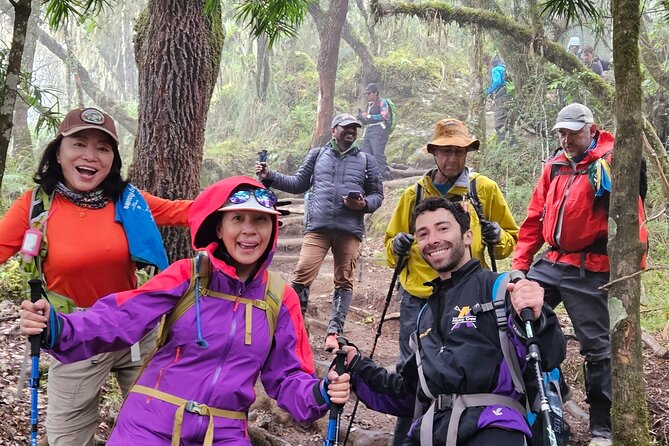
The Northern Circuit Route gives you Kilimanjaro’s rarest luxury: time. You start on the Lemosho side, cross the Shira Plateau, then circle the quiet northern slopes before joining the summit trail. The route is long, but that extra pacing can help your body adjust before summit night.
I like the small private-group format, where only your party takes part, and the high level of mountain support. A private toilet, shower tent, mess tent, hot washing water, fresh meals, oxygen, and a Gamow bag make a real difference after a long day.
The main drawback is simple: this is a serious, costly climb at $3,000 per person, with one very hard 13 to 16-hour summit day. You must also bring or rent your personal trekking gear, and staff gratuities are not included.
Key points to know before booking
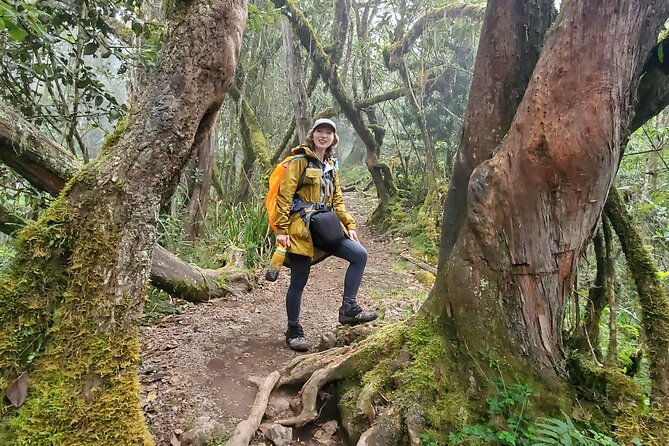
- The longest Kilimanjaro route: Eight days gives you a gradual approach and time on the northern side of the mountain.
- A private climb: Only your group participates, with airport transfers and park-gate transfers included.
- Remote northern camps: Days four and five are quieter, rougher, and less developed than the busier southern trails.
- A demanding summit night: You leave around midnight, reach up to 5,895 meters, then descend to 3,100 meters in the same day.
- Strong mountain support: The package includes guides, cooks, porters, emergency oxygen, medical monitoring, a Gamow bag, and evacuation cover through AMREF Flying Doctors.
- Comfort extras at altitude: Expect a private flush toilet, wash tent, hot towels, warm washing water, a mess tent, and large portions of food.
Why the Northern Circuit is worth eight days
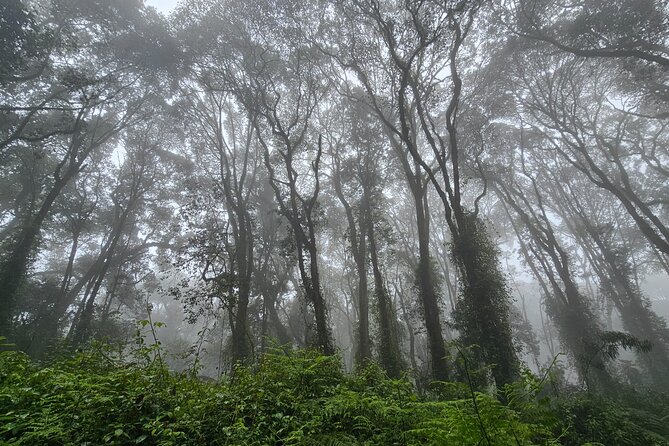
Kilimanjaro has several routes, and the Northern Circuit takes the scenic, patient approach. It begins along the Lemosho route, crosses the western side of the mountain, and then turns north. You spend two days moving through the northern valleys before reaching Third Cave Camp, completing the circuit, and heading toward the summit.
That route shape matters. You do not simply march uphill each day. Several stages gain altitude slowly, and days four and five include repeated climbs and descents. This can feel tiring, but it gives you more time to adapt than a shorter itinerary.
The route is also appealing if you want a quieter mountain experience. The northern slopes are described as little visited, and camps such as Pofu sit in remote, rocky country. You should not expect a soft walk, though. Quiet here means fewer people and fewer easy comforts, not an easier trail.
The tour is priced at $3,000 per person. That is a large sum, but it covers far more than a simple guided hike. Park entry, camping or hut fees, rescue fees, food, staff wages, airport transfers, hotel nights, tents, medical equipment, water, and VAT on park fees are included.
I would compare this price with shorter Kilimanjaro routes carefully. The extra days, private setup, medical preparation, and northern route access help explain the cost. You still need to budget for international airfare, visas, personal gear, laundry, room service, immunizations, communication charges, and tips for the mountain crew.
A few more Moshi & Kilimanjaro days to compare
- Kilimanjaro climb by Lemosho Route (7-day)
★ 5.0 · 651 reviews - Safari Serengeti And Ngorongoro
★ 5.0 · 288 reviews - Kilimanjaro climb, Machame Route (7-day)
★ 5.0 · 262 reviews
Day 1: Lemosho forest and the first camp
After breakfast, you travel by four-wheel-drive vehicle to Londrossi Gate. This is where the park formalities begin. Your guides help with registration, and porters’ duffle bags are weighed to keep each load within the stated 20-kilogram limit.
That detail is worth noticing. Porter treatment is a major concern on Kilimanjaro, and the package specifically includes fair and ethical treatment of porters. The weight check is part of keeping the operation within the required limit, not just an administrative nuisance.
From Londrossi Gate, the vehicle continues for about 11 kilometers on narrow dirt roads through pine plantations. The trek then starts at the Lemosho Glades. You walk about seven kilometers over four to five hours, rising from 1,981 meters to 2,780 meters.
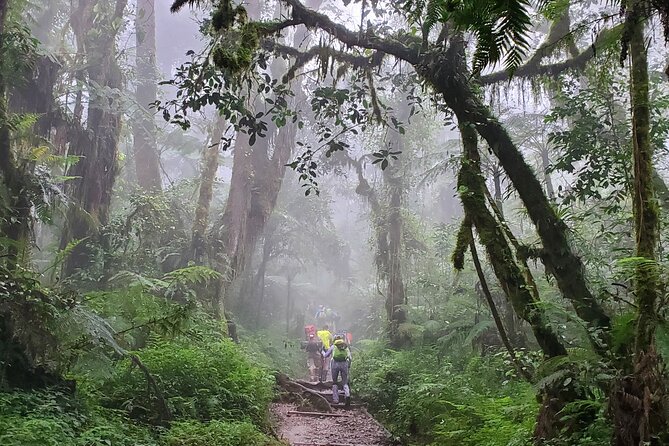
The setting is montane rain forest. This is a gentle first day by Kilimanjaro standards, but do not race. Your goal is to save energy and begin the slow altitude adjustment. The route includes admission to the national park, and camping support begins from this point.
Day 2: The Shira Plateau at a patient pace
Day two covers about 12 kilometers in roughly seven hours. You climb from 2,780 meters to 3,511 meters, leaving the forest and entering moorland.
The trail follows narrow tracks that weave over ridges. Giant heather and erica appear first, followed higher up by giant lobelia and giant groundsel. These unusual plants give the day a distinctly Kilimanjaro feel. This is not generic mountain scenery, and you should keep your camera handy.
The useful word today is pole pole, Swahili for slowly slowly. Walk at the pace your guide sets, drink regularly, and resist the urge to treat the early days as a race. The Shira Plateau is already high, and arriving at camp feeling fresh is more useful than arriving early.
The day is long enough to test your legs, but it is also one of the route’s important adjustment stages. You gain roughly 731 meters, then sleep at 3,511 meters. That gradual rise is one reason this itinerary appeals to climbers who prefer a slower plan.
Day 3: Shark’s Tooth and the alpine desert
The third day heads north through heather and into Kilimanjaro’s alpine desert. You cover about nine kilometers in five to six hours, gaining roughly 664 meters to reach 4,175 meters.
The route passes a natural landmark called Shark’s Tooth. The surrounding terrain becomes stark and spare. Hardy everlasting plants and small senecios survive here, while a huge glacier-shaped bowl rises above the trail. Lava tube caves appear in the cliffs near the upper edge.
You also get broad views back over the Shira Plateau, with the Kibo Massif and Northern Ice Field above. This is one of the days when the route feels far removed from ordinary walking. The scenery is impressive, but the thin air may slow you down. Let the guide control the pace and take short stops when needed.
At this height, a five or six-hour schedule can feel longer than the numbers suggest. The itinerary gives you admission fees and mountain support, but the real work remains yours: steady walking, eating enough, and paying attention to how your body feels.
A change of scene while you are in Moshi & Kilimanjaro:
- Kilimanjaro Climbing Lemosho Route 8 Days.
★ 5.0 · 186 reviews - Climbing Kilimanjaro – Machame Route
★ 5.0 · 170 reviews - Climbing Kilimanjaro through 7 days Machame Route
★ 5.0 · 151 reviews - Kilimanjaro climb, Lemosho Route (8-day)
★ 5.0 · 148 reviews
Day 4: Rough northern valleys and Pofu Camp
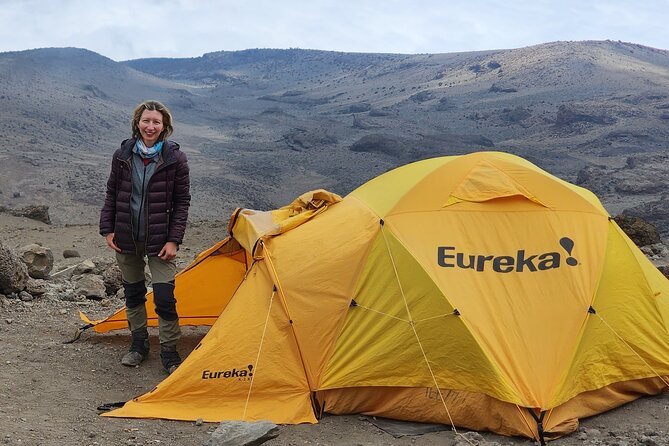
Day four is strenuous. You walk about 12 kilometers for seven to eight hours, moving around Kibo’s northern face. The route rises and falls through valleys at the base of the peak, finishing at about 4,020 meters.
This is not a simple uphill day. You crest one ridge, enjoy a new view, then descend before climbing again. The vegetation changes quickly between valleys, which makes the route interesting but adds to the physical effort.
Pofu Campsite sits on a remote, rocky ridge and is described as rather barren. That is part of the appeal and part of the challenge. You are well away from busy trail sections, but you should not expect much shelter from the elements or a comfortable evening stroll.
The support system matters more here. A walk-in mess tent gives you a place to eat, and a private flush toilet and wash tent reduce the roughness of camp life. You receive hot washing water in the morning and evening, plus a hot towel at camp. These touches will feel practical rather than fancy when you are cold and tired.
Day 5: Completing the Northern Circuit
The route continues across the northern slopes for about seven kilometers and six hours. You begin at 4,020 meters and finish near 3,960 meters, but the total altitude change does not tell the full story. You continue to climb and descend through rocky alpine desert and sparse moorland.
Kibo and Mawenzi rise above you, giving the day some of the route’s best mountain views. The northern side feels spacious and exposed, with little sign of ordinary life.
Third Cave Camp marks the completion of the Northern Circuit. This is a satisfying point in the trip because you have not just approached the mountain, you have circled a large part of it. The camp sits at a useful height before the final push upward.
For me, this is where the route’s slower design makes sense. You have spent several days at altitude before the summit attempt, while still moving through changing terrain instead of repeating the same trail. The tradeoff is that the repeated ups and downs can make your legs feel more worn than the short distance suggests.
Day 6: The steep climb to School Hut
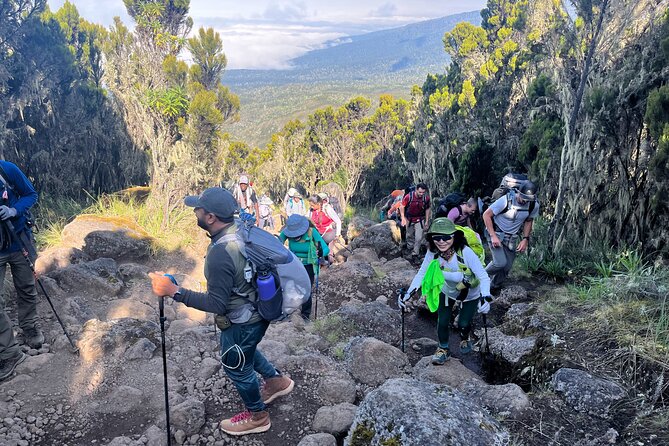
Day six is only about six kilometers and five hours, but it includes a sharp ascent of approximately 780 meters. You climb from 3,960 meters to 4,790 meters through alpine desert.
School Hut is a mountain training facility for park rangers. Its position gives you strong views of Kibo Peak, and the climb offers plenty of reasons to stop, breathe, and look around.
This day is about positioning yourself for summit night. It is not the time to spend energy trying to prove you are strong. Walk slowly, listen to your guide, and use the breaks to drink and eat.
The high camp setting also makes the next day feel real. You are now sleeping close to the summit, and the midnight departure will come quickly. Try to treat the afternoon as quiet recovery time.
Day 7: Gillman’s Point, Stella Point, and Uhuru Peak
Summit day begins around midnight with a warm drink and a light snack. The full day lasts 13 to 16 hours, covers about 19 kilometers, and includes the climb to Kilimanjaro’s highest point, Uhuru Peak at 5,895 meters.
You first work toward Gillman’s Point and Stella Point. This is the hardest part of the trip, with darkness, cold, steep ground, and thin air all adding to the strain. The itinerary lists stone scree and moorland, and conditions near Stella Point are normally snow-covered.
From Stella Point, the final ascent to Uhuru Peak takes about two hours. Each step can feel slow. Take the summit steadily rather than thinking about the full distance left.
At the top, you have views over the clouds and a major personal achievement. The package includes wine and champagne for the summit, a celebratory touch that can make the arrival feel special. The descent is not an afterthought. After reaching the summit, you continue down to about 3,100 meters, making this an exceptionally long day.
Emergency oxygen, vital-sign monitoring, a pulse oximeter, a medical kit, and a Gamow bag are included. These tools do not remove the risks of altitude, but they show that the operator has planned for medical problems rather than treating them as an afterthought. You should still disclose medical concerns before booking and understand that personal medical or extra evacuation costs may not be covered.
Day 8: Mweka Forest and the finish
The final day descends eight kilometers over three to four hours, dropping from 3,100 meters to 1,800 meters. The trail passes through lush Mweka rain forest and can be steep and slippery when wet.
You follow the crest of a broad ridge between two river valleys, then walk the final 40 minutes along a road to Mweka Park Gate. A picnic lunch is planned at the gate, followed by summit certificates from the Kilimanjaro National Park Authority.
Gold certificates are listed for Uhuru Peak, while green certificates are for Stella Point. After the celebration, you transfer to your hotel for the night.
The descent may sound easy after summit day, but tired legs can make steep, wet ground awkward. Trekking poles and shoes with good grip are personal equipment, so make sure you arrange them yourself. Do not expect the last day to be a free stroll.
Camp comfort, meals, and staff support
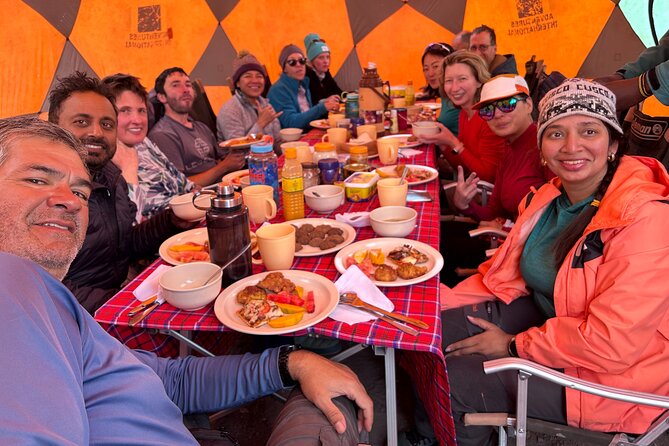
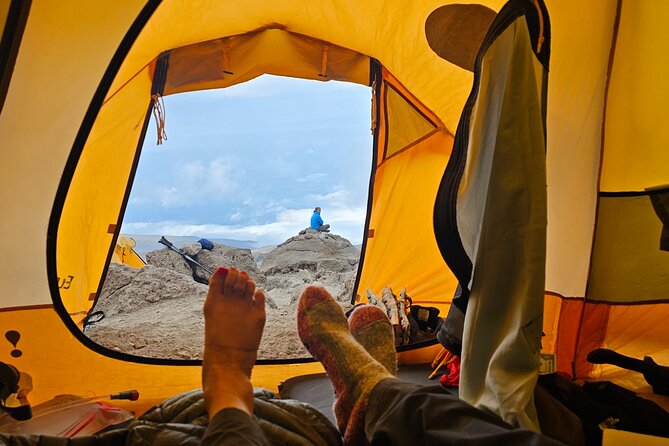
This is a high-support camping trip rather than a basic hut-to-hut climb. Two people share a three-person expedition tent, and a mountaineering mattress is included. You also have a mess tent, lightweight tables, chairs with back rests, a private flush toilet, and a shower or wash tent.
Food is another strong part of the package. Breakfast, lunch, and dinner are included for the listed days, along with purified water on the mountain. The operator describes large portions of fresh, healthy food, which matters because long days at altitude can reduce your appetite while increasing your need for calories.
The crew includes guides, cooks, and porters, with their salaries covered in the price. A two-way radio and mobile phone support communication, while the professional wilderness first responder trained guide or equivalent assistant guide provides an additional safety layer.
Past trips with this provider have involved staff named Joseph, Kisali, Samuel, and Goodluck. The information does not confirm which person will lead your Kilimanjaro climb, so ask for the assigned guide’s name and experience before departure. That simple question also helps you understand who will set the pace and make decisions during summit night.
Who should book this climb?
I would choose this route if you want a quieter, private climb and can handle a long trip at altitude. It suits people who value time for acclimatization, remote camps, and strong logistical support more than a low price or a short schedule.
It is also a good fit for a family or group that wants to climb together, as one private party. An earlier climb arranged for a couple and their two 18-year-old sons shows that the provider has handled a family group, though the data does not establish a universal age policy or guarantee that every family will find the route suitable.
You should think twice if you dislike camping, find long walking days difficult, or want a relaxed holiday. The summit day is especially demanding, and personal equipment, tips, visas, flights, immunizations, and possible extra medical costs remain outside the package.
The tour offers free cancellation if you cancel at least 24 hours before the local start time. Poor weather can lead to a new date or a full refund. Changes made less than 24 hours before the start are not accepted under the stated policy.
Is the $3,000 price good value?
The price makes the most sense when you use the included support. Park fees alone are only one part of a Kilimanjaro climb. Here you also receive two hotel nights on bed and breakfast at either Ameg Lodge or Salinero Hotels, airport transfers, transport between your Arusha hotel and the park gate, tents, food, porters, cooks, guides, water, and safety equipment.
Medical planning is unusually prominent in the package. Emergency oxygen, a Gamow bag, vital-sign monitoring, a pulse oximeter, a wilderness first responder trained guide, and AMREF Flying Doctors evacuation cover are listed. Check the terms carefully, since extra evacuation fees and costs linked to medical conditions or airline schedule changes are excluded.
The value is strongest for a group that wants privacy and comfort at camp. It is weaker if you already have transport, equipment, or a support team arranged elsewhere. Group discounts are offered, so larger private parties should ask for the current rate rather than assuming every person pays exactly $3,000.
Should you book the Northern Circuit?
Book it if you want the longest, quietest route and prefer a patient ascent over a quick Kilimanjaro challenge. The northern valleys, Shira Plateau, unusual high-altitude plants, and views of Kibo and Mawenzi give the climb plenty of variety.
Do not book it simply because it is described as having a high success rate. No route guarantees a summit, and the 13 to 16-hour summit day remains a serious physical test. Go in prepared, confirm the personal gear list, ask who your lead guide will be, and check the medical and evacuation terms.
For a private group with a healthy budget, the mix of extra acclimatization time, remote trails, ethical porter standards, good food, and serious safety equipment makes this a strong Kilimanjaro option.
FAQ
How long is the Northern Circuit Kilimanjaro climb?
The experience lasts approximately eight days. It includes six approach and acclimatization days, one summit day, and one descent day through Mweka Forest.
What is the highest point reached?
The highest point is Uhuru Peak at 5,895 meters. The summit day reaches the peak via Gillman’s Point and Stella Point.
Is this a private tour?
Yes. Only your group participates in the activity. Group discounts are available.
Is airport pickup included?
Yes. Airport transfers are included, along with return transport between an Arusha hotel and the park gate.
What accommodation is included before or after the climb?
Two nights on a bed-and-breakfast basis are included at either Ameg Lodge or Salinero Hotels.
Are meals included?
Yes. Breakfast, lunch, and dinner are included for the listed itinerary days. Purified water is also provided on the mountain.
Is personal trekking equipment included?
No. Personal trekking equipment is not included. International airfare, visas, staff gratuities, laundry, room service, souvenirs, immunizations, and excess baggage charges are also excluded.
What happens if the climb is canceled because of weather?
If poor weather causes the experience to be canceled, you will be offered a different date or a full refund. For a full refund under the normal cancellation policy, you must cancel at least 24 hours before the local start time.
Newly listed around Moshi & Kilimanjaro
- Climb Mount Kilimanjaro: 7 Days Machame Route★ 5.0 · 3 reviews
- 6 Days Mount Kilimanjaro Climbing via Rongai Route★ 5.0 · 3 reviews
- Explore 1 day Ngorongoro Crater Budget Group Safari from Arusha★ 5.0 · 3 reviews
- Mt. Kilimanjaro Day Hiking★ 5.0 · 3 reviews
- Chemka (Kikuletwa) Hot Springs, Tanzania★ 5.0 · 3 reviews
- Guided City tour of Moshi★ 4.3 · 3 reviews
- 8 Day Tanzania Family Safari★ 5.0 · 3 reviews
- Serengeti Safari with Sirikwa Travel★ 5.0 · 3 reviews
Moshi & Kilimanjaro Tours, compared.







