
Reviewed · MOSHI & KILIMANJARO TOURS
8-Day Grumeti Migration Safari-Luxury Tour May-July
The main reason to book this safari is its attempt to cover both the Grumeti River area and central Seronera during the May to July migration window. That gives you a better spread of habitats and a sensible chance of finding moving wildebeest, predators, elephants, and the rest of the Serengeti cast. I like the private format, too, since only your group participates and your guide can focus on your pace.
I also like the hot table-served lunches, complete with soup, bread, a main dish, fruit salad, tea, coffee, and sometimes wine. Guides such as Calvin Kileo, Bariki, William, and Ombeni receive especially strong praise for animal spotting, careful driving, clear explanations, and personal attention. The main caution is that a river crossing is never guaranteed, and the route as written appears to shift between Serengeti and Ngorongoro in a way you should clarify before paying.
Key points to know before booking
- Grumeti focus: May to July is chosen to give you a chance of seeing wildebeest in the Western Serengeti near the Grumeti River.
- Two Serengeti zones: You spend time in both the Western Corridor and Seronera, improving your range beyond a one-area safari.
- Private vehicle and guide: Your group travels privately, with guides including Calvin Kileo, Bariki, William, and Ombeni named in the operator’s service record.
- Luxury-style camp routine: Lodges and tented camps are paired with full meals and close-to-nature settings.
- A broad northern circuit: Tarangire, Lake Manyara, Serengeti, and Ngorongoro are all included in eight days.
- Long driving days: Most safari days are listed at about eight hours, so comfort and road stamina matter.
Why May to July is the right window for this route
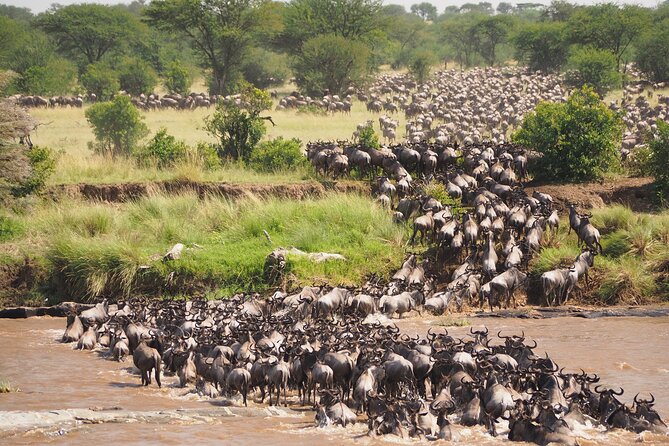
The Great Migration is not a single event in one fixed place. Herds move according to rain, grass, water, and instinct. From May to July, many wildebeest typically move west from the central Serengeti toward the Western Corridor, where the Grumeti River becomes one of the important obstacles along the route.
That timing explains the shape of this safari. Instead of staying only around Seronera, the program makes room for the western side of the park, then returns to central Serengeti for more big-cat viewing. You are not simply chasing one dramatic crossing. You are covering several areas where wildlife can gather.
Still, keep your expectations sensible. A river crossing depends on the animals, the water level, recent rain, and the herd’s exact position. You may see huge herds near the river without seeing a crossing. You might also spend long periods watching resident lions, elephants, giraffes, zebras, or smaller animals while the wildebeest are elsewhere. That is not a failed safari. The Serengeti is worth visiting even when the migration refuses to perform on schedule.
More Safaris in Moshi
- Safari Serengeti And Ngorongoro
★ 5.0 · 288 reviews - Big Five Safari In Tanzania
★ 5.0 · 99 reviews - Unforgettable Tanzania Safari And Zanzibar Beach
★ 5.0 · 97 reviews
Arusha begins the safari at a gentle pace
Your first day starts with a meeting with the guide and a transfer to Arusha for dinner and an overnight stay. The supplied timing lists about four hours, so you should treat this as a travel and orientation day rather than a wildlife day.
Arusha sits below Mount Meru and serves as a gateway to Tanzania’s northern safari parks. It is also the practical starting point for a route that reaches Tarangire, Manyara, Serengeti, and Ngorongoro.
The airport meeting point is Kilimanjaro International Airport. If you arrive earlier or want to spend extra time in Arusha, additional accommodation before or after the safari is not included. Ask the operator to confirm the exact pickup time, hotel, and transfer plan, especially if your flight lands late.
Tarangire brings elephants and a quieter park mood
After breakfast and a short safari briefing, you drive to Tarangire National Park for a full game drive. The day is listed at about eight hours, with a hot lunch prepared beside the vehicle before the afternoon drive continues. You then head to a lodge or camp for dinner and sleep.
Tarangire is a smart first park because it offers a different feel from the Serengeti. The park is known for elephants, birdlife, and a quieter safari atmosphere. It is slightly off the main northern route, which can make the first wildlife day feel less rushed.
I especially like the planned lunch setup here. A proper meal with soup, bread rolls, a main course, fruit salad, tea, coffee, and a glass of wine is a welcome change from eating quickly in the vehicle. It also gives you a chance to rest your eyes after the drive.
You should ask which lodge is assigned, since the exact property is not named. The word luxury can mean different things across safari camps. Ask about room style, electricity, hot water, Wi-Fi, and whether the camp is permanent or mobile. Those details matter more than a polished label.
Lake Manyara adds birds and tree-climbing lions
Day three takes you to Lake Manyara National Park for another full day. The park is particularly good for birdwatching, with more than 400 species recorded. You may also find elephants in the acacia woodland and, with luck, the famous tree-climbing lions.
Manyara is compact compared with the Serengeti, yet it packs several habitats into one stop. That makes it a useful contrast after Tarangire. You can spend part of the day looking for larger mammals and part watching birdlife around the lake and floodplain.
The same hot lunch arrangement is planned here, using the shade of the safari vehicle. Your guide then continues the game drive before taking you to the lodge for dinner and the night.
The drawback is time. An eight-day safari that includes four major park areas must keep moving. Manyara receives only one day, so you should not expect an exhaustive visit. If birds are a major reason for your trip, tell the guide early. If big cats are your priority, let the guide balance the day around that goal.
More Safaris in Moshi & Kilimanjaro:
- 8-Day Essence of Tanzania Safari – Luxury
★ 5.0 · 72 reviews - Great Migration Safari In Tanzania
★ 5.0 · 71 reviews - Serengeti, Ngorongoro and Tarangire 4 Days Safari
★ 5.0 · 59 reviews - 6 Days 5 Night Safari
★ 5.0 · 57 reviews
Entering the Serengeti for big cats and open country
Day four introduces the Serengeti, with game viewing aimed at big cats and the Big Five. Lunch is again served out in the park, followed by an afternoon drive. The day description then places the overnight near Ngorongoro, which is one reason you should request a final day-by-day camp list before departure.
The Serengeti is famous for migration, but its resident wildlife is the reason it remains rewarding all year. Lions are a major attraction, and the park supports large numbers of other animals as well. Your guide’s ability to spot movement in the distance becomes important here, where an apparently empty plain can hold a well-camouflaged cat.
William is praised for finding animals and explaining how to distinguish different species. Calvin Kileo is also noted for careful driving, sharp spotting, useful information, and making sure water is available. Those are not minor details on long game-drive days. A patient guide can turn a distant shape into a proper sighting and can help you understand what you are seeing rather than simply ticking off names.
The schedule is demanding. Driving between areas can take time, and a late arrival near Ngorongoro followed by a return toward the Serengeti would need careful planning. Confirm the actual overnight location for this night.
The Grumeti area is the heart of the migration plan
Day five is devoted to the Western Serengeti and the Grumeti area. The stated aim is to search for the migration, watch for a possible river crossing, and continue looking for big cats and other major wildlife.
This is the most specialized part of the safari. Many northern Tanzania programs focus on the central or eastern Serengeti, while this route deliberately reaches farther west in the May to July season. That can give you a better shot at finding the herds during their westward movement.
The Grumeti River is also known for the drama of crossing points. But you need to be patient and realistic. The animals may gather on one bank, change direction, or cross at a place you cannot reach quickly. No operator can promise the exact moment. The value here is the effort to place you in the right broad region during the usual seasonal window.
A full day in this area also means you are not dependent on one brief sighting. You can spend the morning locating herds, pause for the prepared lunch, then continue through the afternoon. Ask how much time is normally allocated to a stationary crossing watch and how much is spent moving through the wider area.
Seronera gives you a second Serengeti perspective
Day six moves to central Serengeti and the Seronera area. This return is useful because Seronera is known for resident wildlife and strong big-cat viewing. It also helps prevent the trip from becoming entirely dependent on migration timing.
The central area offers a different safari rhythm from the Western Corridor. Here, your focus can shift toward lions, leopards, cheetahs, elephants, and other resident animals. You may also continue to find wildebeest, zebras, and gazelles, since migration routes change and herds spread widely.
This is a full game-drive day with a prepared lunch and an evening return to camp. The benefit is variety. You get a second chance at wildlife sightings after the western search, and your guide can use knowledge gained from the earlier days to adjust the plan.
Ombeni is described as attentive to comfort, checking whether passengers are hot, cold, or sitting awkwardly while also driving and explaining what is happening. That kind of care is valuable when you spend many hours on uneven roads. Bariki is praised for explaining animal behavior, answering questions, and finding animals that are difficult to see. You should tell the operator if you have a preferred guide, although assignment cannot be assumed.
Ngorongoro Crater closes the safari with a concentrated wildlife day
Day seven is listed as another Serengeti game-drive day, followed by an overnight near Ngorongoro. Day eight begins early, with a drive into Ngorongoro Crater for game viewing before the afternoon return to Arusha and airport drop-off.
The crater is a strong final stop because its enclosed setting can produce concentrated wildlife viewing. The caldera is about 20 kilometers across, around 600 meters deep, and roughly 300 square kilometers in area. Lake Magadi is one of the named places within the crater.
You will have a short time window on the final day, since the crater drive is followed by the road to Arusha and an airport transfer. Do not book an international flight too close to the planned drop-off. The exact drive time is not supplied, so ask for a realistic arrival estimate before connecting this safari to your flight.
The crater is not the same experience as the wide Serengeti plains. Its scale feels enclosed, and the day has a more concentrated route. You may appreciate that change after several days of open-country driving, though the early start and final transfer make it a busy finish.
What luxury means on this particular safari
The price is listed at $6,276 per person. That is a substantial fare, but it includes several costly elements: park fees for non-residents, a professional driver-guide, airport transfers, eight breakfasts, seven lunches, and seven dinners.
You are also paying for a private trip rather than a shared vehicle. Only your group participates, which gives you more control over stops, questions, photography, and the pace of each day. A private safari can offer better value for couples, families, or a small group that would rather divide the cost among themselves.
The accommodation is described as luxury lodges and tented camps close to nature. Since the properties are not named in the supplied details, you should not assume five-star hotel facilities. Ask for the exact names and check whether the quoted price includes all accommodation nights, as well as any camp or conservation charges.
Meals are a real strength of the plan. The hot outdoor table service is more comfortable than a basic packed lunch and adds a pleasant sense of occasion. Wine, tea, and coffee are included in the described lunch setup, but ask whether drinks at camp, bottled water, and special diets carry extra charges.
Tips are not included. The suggested guideline is $15 per person per day. Personal purchases, souvenirs, insurance, visa fees, international flights, and extra nights before or after the trip are also your responsibility.
The guide can shape the quality of every day
A safari vehicle only gets you to the animals. The guide determines how well you understand the scene, how patiently you wait, and how safely you travel between parks.
Calvin Kileo is praised for careful driving, kindness, practical attention, and finding a wide range of animals. Bariki is praised for animal explanations and persistence when wildlife is hard to see. William is noted for species identification, patience, road knowledge, and spotting skill. Ombeni receives praise for monitoring passenger comfort while driving and guiding.
Those qualities are especially useful on this route because the days are long and the terrain changes. Ask questions. Tell your guide if you want more birds, more predators, more photography time, or more information about plants and animal behavior. You will get more from the safari when the guide knows what interests you.
Who will get the most from this eight-day route
I would recommend this safari to you if you want a broad northern Tanzania trip with a serious attempt at the Western Serengeti migration. It suits first-time safari-goers who want the major parks in one package, as well as repeat visitors who specifically want the Grumeti region.
It is also a good match for couples and small private groups who value a personal guide, full meals, and lodge or tented-camp accommodation. The attentive service described by the operator may suit a honeymoon or a group that places safety and cleanliness high on the list.
I would hesitate if you want a slow trip with several nights in every camp. Tarangire and Manyara each receive one main day, while the Serengeti sections require long drives and careful timing. I would also hesitate if seeing a river crossing is your only goal. This itinerary improves your odds by visiting the right region at the right time, but nature keeps the final say.
Practical questions to settle before you pay
The schedule needs clarification. Day four mentions a late move toward Ngorongoro, while days five and six return to the Western and central Serengeti. Day seven then moves back toward Ngorongoro. That may reflect camp locations or a condensed description, but you should request the exact overnight properties and driving sequence.
Confirm your arrival transfer from Kilimanjaro International Airport, the Arusha hotel, the vehicle type, and the number of people in your private group. Also ask what happens if the migration is farther west or if weather affects access to a crossing area.
Free cancellation is available up to 24 hours before the start time for a full refund. Changes or cancellations inside that period are not accepted for a refund, and poor weather may lead to a different date or a full refund.
Should you book the Grumeti Migration Safari?
Book it if you want a private, high-cost safari that covers the major northern parks while giving special attention to the May to July migration in the Western Serengeti. The combination of Grumeti, Seronera, hot bush lunches, airport transfers, and experienced guides gives the trip a clear purpose.
Before booking, get the accommodation list and corrected route in writing. If the operator confirms that the western and central Serengeti nights are arranged without unnecessary backtracking, the plan offers strong value for a private luxury safari. If you want a guaranteed crossing or a slower pace, choose a trip with more nights in the Western Corridor instead.
FAQ
When does this safari operate?
The tour is designed for May through July, when the wildebeest migration can normally be found moving through the Western Serengeti and Grumeti area.
Is a Grumeti River crossing guaranteed?
No. The tour is designed to improve your chance of seeing a crossing, but wildlife movement depends on natural conditions and the exact location of the herds.
Is this a private safari?
Yes. Only your group participates in the activity.
Where does pickup take place?
The stated starting meeting point is Kilimanjaro International Airport in Tanzania. Airport transfer is included.
What meals are included?
The package includes eight breakfasts, seven lunches, and seven dinners. Hot lunches are described with soup, bread rolls, a main dish, fruit salad, tea, coffee, and sometimes wine.
What is not included in the price?
International flights, extra accommodation before or after the safari, tips, souvenirs, travel insurance, visa fees, and other personal items are not included. The suggested tipping guideline is $15 per person per day.
Newly listed around Moshi & Kilimanjaro
- Climb Mount Kilimanjaro: 7 Days Machame Route★ 5.0 · 3 reviews
- 6 Days Mount Kilimanjaro Climbing via Rongai Route★ 5.0 · 3 reviews
- Explore 1 day Ngorongoro Crater Budget Group Safari from Arusha★ 5.0 · 3 reviews
- Mt. Kilimanjaro Day Hiking★ 5.0 · 3 reviews
- Chemka (Kikuletwa) Hot Springs, Tanzania★ 5.0 · 3 reviews
- Guided City tour of Moshi★ 4.3 · 3 reviews
- 8 Day Tanzania Family Safari★ 5.0 · 3 reviews
- Serengeti Safari with Sirikwa Travel★ 5.0 · 3 reviews
Moshi & Kilimanjaro Tours, compared.








Browse the lists this tour appears in