

Reviewed · SERENGETI & NGORONGORO SAFARIS
4 Days scenic Tarangire, Ngorongoro, Serengeti Group Safari
The appeal here is simple: in four days, you reach Tarangire’s elephant country, the wildlife-packed Ngorongoro Crater, and the broad Serengeti plains. That is a lot of Tanzania in a short trip, with the chance to see lions, buffalo, hippos, crocodiles, zebra, wildebeest, antelope, and perhaps the Big Five.
I like the strong wildlife mix, especially the contrast between Tarangire’s large elephant population and the open grassland of the Serengeti. I also like the practical pricing at $1,000 per person, which includes park fees, meals, bottled water, and transport rather than leaving the main costs to sort out later.
The trade-off is time. You will cover long distances and begin early, with one day devoted to a six-to-seven-hour game drive. Also, the description refers to Lake Manyara in one place but gives an itinerary for Tarangire, Ngorongoro, and Serengeti, so confirm the exact route before paying.
Key points to know before booking
- Three major parks in four days: The detailed schedule focuses on Tarangire, Ngorongoro Crater, and Serengeti, with the Serengeti receiving the most game-drive time.
- Elephants are a Tarangire specialty: The park is known for an unusually large elephant population, making the first day more than a quick introduction to safari.
- A half-day crater tour: You descend about 2,000 feet, or 600 meters, to the Ngorongoro floor for concentrated wildlife viewing.
- Early starts shape the trip: Breakfast comes early, and the Serengeti drive begins at about 6:30 a.m.
- Good food is part of the value: Lunch and picnic boxes are included, and the food has been praised repeatedly.
- Ask about the operating setup: The experience is described as both a group safari and a private activity, while the first night is listed as camping despite the lodge-safari title.
Three parks, one fast-moving safari
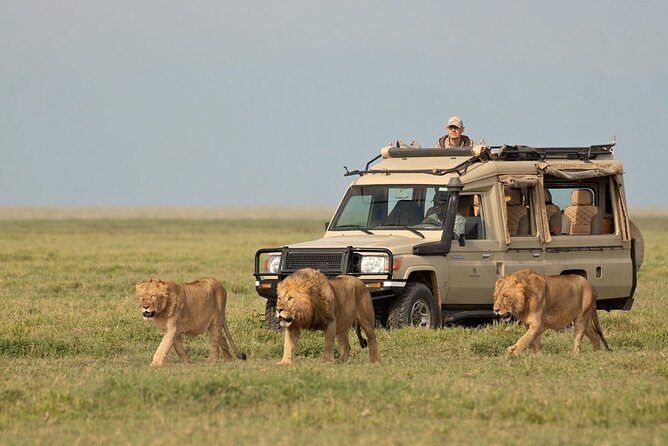
This is best understood as a compact northern Tanzania safari. You do not spend several days in one park waiting for the bush to reveal itself. Instead, you move through three very different settings, each with its own reason to be there.
Tarangire gives you elephants and big savannah scenery. Ngorongoro gives you a dramatic volcanic basin where animals are often easier to spot. Serengeti gives you scale, distance, and the possibility of seeing the great herds moving across open country.
That variety is the main reason I find the itinerary appealing. You can see a lot in four days, but you need to be comfortable with early breakfasts, road time, and a schedule that leaves little room for a slow morning.
The overview also names Lake Manyara National Park, including its flamingos, but the day-by-day schedule does not include a Lake Manyara visit. The listed days instead cover Tarangire, Ngorongoro Crater, and Serengeti. Treat this as an important booking question, not a minor wording issue. If flamingos or Lake Manyara matter to you, ask Aquiline Safaris and Adventures for the confirmed route.
More Safaris in Arusha
- Balloon Safari & Bush Breakfast in Serengeti – Miracle Experience
★ 5.0 · 1,646 reviews - 4 Days Group Camping Safari
★ 5.0 · 1,101 reviews - 5 Days Group Camping Safari
★ 5.0 · 730 reviews
Day one: elephants and baobab country in Tarangire
After pickup from the airport or your hotel, you set out for Tarangire National Park. The schedule describes Tarangire as Tanzania’s third-largest national park and highlights its unusually large elephant population. For many people, that makes the first afternoon a strong start rather than a filler day.
You will have a game drive and a picnic lunch. The supplied information does not give an exact departure time or the length of the drive from Arusha, so you should ask for those details if you are planning an airport arrival or another activity on the same day.
Tarangire is valuable because it adds a different animal focus to the trip. The later Serengeti days are linked with migrating wildebeest and zebra, while Tarangire is singled out for elephants. That change of setting helps the four-day plan feel less repetitive.
At the end of the day, dinner and overnight accommodation are listed as camping. This is worth checking carefully because the experience is also presented as a lodge safari. The type of camp, sleeping arrangements, and included facilities are not specified. If you prefer a fixed lodge, or if you are bringing children, ask exactly what is provided.
Day two: the 600-meter descent into Ngorongoro Crater
Day two starts with an early breakfast and packed picnic lunches. You then head toward Ngorongoro Crater for a half-day tour, descending about 2,000 feet, or 600 meters, to the crater floor.
This is the most concentrated wildlife section of the itinerary. The crater’s enclosed setting can make animal spotting feel rewarding because you are looking across a defined basin rather than a huge open park. The schedule also describes the crater as animal-filled, which is why it earns a full half-day even in a short safari.
You should expect the crater visit to be busy in time, not necessarily in spirit. You have a set route, a picnic lunch, and a drive onward or to accommodation after the tour. There is no spare day built in for weather delays or a second crater visit.
The crater also gives you the best chance to break up the long open-road feel of the Serengeti section. You move from Tarangire’s elephant habitat to a contained wildlife area, then continue toward the broader plains. I like that progression because each day has a clear identity.
Days three and four: long hours in the Serengeti
The Serengeti section begins with another early breakfast. The game drive starts at about 6:30 a.m. and lasts six to seven hours, giving you a serious amount of time in the park rather than a brief pass through.
The animal list includes impala, buffalo, crocodile, and hippo. The Serengeti is also known for large herds of zebra, wildebeest, and antelope. The figures provided are enormous: about 250,000 zebra, 1.5 million wildebeest, and 500,000 antelope connected with the migration.
Those numbers explain the Serengeti’s fame, but they should not be treated as a promise that you will watch a crossing. Migration movements depend on the season and location. You may see animals spread across the savannah rather than a dramatic river crossing, and the itinerary does not give a travel month or a specific migration route.
The schedule says you will spend days three and four exploring the park before returning to Arusha. It also describes the return after an extensive game drive, so the final day may involve substantial road time. You should not plan a tight onward flight or important evening connection unless Aquiline confirms the arrival time.
Still, this is where the itinerary earns its place. A day and a half in the Serengeti gives you more than a quick photo stop. The long drive lets your guide search for different animals and habitats, and it offers time to watch the park change as you move through it.
More Serengeti and Ngorongoro itineraries:
- 3 Days Serengeti & Ngorongoro Group Camping Safari
★ 5.0 · 574 reviews - 5-Day Highlights mid-Range Crater, Serengeti, Tarangire
★ 5.0 · 296 reviews - 3-Day Classic Serengeti Safari
★ 5.0 · 263 reviews - Private 6-Day Tarangire Manyara Crater and Serengeti with Mid-Range Lodges
★ 5.0 · 238 reviews
Guides who can shape the quality of the safari
A safari vehicle can take you into a national park, but the guide determines how much you notice. The information provided names William and Mike as guides who have been praised for locating animals and identifying them accurately.
William is associated with sightings of all the Big Five on one four-day trip. Mike is described as having a strong grasp of animal behavior and knowing where to look. Those are useful signs, but you should request the name of your assigned guide before departure because the guide may not be William or Mike.
You should also ask how wildlife sightings are handled. No safari operator can control where animals appear, and seeing the full Big Five is never guaranteed. What you can reasonably expect is a guide who works to find animals and explains what you are seeing.
The listed arrangements create one point of confusion. The tour title includes the word group, while the additional information calls it a private tour in which only your group participates. One review-based detail also indicates that a solo person can be placed with another group and that departures are available daily. If you are booking alone, ask whether you will have a private vehicle or share with other people.
That question matters for comfort, photography, and flexibility. A private vehicle generally gives you more control over stops, while a shared arrangement can reduce the cost but means fitting your schedule around others. The published price and transport wording do not fully settle this point.
What the $1,000 price covers
At $1,000 per person, this is not a bare-bones park entry package. The listed inclusions cover private transportation, lunch, all fees and taxes, and bottled water. Dinner and overnight accommodation are also described in the daily plan, although the exact accommodation details are limited.
The value is strongest if you want a short safari with the major costs grouped together. Park fees alone can make northern Tanzania expensive, and including meals and water removes several small charges that can otherwise add up. You also do not need to arrange separate transport between Arusha and the parks.
Food appears to be one of the better parts of the operation. Several of the supplied comments praise the meals, including the picnic arrangements. That matters more than it sounds. Safari days are long, and a dependable lunch keeps the day moving when you are far from town.
Tips are not included. You should budget separately for a tip if the guide and support staff provide good service. The amount is not stated, so ask the operator for current guidance rather than guessing.
The camping detail needs equal attention. The first night is specifically described as camping, but no tent type, toilet arrangement, bedding, or other facilities are given. Since the trip is marketed as a lodge safari, ask for the name and standard of each night’s accommodation before booking.
Meals, water, and the rhythm of a safari day
You will not be left to find lunch during the game drives. A picnic lunch is provided on day one, and picnic lunch boxes are prepared for the Ngorongoro day. Lunch is listed as included, as is bottled water.
Breakfast is early on days two through four. That is normal for wildlife viewing, since early morning is part of the scheduled game-drive rhythm, but it can feel demanding if you have just arrived in Tanzania or do not sleep well in camp.
The itinerary does not state that dinner is included on every night, though day one specifically mentions dinner. Ask whether all dinners and breakfasts are covered in the final price. The same applies to drinks beyond bottled water.
I like the practical simplicity here. You can focus on the parks instead of packing a daily lunch or searching for water. Just confirm the full meal plan, particularly for the nights after Tarangire.
Who will get the most from this four-day route
This trip suits you if your main goal is to see several famous northern Tanzania parks in a limited amount of time. It works well for a first safari, a couple with only four days available, or a solo person who wants an established route rather than a custom private itinerary.
It is also a good fit if elephants, crater wildlife, and the Serengeti migration appeal to you more than luxury facilities. The supplied comments describe friendly staff, helpful assistance, good food, and successful Big Five sightings. Those strengths point to a practical safari built around the parks rather than high-end extras.
You may want a longer or slower trip if you dislike early starts or long drives. Four days gives you variety, but it does not give you much spare time. You will also want more information if accommodation standards matter greatly to you.
Photography-focused visitors should ask about vehicle seating and the private versus shared arrangement. The provided information does not specify the vehicle type, number of passengers, or photography setup. Those details can change how comfortable a six-to-seven-hour game drive feels.
Booking questions worth asking Aquiline
Before booking, I would send the operator a short list of clear questions:
- Does the route include Lake Manyara, or only Tarangire, Ngorongoro, and Serengeti?
- Is this a private safari or a shared group departure?
- What accommodation is used each night?
- Is the first night camping, and what facilities does the camp provide?
- Are breakfast and dinner included for all four days?
- Who is the assigned guide, and will it be William, Mike, or another guide?
- What time do you return to Arusha on day four?
- How many people share the vehicle?
These questions are not nitpicking. The route, accommodation, and group format are central parts of the experience, and the supplied details describe them in slightly different ways.
Pickup is offered from the airport or your hotel, and confirmation is received at booking. The cancellation policy allows a full refund if you cancel at least 24 hours before the start time. Inside 24 hours, there is no refund, and poor weather may lead to a new date or a full refund.
Should you book this safari?
I would book this four-day safari if you want a reasonably priced introduction to Tarangire, Ngorongoro, and Serengeti, and you are happy with a brisk schedule. The combination of elephant country, a crater tour, migration territory, included park fees, meals, water, and transport gives the $1,000 price real value.
I would not book until the operator confirms the Lake Manyara reference, the camping versus lodge arrangement, and the private versus group setup. Once those points are clear, this looks like a strong choice for someone who values animal sightings, capable guiding, and a full four days in the parks more than a relaxed pace or luxury accommodation.
FAQ
Where does the safari begin?
The safari begins in Arusha, with pickup offered from the airport or your hotel.
How long is the experience?
The safari lasts approximately four days and includes three nights according to the supplied trip description.
Which national parks are included in the detailed itinerary?
The day-by-day plan includes Tarangire National Park, Ngorongoro Crater, and Serengeti National Park.
Is Lake Manyara included?
Lake Manyara is named in the overview, but it is not included in the detailed day-by-day schedule. Confirm the final route with Aquiline Safaris and Adventures before booking.
How long is the Ngorongoro Crater visit?
The Ngorongoro Crater tour lasts half a day, including a descent of about 2,000 feet, or 600 meters, to the crater floor.
How long is the Serengeti game drive?
The Serengeti game drive begins at about 6:30 a.m. and lasts approximately six to seven hours.
Are meals included?
Lunch is included, with picnic lunch provided during the game drives. Dinner and overnight accommodation are specifically mentioned for day one. Confirm the complete breakfast and dinner plan for the other nights.
Is bottled water provided?
Yes. Bottled water is included.
Are park fees and taxes included?
Yes. All fees and taxes are listed as included.
Is tipping included?
No. Tips are not included in the price.
Can I cancel for a full refund?
Yes, if you cancel at least 24 hours before the experience start time. Cancellations made less than 24 hours before the start time are not refunded.
More four day trips in Arusha
- 4 Days Join Group tour Tarangire Serengeti and Ngorongoro crater
★ 5.0 · 219 reviews - 4-Day Safari from Arusha: Tarangire, Serengeti and Ngorongoro
★ 5.0 · 173 reviews - 4 Days safari Tour Tanzania
★ 5.0 · 159 reviews - 4 Days Tarangire Serengeti Ngorongoro Crater
★ 5.0 · 117 reviews
Newly listed around Arusha
- 5-Day Private Safari Tour in Tanzania’s Wildlife★ 5.0 · 3 reviews
- 3 Days private safari Tarangire ,Ngorongroro crater &Manyara★ 5.0 · 3 reviews
- 3 Day Sharing Safari – Manyara, Ngorongoro Crater and Tarangire National Parks★ 5.0 · 3 reviews
- Tarangire National Park Day Trip★ 5.0 · 3 reviews
- 2 Days Tarangire and Ngorongoro Crater Tour★ 5.0 · 3 reviews
- 6 -Day Tarangire, Manyara, Serengeti & Ngorongoro★ 5.0 · 3 reviews
- 5 Days Group Camping Safari★ 4.7 · 3 reviews
- 4 Days Tanzania Safari★ 4.5 · 3 reviews
Serengeti & Ngorongoro Safaris, compared.


Balloon Safari & Bush Breakfast in Serengeti – Miracle Experience
Read our review →




Private 6-Day Tarangire Manyara Crater and Serengeti with Mid-Range Lodges
Read our review →
5 Days Camping Tarangire, Serengeti & Ngorongoro crater & Visiting Maasai
Read our review →Browse the lists this tour appears in