

Reviewed · STONE TOWN TOURS
3-Hour Private Stone Town Walking Tour
Stone Town is best understood on foot, one crooked lane at a time. This private three-hour walk brings together forts, markets, carved doors, old palaces, religious buildings, and the city’s complicated links to trade and slavery. The guide also points out everyday places that many sightseeing routes skip, including Jamat Khana, Jows Corner, and the narrow lanes where Stone Town feels most like a living city.
I like the private format, since your group can ask questions and request more time at the places that matter most. I also like the range of the route: you get grand waterfront buildings, the smells and noise of Darajani Bazaar, local architectural details, and major historical sites for $35 per person.
The main consideration is pace. Seven stops in about three hours means most visits are brief, often around 18 minutes, so this is a strong introduction rather than a slow, in-depth study of every building. Some sites, including the Freddie Mercury Museum, may be viewed as part of the route without a separate admission visit.
Key points to know before you book
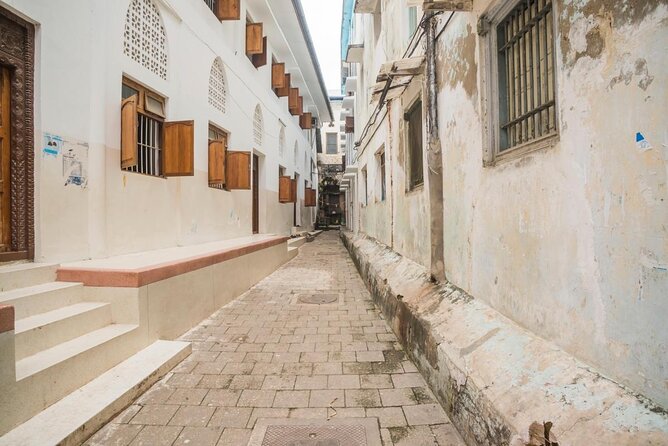
- Seven stops in three hours: The route covers the Old Fort, Forodhani Gardens, Old Customs House, Stone Town’s lanes, Darajani Bazaar, the former slave market, and the Freddie Mercury Museum.
- A genuinely private walk: Only your group takes part, making it easier to ask questions or request attention to architecture, food, music, or local customs.
- Guides with local pride: Hassan and Ahmad are named as guides who explain the city clearly, with Hassan also praised for adapting the route and sharing his artistic side.
- No entry fees listed: The tour includes the main sights from the outside or as guided stops, while any museum admission should be checked before you go.
- A useful mix of famous and everyday Stone Town: You see major landmarks, then turn into narrow lanes, local market streets, Jamat Khana, carved doors, and Jows Corner.
- Easy cancellation terms: Cancel at least 24 hours before the start for a full refund. Changes or cancellations inside 24 hours are not refunded.
Starting beside the Old Fort on Mizingani Road

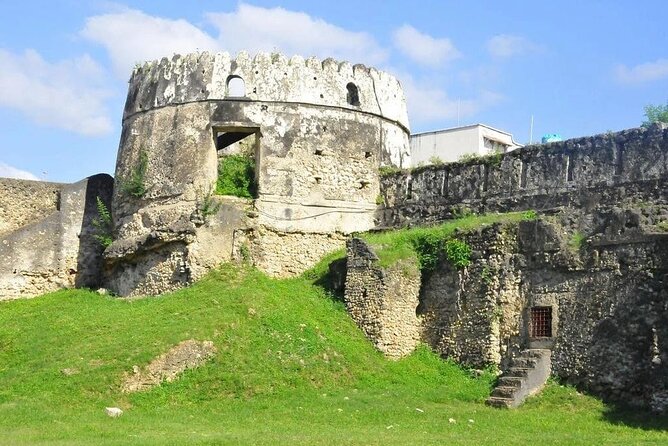
The walk begins at the Old Fort, also called the Arab Fort, on the main seafront. It is next to the House of Wonders and faces Forodhani Gardens, so you start in one of Stone Town’s most concentrated historic areas.
The fort is described as Stone Town’s oldest building. That makes it a sensible place to begin, since your guide can establish the broad story of the city before leading you into its lanes. The setting also gives you an immediate feel for the meeting point of land, sea, trade, and royal power.
Expect about 18 minutes here. That is enough for an introduction to the fort and its role in Stone Town, but not enough for a detailed architectural study of every wall or courtyard. If forts are a major interest, tell your guide early so the private format can work in your favor.
Hassan and Ahmad are among the guides associated with this experience. The guide you receive may vary, but the strongest reports about both men focus on clear English, good communication, and an ability to explain the city rather than simply point at buildings.
More Walking Tours in Zanzibar
- Stone Town Private Walking Tour
★ 5.0 · 371 reviews - Zanzibar: 3 Hours Private Stone Town walking Tour with Guide
★ 4.6 · 301 reviews - Zanzibar: Stone Town Historical Cultural Walking Guided Tour
★ 4.5 · 179 reviews
Forodhani Gardens and the city after dark
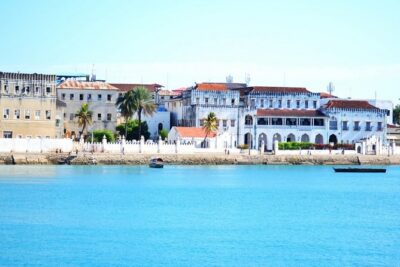
From the fort, the route continues to Forodhani Gardens, a small waterfront park directly in front of the House of Wonders and the Old Fort. By day, it is a pleasant place to understand the shape of the seafront. After sunset, it becomes one of Zanzibar’s best-known food areas.
The food market is especially associated with grilled seafood, samosas, cassava, sweet potatoes, Zanzibar pizza, and urojo, a local soup-like dish often called Zanzibar mix. The tour does not promise a meal or tasting, so treat this stop as a useful introduction to local food rather than a food tour.
I like this part of the route because it connects history with ordinary city life. Stone Town is not only a collection of old buildings. It is also a place where people meet, eat, work, and gather near the sea.
The scheduled stop is about 18 minutes. If you are walking in the evening, you may want to return to Forodhani Gardens after the tour for a fuller look at the food stalls. Since the walk ends back at the Old Fort, the location is easy to find again.
The carved door at the Old Customs House

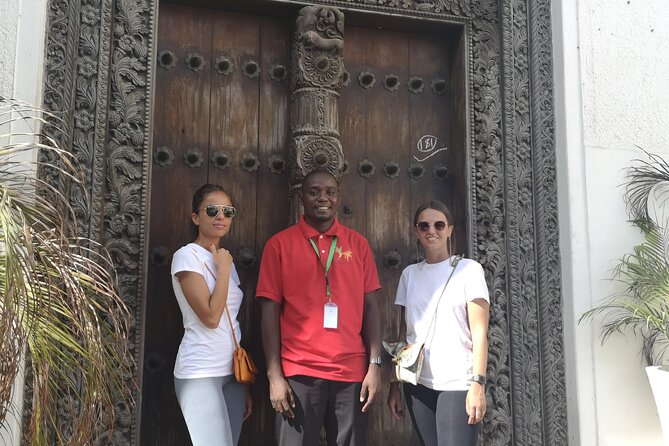
The Old Customs House sits on Mizingani Road, facing the sea. It dates from the 18th century and is linked to the island’s sultanate. The building is particularly worth seeing for its carved wooden door, decorated with fish, lotus, and anchor motifs.
Stone Town’s doors are one of the best details to watch for during any walk here. They are not just entrances. Their designs reflect status, trade, faith, and the city’s connections with Arab, Indian, Persian, and European cultures.
The stop lasts about 18 minutes, which should give you time to examine the door and hear its background. This is where a good guide adds real value. Without explanation, you might pass it as an attractive old entrance. With context, you begin to read the symbols and see how much information a doorway can carry.
The Old Customs House is also a reminder that Stone Town’s waterfront was a working center of commerce. The sea-facing road was not designed only for scenic strolls. It connected ships, customs officials, merchants, rulers, and goods moving through Zanzibar.
Into Stone Town’s narrow lanes
The longest section of the tour is the central walk through Stone Town, lasting about 1 hour and 12 minutes. This is the heart of the experience and the part most likely to reward curiosity.
Stone Town became a UNESCO World Heritage Site in 2000 because of its unusual blend of architectural influences and its importance in East African history. Arab, Persian, Indian, and European elements appear side by side, often within a short walk of one another.
Your guide points out more than the headline buildings. Expect narrow winding streets, carved doors, the Ismail Khoja Jamat Khana, Jows Corner, and other local cultural places. These details help you understand how the city functions beyond its best-known monuments.
The narrow lanes are also why a walking guide is more useful than a quick drive through Stone Town. A vehicle can take you along the edge of the district, but it cannot show you the small architectural signs that make the old city distinctive.
The private setup matters most here. You can ask why a doorway looks different from another, how the city’s communities shaped its buildings, or which streets have particular local meaning. Hassan was specifically praised for tailoring the walk to requested stops, so it is worth sharing your interests at the start.
The route brings together Arabic, Indian, and British influences, but the city is not a neat architectural display case. Its buildings have changed use over time, and the streets remain part of daily life. You may find weathered walls, busy passages, shops, and residences beside major historic sites.
That mix is a strength, but it can also feel untidy if you expect a polished museum district. Stone Town’s appeal lies partly in seeing history alongside present-day life.
More Stone Town walks:
- Zanzibar: Stone Town, Spice Tour, Prison Island with Lunch
★ 4.4 · 1,219 reviews - Zanzibar: Prison Island, Stone Town, & Spice Farm Tour
★ 4.5 · 579 reviews - Zanzibar; Prison Island, Nakupenda, StoneTown Tour with BBQ
★ 4.3 · 457 reviews - Zanzibar: Stone Town, Spice tour & Prison Island with Lunch
★ 4.6 · 453 reviews
Darajani Bazaar: fresh food and everyday Zanzibar
Darajani Bazaar is known by several names, including the spice market and local market. It is one of the more useful stops for understanding what people buy and sell in Stone Town today.
The market carries fresh fruit, fish, spices, and other food products. The stop lasts about 18 minutes, so you will not have time to inspect every section. Still, the market gives the route a welcome change of pace after the waterfront buildings and formal historic sites.
I would keep your attention open here. Look at the produce, notice the range of spices, and watch how the market fits into the surrounding streets. This is not simply a photo stop. It shows the practical side of the city, where food arrives, changes hands, and becomes part of daily meals.
The market may feel more crowded and less orderly than the open seafront. That is part of its character, but people who prefer quiet sightseeing should be ready for a busier stretch. The guide’s help is valuable in explaining what you are seeing and keeping the visit focused.
The former slave market and Anglican Cathedral
The stop at the Old Slave Market and Anglican Cathedral is the most difficult part of the tour emotionally. Zanzibar was a major center of political and economic power in East Africa, and it was also central to the region’s slave trade.
People captured on the mainland were brought to Zanzibar in chains and sold in the city’s market. The market closed in 1873 by order of the Sultan, and the site later became linked with the Anglican Cathedral.
This part of the walk gives essential context for understanding Zanzibar’s role in the abolition of slavery. The subject should not be rushed or treated as a simple landmark story. Even with an 18-minute stop, you may want to ask your guide for a clear explanation of what happened at the site and how the end of the market came about.
The information provided does not state that admission to an exhibition or interior space is included. The listed stops show no admission charge, but check with the provider if entering the cathedral or a slave-trade exhibition is important to you.
This stop is one reason I would not describe the tour as only a light sightseeing walk. Along with architecture and food, it addresses a painful part of Zanzibar’s past. The guide’s tone and clarity matter here, and the experience is best suited to people ready to listen carefully.
Freddie Mercury and Zanzibar’s modern identity
The final listed stop is the Freddie Mercury Museum in the center of Stone Town. Freddie Mercury was born in Zanzibar and moved to England around 1963. The museum covers his birthplace, family roots connected with the Zoroastrian religion, childhood, schooling in Panchgani, India, and later rise to international fame.
This stop adds a modern and personal layer to the tour. After forts, sultans, markets, and colonial-era buildings, you get a direct connection to a globally known musician whose early life began on the island.
The itinerary allows about 18 minutes here. That is enough for an introduction, but possibly not enough for an extended museum visit. The information does not specify a separate admission ticket, so confirm whether museum entry is included if you want to spend time inside.
Freddie Mercury’s story also helps broaden your picture of Zanzibar. The island’s identity is not limited to one culture or one period. Its connections reach across East Africa, the Indian Ocean, India, Britain, and the wider world.
What $35 means for the experience

At $35 per person, the price is reasonable if you want a private introduction to Stone Town with a local guide. You are paying for about three hours of walking, a route that covers seven major stops, and the chance to shape the conversation around your group’s interests.
The value is strongest when you use the guide actively. Ask about the carved doors. Request more detail about the city’s religious and cultural mix. Tell the guide if you care most about food, architecture, slavery, music, or Zanzibar’s sultanate.
The price does not appear to cover a meal, and the listed stops show free admission. It is wise to confirm any separate museum or interior entry fees before booking, especially if the Freddie Mercury Museum is a priority.
A private tour can also be better value than a larger group if you have limited time or want a more personal explanation. You do not have to wait for a long line of people to gather, and your group can ask questions without holding up strangers.
Timing, walking, and practical details
The tour lasts approximately three hours and starts and ends at the Old Fort on Mizingani Road. It is near public transportation, and confirmation is provided at booking.
Most people can participate, and service animals are allowed. The tour is on foot through narrow streets, so you should be comfortable walking for several hours and spending time in market areas. The supplied details do not state the exact walking distance, surface conditions, or start times, so ask the provider if those points affect your plans.
The activity is offered as a mobile ticket, which is handy if you do not want to carry printed paperwork. Since Stone Town’s lanes can be confusing, arriving at the Old Fort meeting point with time to spare is a sensible idea.
The tour is commonly booked well ahead, with an average booking time of 26 days before the experience. That does not mean you must reserve that early, but it is useful information if your Zanzibar dates are fixed.
Cancellation is free up to 24 hours before the start time for a full refund. Inside that 24-hour window, cancellations and changes are not refunded, and the cut-off follows local time.
Who will get the most from this Stone Town walk?
I would choose this tour if you want a broad first look at Stone Town and prefer a person-to-person explanation over wandering alone. It suits couples, families, and small private groups who want to ask questions and adjust the focus.
It is also a good fit if you want more than the standard postcard sights. The inclusion of Jamat Khana, Jows Corner, local lanes, market streets, and carved doors gives the walk a stronger local angle than a route limited to the waterfront.
History-minded visitors will appreciate the Old Customs House and former slave market, while music fans have a clear reason to value the Freddie Mercury stop. Food-focused visitors get an introduction to Darajani Bazaar and Forodhani Gardens, though this is not presented as a tasting tour.
I would look elsewhere if you want long interior visits, a slow architectural survey, or a dedicated food experience. The schedule is tight, with several stops around 18 minutes, and the route covers a lot of ground in a short time.
Should you book the 3-Hour Private Stone Town Walking Tour?
Book it if you want a well-priced private orientation to Stone Town, especially with Hassan or Ahmad if one of those guides is available. The strongest reason to go is the balance of major landmarks and smaller cultural details, all explained while you walk through the city itself.
Keep your expectations realistic. This is a fast-moving introduction, not a full archaeological study or museum tour. Ask in advance about museum entry, tell the guide what interests you most, and allow extra time afterward if you want to return to Forodhani Gardens or explore a site at a slower pace.
For $35 per person, the tour offers a practical way to get your bearings, understand Zanzibar’s past, and see why Stone Town feels unlike any other city on the island.
FAQ
How long is the Stone Town walking tour?
The tour lasts approximately three hours.
Where does the tour start?
It starts at the Old Fort on Mizingani Road in Zanzibar, Tanzania.
Where does the tour end?
The activity ends back at the Old Fort meeting point.
Is this a private tour?
Yes. Only your group participates in the activity.
How much does the tour cost?
The listed price is $35 per person.
Are admission tickets included?
The listed itinerary shows free admission for each stop. It does not clearly state whether separate entry to the Freddie Mercury Museum or other interiors is included, so confirm this with the provider.
Can service animals join the tour?
Yes. Service animals are allowed.
What is the cancellation policy?
You can cancel at least 24 hours before the start time for a full refund. Cancellations or changes made less than 24 hours before the start are not refunded.
More three hour outings in Zanzibar
- 3 Hours Private Stone Town Walking Tour
★ 5.0 · 71 reviews - Zanzibar: Stone Town 3-Hour Walking Tour
★ 4.1 · 68 reviews - 3-Hour Private City Tour in Zanzibar Island
★ 5.0 · 47 reviews - Zanzibar: 3-hour Kayak Tour through the Mangrove Forest
★ 4.9 · 21 reviews
Newly listed around Zanzibar
- Zanzibar: Nungwi/Kendwa Beach Sunset Dhow Cruise with Fruits★ 3.4 · 3 reviews
- Prison Island, Sea Turtles, Rock Restaurant & Relax in Beach★ 4.6 · 3 reviews
- Starfish Beach; The Rock; Kuza Cave; Paje Beach; Salaam Cave Tour★ 4.5 · 3 reviews
- Zanzibar: Half-Day Spice Farm Tour,the flavours of Zanzibar★ 4.7 · 3 reviews
- Joazani forest & Spice farm with lunch★ 5.0 · 3 reviews
- Nakupenda Island Snorkeling Sea trip & Lunch W/Transfer -Zanzibar★ 4.0 · 3 reviews
- Mnemba Island Snorkeling and Dolphin tour★ 5.0 · 3 reviews
- Zanzibar:Jozani forest, Spice farm with Swahili Cuisine clas★ 4.2 · 3 reviews
Stone Town Tours, compared.





Full-Day Private Stone Town +Spice Farm and Prison Island Tour
Read our review →
Browse the lists this tour appears in