
Reviewed · ARUSHA TOURS
8 Days Great Migration – Grumeti River
The main draw is the chance to see the Great Migration near the Grumeti River, where wildebeest and other hoofed animals may cross between May and July. Crocodiles wait in the water, predators wait beyond it, and timing matters more than any brochure can promise.
I like two things here: the promise of unlimited driving mileage, which gives your guide room to keep searching, and the small group size of six. I also like the mix of wildlife and local life, especially the Mto wa Mbu walk and Maasai village visit.
The caution is serious. The advertised title says eight days, while the supplied plan covers six safari stops and is described as about six days. One past booking also ended with a reported stranded passenger in Ngorongoro, so confirm the final schedule, payment terms, and operating team before sending money.
Key points to know before booking
- Grumeti River timing: The migration crossing chance is linked to May through July, but animal movements cannot be guaranteed.
- Unlimited mileage: Your driver is not given a fixed mileage limit while searching for animals.
- Small vehicle group: The maximum group size is six people in a 4×4 with a pop-up open roof.
- Strong wildlife variety: Tarangire, Manyara, Serengeti, and Ngorongoro each offer a different setting and animal mix.
- Local culture included: Mto wa Mbu and a Maasai village add human context beyond game drives.
- Check the duration: The product title says eight days, but the described route is approximately six days.
Following the herds toward the Grumeti River
This safari is built around a classic northern Tanzania route. You begin near Arusha, head through Tarangire and Lake Manyara, spend three game-drive days in the Serengeti, and finish at Ngorongoro Crater.
The route makes sense for a first safari because it combines several famous parks instead of betting the entire trip on one place. The tradeoff is time on the road. Moving from park to park means less time in camp, but it gives you a broader view of northern Tanzania.
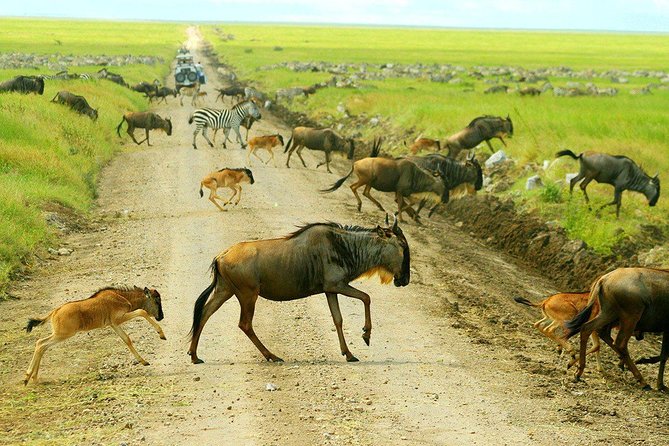
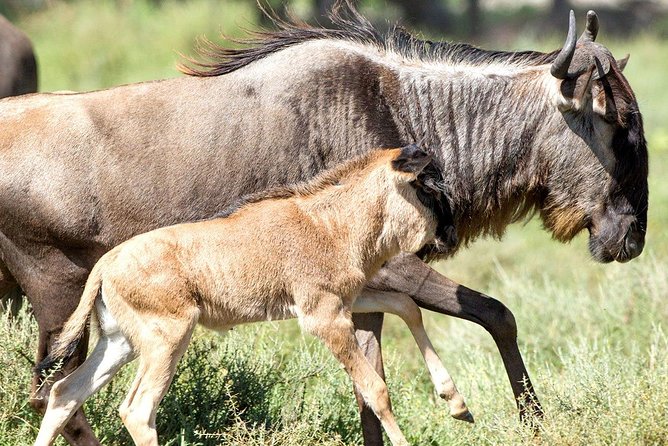
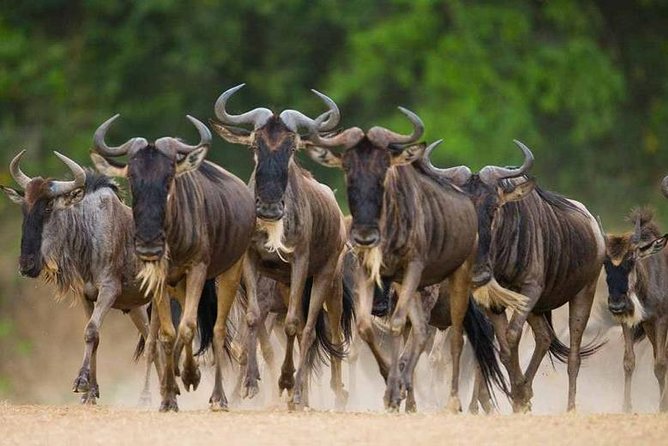
The Great Migration is the headline attraction. From May to July, the herds may be in the western Serengeti near the Grumeti River. You could see wildebeest crossing fast-moving water while crocodiles wait below and predators gather nearby. That is the dream scene, but migration routes shift with rain, grass, and animal instincts. No operator can promise a crossing on a particular day.
The offer of unlimited mileage is useful here. Your guide can keep looking rather than ending the drive after a preset distance. That does not guarantee a sighting, but it improves the flexibility of the search, especially when animals are spread across wide plains.
A few more Arusha days to compare
- Balloon Safari & Bush Breakfast in Serengeti – Miracle Experience
★ 5.0 · 1,646 reviews - Tanzania Classic – 7 Days
★ 5.0 · 1,151 reviews - 4 Days Group Camping Safari
★ 5.0 · 1,101 reviews
Tarangire: elephants, baobabs, and a strong first game drive
Your first day starts early, with a packed lunch and a drive to Tarangire National Park. The planned game drive lasts about eight hours, followed by dinner and an overnight stay at the assigned accommodation.
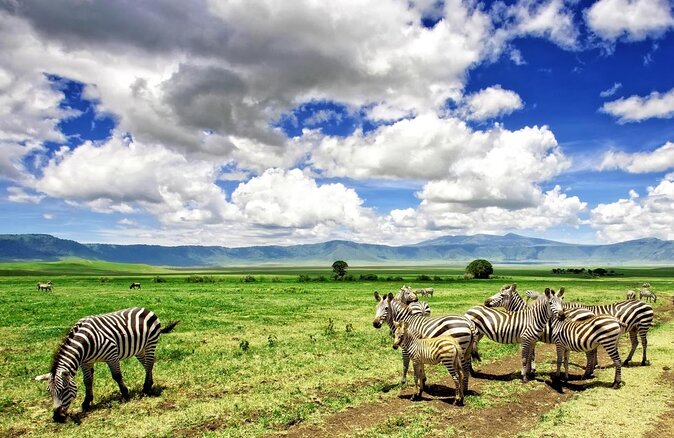
Tarangire is a good opening act because it has a strong concentration of elephants. The Tarangire River draws wildebeest, zebra, and gazelles, and those herds attract lions and other predators. During the dry season, wildlife gathers around remaining water sources, making the park especially productive.
You might also find cheetahs and leopards, along with less commonly seen animals such as kudu, oryx, and gerenuk. Birdwatchers have a good reason to pay attention here too, since the park is noted for its high number of breeding bird species.
I like starting with Tarangire because it gives you a serious wildlife day before the long Serengeti section. The drawback is that an early departure and full game drive can make day one tiring, particularly if you have just arrived in Tanzania. Pack sun protection and keep your expectations practical: a safari is a search, not a parade of animals on schedule.
Mto wa Mbu and Lake Manyara in one day
The second stop begins with a walking tour in Mto wa Mbu, a farming town near Lake Manyara. The town is home to more than 120 tribes, and the walk is designed to show daily life through rice and banana plantations, a local beer factory, a school, and a carving factory.
This is one of the more distinctive parts of the trip. A game drive shows you wildlife, but a town walk helps you understand how people live around the parks. You will see agriculture and local crafts rather than simply passing through by vehicle.
After the walk, you continue to Lake Manyara National Park for about seven hours of activity. The soda lake can attract pink-hued flamingos, while baboons and many other bird species add movement along the route. You might also see giraffes, elephants, hippos, and buffalo.
Lake Manyara works well as a contrast to Tarangire. The first park is known for dry-season wildlife and elephants, while Manyara brings water, birdlife, and forested areas into the picture. The possible drawback is the pace. Combining a town visit with a park visit creates a full day, so you should expect a busy schedule rather than a slow morning at camp.
Entering the Serengeti through Maasai country
The third day takes you toward Serengeti National Park, with a stop at a Maasai village along the way. The stated purpose is to give you an insight into the lifestyle of the Maasai, often described through their pastoral traditions and warrior culture.
This stop matters because it breaks up a long transfer and adds a human element before the main migration days. It also lets you see that northern Tanzania is more than a series of protected areas viewed through a vehicle window.
Once inside the Serengeti, you have a picnic lunch and continue with a game drive. The planned day runs about nine hours. Depending on the season and location of the herds, this may be your first real chance to search for the migration near the Grumeti River.
Keep the river crossing idea in its proper place. It is a possible highlight, not a scheduled performance. Even if the herds are elsewhere, the Serengeti offers large open plains and a chance to look for predators and grazing animals over a wide area.
A change of scene while you are in Arusha:
- 5 Days Group Camping Safari
★ 5.0 · 730 reviews - Materuni Waterfalls, coffee tour & Kikuletwa Hot Springs
★ 5.0 · 643 reviews - 3 Days Serengeti & Ngorongoro Group Camping Safari
★ 5.0 · 574 reviews - 7-Day Premium Luxury Tanzania Safari All-Inclusive
★ 5.0 · 426 reviews
Three Serengeti days, three different goals
The itinerary gives you three consecutive Serengeti days, which is one of its best features. A single drive can produce a lucky sighting, but several days give your guide more chances to respond to animal movements and changing conditions.
The first Serengeti day focuses on reaching the park and searching along the route. The next is an early start for a full day moving across the plains with the herds. This day is scheduled for about ten hours, so it is the strongest candidate for a migration-focused outing.
You may see large groups of wildebeest and other hoofed mammals moving in their annual clockwise cycle. Predators follow the herds, creating the possibility of lions, cheetahs, and other hunters nearby. The Serengeti is also one of the places where you might see the Big Five: lion, elephant, leopard, rhino, and buffalo. Seeing all five is never assured, but the park gives you a genuine chance.
The third Serengeti day concentrates on the central area, known for frequent lion and leopard sightings. It is also a good place to search for cheetahs, elephants, giraffes, hippos, ostriches, and other animals. Pangolins are mentioned as a possibility, though they are notoriously difficult to find, so treat that as a lucky extra rather than a realistic target.
A full day in a safari vehicle can be dusty, hot, and tiring. Still, I prefer this setup to a rushed one-night Serengeti visit. Three days give you time to enjoy the plains and allow your guide, including guides such as Mike, to adjust the search. Mike is specifically praised for patience, organization, timing, and making an effort to avoid shortcuts.
Ngorongoro Crater provides a compact finale
Your final game drive is at Ngorongoro Crater, with about seven hours planned before continuing to the overnight accommodation. The crater is a natural enclosure with a large concentration of animals, including close to 30,000 according to the supplied description.
This is a different kind of wildlife experience from the Serengeti. Instead of searching across huge open plains, you are looking within a defined crater setting. Zebras, buffaloes, lions, wildebeest, baboons, elephants, flamingos, ostriches, hippos, and cheetahs may all be present. The rare black rhino is another possible sighting.
The crater is also visually striking, with changing colors and clouds around the rim. It is easy to understand why it is counted among Africa’s Seven Natural Wonders.
The main limitation is that this is a finale, not a replacement for the Serengeti. If your main goal is a river crossing, Ngorongoro does not serve that purpose. It is best viewed as a final chance for concentrated wildlife and a strong change of scenery.
What the vehicle and guide setup mean for you
Transport is provided in a 4×4 with a pop-up open roof for the full safari. That roof design gives you a better view upward and outward than a closed vehicle, which matters when scanning for birds, giraffes, and animals at a distance.
The group maximum is six. That is not a private safari, but it is small enough to make the vehicle more manageable than a large coach. You should still confirm how many people are actually booked before departure if personal space matters to you.
The guide is described as English-speaking, with other language options available, and trained in wildlife knowledge. The best feature on paper is not a particular vehicle accessory. It is the stated freedom to drive without a mileage cap while searching for animals.
A good guide can explain behavior, identify species, and decide when to stay with a sighting or move on. Past praise has singled out Mike for patience and careful organization. At the same time, one serious complaint names an individual called Godfrey and describes a payment dispute followed by being left stranded near Ngorongoro. That account should not be ignored.
Before booking, ask for the full name of your guide, the exact accommodation list, the confirmed number of days, and the company payment procedure. Pay attention to written confirmation. Those simple steps are especially important because the overall rating is 4 from only four recorded reviews, a small sample with sharply mixed experiences.
Is the $4,984.62 price good value?
At $4,984.62 per person, this is a major purchase. The value depends heavily on how many nights and services are actually covered, because the headline says eight days while the detailed plan describes approximately six days.
Included costs are substantial: 4×4 transport, park entrance fees, full-board accommodation as described, unlimited drinking water, government taxes, and a professional guide. Park fees and several days of meals can add up quickly on a Tanzania safari, so the price is not just paying for vehicle time.
Still, you need the duration clarified before judging value. If the trip is six days, compare it with other six-day northern Tanzania safaris. If it is eight days, ask for the two additional days in writing. Also confirm the accommodation names, since the plan repeatedly uses a recommended accommodation placeholder rather than specific properties.
Tips, travel insurance, and international flights are not included. You will also need to budget for those separately. The free cancellation policy allows cancellation at least 24 hours before the start time for a full refund, while cancellations or changes inside that window are not accepted.
Who should choose this safari?
I would consider this trip if you want a first Tanzania safari with the famous northern circuit, several full Serengeti days, and a real attempt at seeing the migration near the Grumeti River. It suits you if you value flexible game drives and want some local cultural contact through Mto wa Mbu and the Maasai village visit.
It also fits people who like a small group but do not need a fully private vehicle. The full-board setup and included park fees simplify planning.
I would hesitate if you need a tightly documented schedule, named hotels, or a guaranteed eight-day trip. I would also be cautious if you are uncomfortable with the serious payment and stranded-passenger complaint. Ask questions first, get every promise in writing, and do not rely on the migration crossing as a certainty.
Should you book it?
Book this safari only after the duration and operator details are confirmed. The route itself is appealing: Tarangire for elephants, Manyara for birds and village life, three Serengeti days for migration and predators, and Ngorongoro for concentrated wildlife.
The strongest reasons to go are the unlimited mileage, small group limit, and the amount of time in the Serengeti. The strongest reasons to pause are the eight-day versus six-day mismatch and the serious service complaint involving payment and transport.
If the company provides a clear written itinerary, named accommodations, a confirmed guide, and secure payment terms, this could be a good-value safari for someone chasing the migration without giving up the classic northern Tanzania parks.
FAQ
Where does this safari start?
The experience starts in Arusha, Tanzania, with a stated start time of 7:30 am.
How long does the safari last?
The supplied details describe the experience as approximately six days, although the title says eight days. Confirm the exact duration before booking.
When might I see the Great Migration at the Grumeti River?
The migration may be seen in this part of the Serengeti between May and July. A river crossing is possible but not guaranteed.
What parks are included?
The route includes Tarangire National Park, Lake Manyara National Park, Serengeti National Park, and Ngorongoro Crater.
How large is the group?
The activity has a maximum of six participants.
What type of vehicle is used?
Transport is provided in a 4×4 vehicle with a pop-up open roof for the entire safari.
Are park entrance fees included?
Yes. Park entrance fees for the national parks are included, and the Ngorongoro Crater admission is also included.
Are meals and accommodation included?
Full-board accommodation is included as described in the itinerary. The specific accommodation names should be confirmed before booking.
What is not included in the price?
Tips, travel insurance, and international flights are not included.
Newly listed around Arusha
- 5-Day Private Safari Tour in Tanzania’s Wildlife★ 5.0 · 3 reviews
- 3 Day Sharing Safari – Manyara, Ngorongoro Crater and Tarangire National Parks★ 5.0 · 3 reviews
- 3 Days private safari Tarangire ,Ngorongroro crater &Manyara★ 5.0 · 3 reviews
- Tarangire National Park Day Trip★ 5.0 · 3 reviews
- 6 -Day Tarangire, Manyara, Serengeti & Ngorongoro★ 5.0 · 3 reviews
- 2 Days Tarangire and Ngorongoro Crater Tour★ 5.0 · 3 reviews
- 5 Days Group Camping Safari★ 4.7 · 3 reviews
- 7-Day Mt. Kilimanjaro Hiking: Machame Route★ 5.0 · 3 reviews
Arusha Tours, compared.

Balloon Safari & Bush Breakfast in Serengeti – Miracle Experience
Read our review →





